Skip to content
Tea & Realm
English

Jiuqu Hongmei

Black tea · curled gongfu black tea

A touch of red from Qiantang's sheltered hills, fine hooked leaves, polished darkness, and a delicate plum-like sweetness.

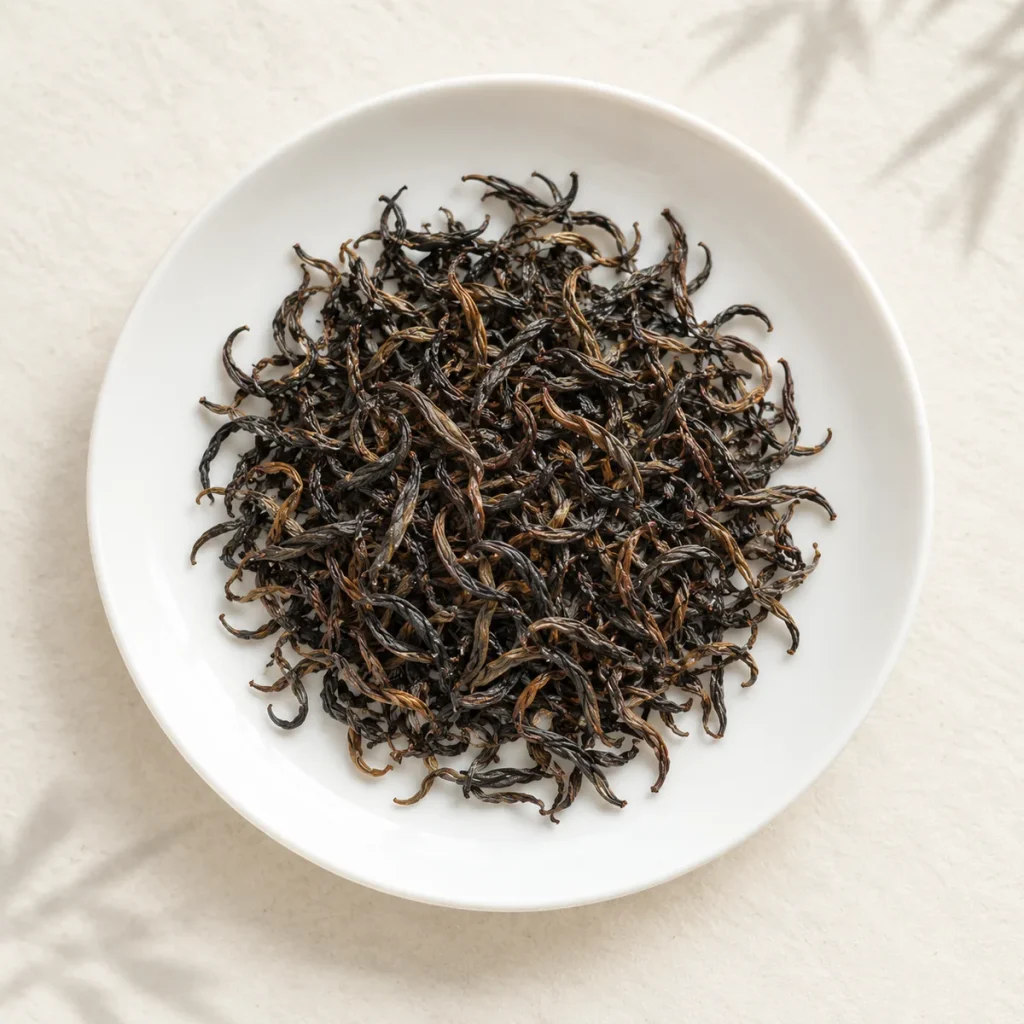
Jiuqu Hongmei is a representative traditional gongfu black tea of Hangzhou's West Lake District, with its historic core centered on Hubu, Lingshan and nearby valleys in Shuangpu. It is made from tender buds and leaves of tea cultivars suitable for black tea and processed through withering, rolling, oxidation and drying. The finished tea is fine, tight and curled, often compared to a fishhook, with a glossy dark appearance. The liquor ranges from bright orange-red to vivid red, the aroma is clean and sweet, and higher grades may show refined floral notes traditionally evoked as a “plum blossom” fragrance. The taste is fresh, mellow, sweet and brisk, with a light, graceful Jiangnan character.

Origin
West Lake District, Hangzhou · Shuangpu as the traditional core
Harvest
Tender spring picking · one bud with one to two leaves is common
Craft
Withering · rolling · oxidation · drying
Aroma
Clean, elegant sweetness · Floral, with a plum-blossom impression
Taste
Fresh, mellow, sweet and brisk · Light and gently sweet
Liquor
Bright orange-red · Clear and translucent
Dry Leaf
Fine, tight and curledGlossy dark with fine hairs
Liquor Color
Bright orange-redClear and translucent
Aroma
Clean, elegant sweetnessFloral, with a plum-blossom impression
Taste
Fresh, mellow, sweet and briskLight and gently sweet
Finish
Clean returning sweetnessLong after-aroma
Infused Leaf
Tender, even and bright redSoft and lively

Tea Overview

Tea Category
Black tea · curled gongfu black tea
Cultivar
Longjing population plants, Longjing 43 and other suitable cultivars
Grade
Special Grade · Grade 1 · Grade 2 · Grade 3 · Grade 4 · Grade 5
Harvest Period
Primarily spring · can be produced in multiple seasons
Plucking Standard
Tender buds and leaves · one bud with one to two leaves is common
Processing
Withering → rolling → oxidation → drying → refining
Also Known As
Jiuqu Hong · Jiuqu Wulong (historical name)
Oxidation / Fermentation
Jiuqu Hongmei is a fully oxidized black tea. The traditional term “fermentation” mainly refers to enzymatic oxidation of polyphenols after rolling, which transforms the leaf and creates bright red liquor, sweet aroma and a fresh mellow taste.

Origin & Terroir

The standard production area of Jiuqu Hongmei is the jurisdiction of Hangzhou's West Lake District, while the most celebrated traditional core lies around Hubu, Lingshan and surrounding sheltered valleys in Shuangpu beside the Qiantang River. This is a landscape where Hangzhou's low hills meet river systems: warm and humid, with abundant rainfall, wooded valleys and favorable local microclimates. Traditional areas such as the Dawu basin are especially representative of sheltered slopes, mist and valley terrain.

Origin
West Lake District, Hangzhou · Shuangpu as the traditional core
Altitude
Low hills · predominantly sheltered valley gardens
Climate
Warm and humid · abundant rainfall
Soil
Acidic mountain soils · red/yellow-red soil background
Landform
Hills and sheltered valleys · beside the Qiantang River

Brewing

White porcelain gaiwan · 90–95°C waterWater first, then tea, then top up
Leaf Method
White porcelain gaiwan · 90–95°C water
Teaware
White porcelain gaiwan or porcelain cup
Leaf Amount
About 3 g / 150 mL
Water Temperature
About 90–95°C
Tea-to-Water Ratio
About 1:50
Time
Gaiwan: start around 10 seconds
Infusions
About 4–6 infusions, adjusted to grade and strength
Water
Clean low- to medium-mineral drinking water
Brewing Steps · 4
  1. Warm the vessel and add tea: Warm a white porcelain gaiwan, empty it, then add about 3 g of Jiuqu Hongmei and smell the dry leaf's sweet and delicate floral aroma.
  2. Pour moderately hot water: Pour water at about 90–95°C along the side of the gaiwan so the fine curled strands are wetted evenly.
  3. Pour out after about ten seconds: For the first infusion, pour out after roughly 10 seconds and observe the bright orange-red liquor, clean sweetness, floral aroma and fresh mellow taste.
  4. Extend later infusions: Lengthen later steeps gradually according to liquor strength, avoiding prolonged soaking that can increase astringency.

Composition & the Body

Research on Jiuqu Hongmei includes flavor-chemistry studies comparing traditional and newer processing methods and multiple grades, allowing a tea-specific profile to be built from both non-volatile taste indicators and volatile aroma chemistry.

Composition Profile

Verified · 2026-09-25
  1. 01
    Free amino acidsNew-process Jiuqu Hongmei had lower free-amino-acid content than traditional Jiuqu Hongmei, and free amino acids were identified as one of the important chemical indicators distinguishing taste among grades.
    Dry-leaf sample
  2. 02
    Theaflavins / thearubigins / theabrowninsTheaflavins, thearubigins and theabrownins were all identified as important chemical indicators associated with taste differences among Jiuqu Hongmei grades.
    Dry-leaf sample

    The black-tea pigment system is related to differences in liquor color and taste among grades.

  3. 03
    Jiuqu Hongmei volatile aroma profileA total of 39 volatile compounds were identified, including geraniol, linalool, phenethyl alcohol, benzyl alcohol, benzaldehyde, phenylacetaldehyde, β-ionone and methyl salicylate. Relative abundances of multiple volatiles changed across grades in newer-process tea.
    Dry-leaf sample

    Geraniol, linalool, phenethyl alcohol and related compounds jointly contribute to fresh, floral and sweet aromatic expression.

Free amino acids, caffeine and theaflavin/thearubigin/theabrownin pigments are associated with processing and grade differences, while one study identified 39 volatile compounds, including geraniol, linalool and phenethyl alcohol among major aroma contributors.

The publicly available abstracts do not provide complete numerical tables for every compound, so this batch retains only trends and qualitative relationships explicitly supported by the papers and does not reconstruct values from figures or secondary sources. No tea-specific human evidence was included.

View Research Sources

不同等级新九曲红梅茶的风味化学特征

郭丽, 彭群华, 赵锋, 卢红渭, 包兴伟, 林智 · 食品科学 · 2021

Finished Jiuqu Hongmei of multiple grades made with newer processing, compared with traditionally processed Jiuqu Hongmei.

Free amino acids were associated with grade-related taste differences, but the abstract did not provide a complete numerical table suitable for safe transcription.

DOI: 10.7506/spkx1002-6630-20200210-073View Source

Tea Culture

Landscapes, people and history within a single leaf.

01

Red Plum in the Cup

Jiuqu Hongmei is a gongfu black tea whose appearance and temperament feel distinctly Jiangnan. GH/T 1116—2015 defines it as a curled gongfu black tea made from suitable tea-plant buds and leaves grown within Hangzhou's West Lake District and processed locally through withering, rolling, oxidation and drying. “West Lake District,” “curled form” and “local processing” are three conditions that together establish its standard identity.

Visually, it differs clearly from robust large-leaf black teas. Higher-grade Jiuqu Hongmei is fine, tight and curled, often compared to a bent hook or fishhook, with a glossy dark surface and some visible fine hairs. The liquor ranges from bright orange-red to vivid red. Aroma centers on clean sweetness and floral notes, while traditional tasting language often uses “plum fragrance” to describe the elegant, restrained aromatic impression.

The current industry standard further divides the tea into six grades, from Special Grade through Grade 5. Jiuqu Hongmei is therefore not a single style of “pre-Qingming bud tea,” but a complete product system built from different raw-material tenderness and sensory quality levels.

02

The Jiuqu Tea Lineage

The tradition of Jiuqu Hongmei took shape in the middle to late Qing dynasty. Public materials from Zhejiang's social-science institutions and China's intangible-cultural-heritage portal both note that generations of Hangzhou tea farmers gradually formed a distinctive black-tea craft through cultivation and processing improvements. Historical names included “Jiuqu Wulong” and “Jiuqu Mei,” before the name “Jiuqu Hongmei” became established as its vivid red liquor and elegant aroma came to define the tea.

By the late Qing and early Republican period, this Hangzhou black tea had entered a wider market. Republican-era Hangzhou tea-industry records and later local cultural narratives often place it beside West Lake Longjing: one green, one black, representing two entirely different processing paths within the same West Lake tea region. Jiuqu Hongmei also experienced decline through war, industrial change and the growing dominance of the green-tea market.

From the late 20th century onward, local branding, heritage protection and standardization helped revive it. Its craft entered Hangzhou's intangible cultural heritage list in 2006 and Zhejiang's provincial list in 2009. The GH/T 1116 industry standard followed in 2015, and Hangzhou implemented a new processing technical specification in 2023. Traditional skill thus moved from oral transmission into a system where intangible heritage and modern standards coexist.

03

Sheltered Valleys by the Qiantang

In standard terms, Jiuqu Hongmei can be produced across Hangzhou's West Lake District, but its classic terroir is best understood through Shuangpu. Shuangpu lies along the Qiantang River, with the historical core around Hubu, Lingshan and nearby villages. This is not a high-altitude mountain region like Wuyishan, but a southern Hangzhou tea landscape where river, hills, sheltered valleys and slopes meet.

Hubu's Dawushan and the Dawu basin are among the most frequently mentioned traditional core areas. Hills and woodland enclose the valley and create a relatively sheltered microclimate, while proximity to the Qiantang River adds humidity. Hangzhou itself lies in a humid subtropical monsoon zone, with warm, rainy spring conditions favorable to tea growth. In 2026, population tea trees over a century old were still being protected locally, showing that traditional tea-plant resources remain part of the living landscape rather than merely historical memory.

The industry standard does not set a single altitude, temperature or soil-pH threshold for Jiuqu Hongmei. It is therefore more accurate to describe the overall terroir as “beside the Qiantang River, low hills, sheltered valleys and humid conditions” than to force data from one Dawushan garden across all of West Lake District.

04

Rolled into Hooks

The core logic of Jiuqu Hongmei remains the four classic black-tea steps: withering, rolling, oxidation and drying. One valuable feature of DB3301/T 1122—2023 is that it regulates both traditional and modern processing, preserving distinctive local practices while allowing contemporary production methods.

In traditional processing, fresh leaves are spread and sun-withered before rolling. Rolling not only brings tea juice to the surface and creates the conditions for enzymatic oxidation, but is also crucial to the tea's fine, tight, curled hook-like form. After rolling, the leaves are loosened and traditionally oxidized in bags, with the maker judging degree from changes in color, veins and aroma. The disappearance of raw grassy odor and the emergence of floral and sweet notes are important signs that oxidation has progressed appropriately.

After oxidation, the traditional method may use sun drying to reduce moisture before baking completes drying and aroma-setting, followed by screening and refining. Modern production may instead use withering troughs, mechanical rolling and more controllable oxidation and drying equipment. Whatever the tools, the goal remains the same: fine, tightly curved strands, bright orange-red liquor and a clean sweet aroma.

05

Plum-Like Aroma, Red Liquor

Tasting Jiuqu Hongmei begins with its “curve.” The dry leaf should not be thick and straight, but fine, tight and curled, with an obvious hooked or bent appearance. Higher grades are glossy dark, relatively even and may show fine hairs. This delicate curve is the first visual cue that separates the tea from many other gongfu black teas.

The liquor should remain bright. Across the grades in the current standard, color shifts from vivid red and bright orange-red at higher levels, but brightness rather than dullness is the consistent expectation. The standard uses terms such as sweet fragrance, while local culture often describes high-grade tea with phrases such as “a fragrance clear as red plum” or “plum aroma.” This “plum” idea is best understood as a traditional flavor image for elegant floral-sweet aroma, not as added plum-blossom flavoring.

The taste should combine black tea's sweet mellowness with the freshness and lightness associated with tender local material. The infused leaf should be bright red, tender, even and soft. A tea that has only intense caramel sweetness but loses the curled form, bright liquor and delicate fresh quality does not fully express the classic Jiuqu Hongmei style.

06

West Lake's Red Tea

Hangzhou tea culture is visually dominated by West Lake Longjing, and that is exactly why Jiuqu Hongmei has a distinct cultural role: the same West Lake tea region can travel from tender green freshness to red liquor and sweet aroma through a completely different processing path. Local descriptions therefore often speak of Longjing and Jiuqu Hongmei as “one green, one red.”

In 2009, the making of Jiuqu Hongmei entered Zhejiang's provincial list of representative intangible cultural heritage projects. Shuangpu today still has heritage practitioners, experience centers, tea museums and traditional gardens involved in transmitting the craft. West Lake District's 2026 government work arrangements also called for using the local science-and-technology courtyard and actively applying for national intangible-heritage status. That means the tea should still be accurately described as provincial-level heritage at present rather than prematurely labeled national heritage.

This condition is representative of the tea itself: Jiuqu Hongmei is both a local craft continuing from the Qing dynasty and a tea being reshaped by science, standards, old-tree protection and brand rebuilding. It is not an appendage of West Lake Longjing, but an independent red line within Hangzhou tea culture.

Frequently Asked Questions

What type of tea is Jiuqu Hongmei?
Jiuqu Hongmei is a curled gongfu black tea. It is made from tender buds and leaves of suitable tea cultivars in Hangzhou's West Lake District and processed through withering, rolling, oxidation and drying.
Where is Jiuqu Hongmei produced?
GH/T 1116—2015 uses the jurisdiction of Hangzhou's West Lake District as the raw-material and local-processing area. The historic traditional core is most strongly associated with Hubu, Lingshan and surrounding sheltered valleys in Shuangpu.
How many grades does Jiuqu Hongmei have?
The current GH/T 1116—2015 standard recognizes six grades: Special Grade, Grade 1, Grade 2, Grade 3, Grade 4 and Grade 5.
Does Jiuqu Hongmei really smell like plum blossom?
Traditional tasting language often uses “plum fragrance” or “a fragrance clear as red plum” to describe its elegant floral and sweet impression. This aroma forms naturally from cultivar and processing during withering, oxidation and drying; it does not require added plum-blossom flavoring.
Is Jiuqu Hongmei made from the same tea plants as West Lake Longjing?
The two teas overlap substantially in production area and tea-plant resources. Current Shuangpu gardens are dominated by Longjing population plants and Longjing 43, but GH/T 1116—2015 does not specify a single cultivar and instead allows tea cultivars grown in West Lake District that are suitable for Jiuqu Hongmei.
What water temperature should I use for Jiuqu Hongmei?
For everyday drinking, around 90–95°C is a useful range. With a gaiwan, begin around a 10-second first infusion and lengthen later steeps according to grade and preferred strength. These are drinking recommendations rather than compulsory product-standard parameters.

Tea Conversations

Tea lovers from around the world meet over a cup of tea.

Sign in or register to join the conversation. Your comment account is created automatically the first time you use a connected account.