Skip to content
Tea & Realm
English

Hubei Qingzhuan Tea

Dark tea · compressed tea · Qingzhuan Tea

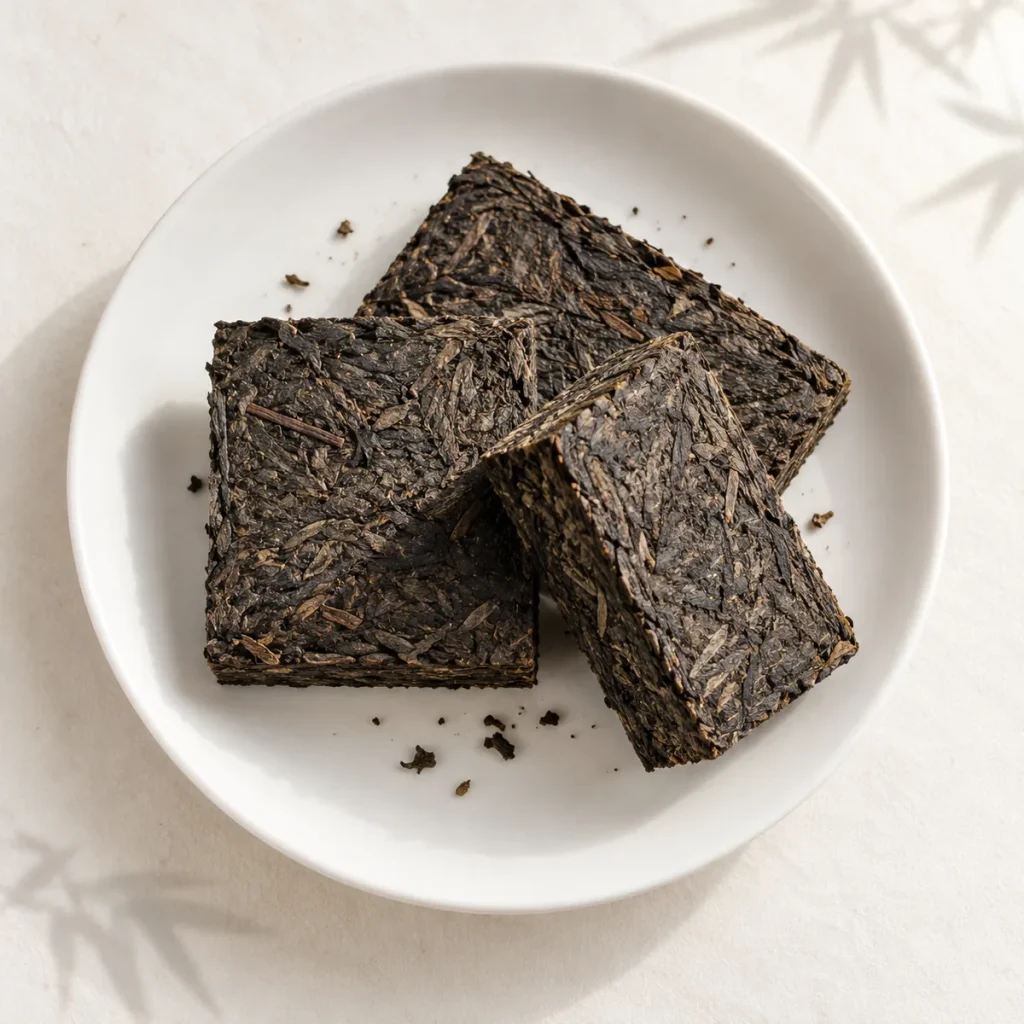
Blue-brown dense brick · clear orange-red liquor · mellow and warm.

Hubei Qingzhuan Tea is one of the most representative compressed dark teas of Hubei. It is made mainly from Laoqing tea through heat-fixing, rolling, pile fermentation, screening and blending, steam pressing and drying. The current national standard states that Qingzhuan Tea is ungraded. Its typical quality is a smooth brick surface, dense blue-brown appearance, clean aroma, orange-red liquor, mellow taste and dark-brown infused leaf.

Origin
Hubei · traditional lines around Yangloudong, Zhaoliqiao and Yichang
Harvest
Laoqing tea raw material · face-tea and inner-tea tenderness differ
Craft
Heat-fixing · rolling · pile fermentation · blending · steam pressing · drying
Aroma
Clean aroma · Calm and gentle
Taste
Mellow and easy-drinking · Slight returning sweetness
Liquor
Clear orange-red · Warm and translucent
Dry Leaf
Flat brick surfaceDense blue-brown appearance
Liquor Color
Clear orange-redWarm and translucent
Aroma
Clean aromaCalm and gentle
Taste
Mellow and easy-drinkingSlight returning sweetness
Finish
Sweetness gradually appearsWarm lingering finish
Infused Leaf
Dark brown and softStems and leaves open naturally

Tea Overview

Tea Category
Dark tea · compressed tea · Qingzhuan Tea
Cultivar
Laoqing tea raw material · no single cultivar required
Grade
National standard: ungraded
Harvest Period
Depends on Laoqing raw material and process route
Plucking Standard
Face tea / inner tea differ in tenderness · higher-tenderness routes also exist
Processing
Heat-fixing · rolling · pile fermentation · blending · steam pressing · drying
Also Known As
Laoqing Brick · Dong Brick (specific historical contexts)
Oxidation / Fermentation
It belongs to the dark-tea post-fermentation system and should not be described with a fixed black-tea-style oxidation percentage.
Aging
Traditional Qingzhuan includes practices of aging rough tea before pressing and further maturation after brick formation. Quality depends on raw material, fermentation and storage, so the page avoids the absolute claim “the older, the better.”

Origin & Terroir

“Hubei Qingzhuan Tea” is better treated as a regional and historical tea lineage than as one unified geographical-indication object. Directly related Hubei GIs include the national GI product Yangloudong Brick Tea (Dong Tea) and the geographical-indication certification trademark Chibi Qingzhuan Tea, alongside different craft and brand lineages such as Zhaoliqiao and Changshengchuan.

Origin
Hubei · Yangloudong, Zhaoliqiao, Yichang and related areas
Altitude
No unified legal value
Climate
Humid tea areas of southern and southwestern Hubei
Soil
Large regional variation · no unified hard values
Landform
Southern-Hubei hills · southwestern-Hubei mountains

Brewing

Gaiwan / clay pot / simmeringWater first, then tea, then top up
Leaf Method
Gaiwan / clay pot / simmering
Teaware
Gaiwan, clay teapot or heat-resistant simmering vessel
Leaf Amount
About 5–8 g
Water Temperature
95–100°C
Tea-to-Water Ratio
About 1:20–1:30 (editorial recommendation)
Time
First infusion about 15–25 s · can also be simmered
Infusions
About 6 or more, depending on the tea
Water
Clean drinking water
Brewing Steps · 4
  1. Break off the tea: Work gently along the brick's natural layers to minimize broken fragments.
  2. Warm the vessel: Warm the gaiwan, teapot or simmering vessel thoroughly with boiling water.
  3. Brew hot: Use 95–100°C water. Older or tightly compressed tea can be rinsed briefly.
  4. Decant promptly: Begin around 15–25 seconds, extend according to strength and brick density, and simmer in later rounds if desired.

Composition & the Body

Hubei Qingzhuan Tea has metabolomics research across different production years and aroma-chemistry research on 16 representative samples, supporting a tea-specific profile from both aging dynamics and aged-aroma composition.

Composition Profile

Verified · 2026-09-26
  1. 01
    Metabolite profiles of Qingzhuan from different yearsAcross five production years, 189 characteristic compounds were identified and 26 key differential metabolites screened. Eight catechin monomers declined with increasing storage age, seven flavonoids first rose and then fell, while caffeic acid, lactobionic acid, linolenic acid, theophylline, betaine and other compounds increased with age.
    Dry-leaf sample
  2. 02
    Qingzhuan aroma profileSeventy-two aroma compounds were identified across 16 representative Qingzhuan samples. Compounds with relatively high abundance included hexanal, linalool, nonanal and toluene, while aldehydes and ketones were major aroma classes.
    Dry-leaf sample

    Aged, fungal and woody aroma impressions are associated with the combined contribution of multiple aldehydes, ketones, linalool oxides, camphor, ionones and other volatiles.

As storage years increase, catechins, flavonoids and some alkaloids and organic acids move in different directions. Volatile research further shows that aldehydes, ketones, linalool and related compounds jointly contribute to aged, fungal and woody aroma impressions.

The aging study includes only five representative production years, so its time trends must not be generalized into one universal aging curve for all Qingzhuan. Existing animal weight-loss or lipid studies are not human evidence and are not included in tea_specific_health_evidence.

View Research Sources

基于代谢组学的不同年份青砖茶主要品质成分分析

马梦君, 胡新龙, 邱首哲, 张锐明, 唐慧珊, 刘晨, 余子铭, 李婧, 王明乐 · 茶叶科学 · 2025

Qingzhuan Tea produced in 2022, 2019, 2014, 2009 and 2002.

Storage age systematically changed the chemical profiles of catechins, flavonoids, alkaloids and organic acids in Qingzhuan Tea.

DOI: 10.13305/j.cnki.jts.2025.01.011View Source

青砖茶的香气成分分析

刘盼盼, 郑鹏程, 龚自明, 王胜鹏, 滕靖, 高士伟, 王雪萍, 叶飞, 郑琳 · 食品科学 · 2017

Representative finished Qingzhuan Tea samples.

PCA and correlation analysis identified a group of volatiles important to Qingzhuan aroma quality, showing that aged aroma is not determined by one compound.

View Source

Tea Culture

Landscapes, people and history within a single leaf.

01

“Hubei Qingzhuan Tea” Is a Regional Lineage, Not One Unified GI Certificate

Hubei Qingzhuan works best as a regional gateway into the Qingzhuan traditions of Hubei dark tea, but it is not one unified GI. National standard GB/T 9833.9—2013 regulates Qingzhuan Tea as a product category. Within Hubei, Yangloudong Brick Tea (Dong Tea) is a national geographical-indication product, Chibi Qingzhuan Tea is a geographical-indication certification trademark, and Zhaoliqiao and Changshengchuan each have their own heritage and brand systems. This page therefore treats Hubei Qingzhuan as the regional overview while keeping specific GI and craft identities as separate research objects.

02

Yangloudong, Zhaoliqiao and the Great Tea Road Form the Historical Main Line

Yangloudong in Chibi, southern Hubei, was an important source of brick-tea trade in modern history. From the Qing onward, Shanxi merchants and foreign firms operated tea businesses in Yangloudong, and Qingzhuan and rice brick tea traveled through Hankou, Kyakhta and other nodes of the Great Tea Road. After 1949, the Yangloudong brick-tea factory gradually developed into the Zhaoliqiao tea factory, carrying the traditional craft forward. In parallel, Changshengchuan Qingzhuan craft was transmitted from the Xianning tradition to Yichang, creating another important line in the history of Hubei Qingzhuan.

03

Southern Hubei and the Wuling Mountains Cannot Be Forced into One Terroir

Production and craft traditions of Hubei Qingzhuan do not belong to one small origin. The Yangloudong–Zhaoliqiao line represents the Mufu Mountain tea country of southern Hubei and a historical core of the Great Tea Road, while the national Changshengchuan heritage project uses semi-high-mountain tea material from southwestern Hubei and is transmitted in Yichang and surrounding areas. Precisely because the regional span is large, this page does not invent one altitude, soil pH or tea cultivar for all Hubei Qingzhuan; hard terroir parameters are reserved for specific sub-objects.

04

The Core Is Not Simply “Pressing Tea into a Brick”: Pile Fermentation Happens Before Pressing

The national standard defines Qingzhuan Tea as compressed tea made mainly from Laoqing tea through steam pressing, shaping and drying. The traditional Zhaoliqiao route shows the technical main line more clearly: fresh leaves are first turned into Laoqing rough tea through heat-fixing, rolling, pile fermentation and drying, then screened, blended, steamed, compressed and dried. Pressing is therefore a shaping stage; the earlier pile fermentation is one of the key processes that creates the underlying dark-tea character.

05

The National Standard Is Quite Restrained: Blue-Brown, Orange-Red, Clean and Mellow

GB/T 9833.9—2013 does not divide Qingzhuan Tea into grades but instead uses a physical reference sample as the minimum quality boundary. Its sensory baseline emphasizes a smooth brick surface, neat edges, dense even compression and a blue-brown color, with no abnormal mold inside. The liquor should show a clean aroma, mellow taste, orange-red color and dark-brown infused leaf. Woody, jujube-like or aged aromas may occur in particular vintages and branded products, but they should not be presented as universal legally defined aromas for all Hubei Qingzhuan.

06

Hubei Qingzhuan Has Two UNESCO Heritage Lines: Zhaoliqiao and Changshengchuan

In 2014, Dark Tea Making Craft (Zhaoliqiao Brick Tea Making Craft) entered China's national intangible-cultural-heritage list. In 2021, Dark Tea Making Craft (Changshengchuan Qingzhuan Tea Making Craft) joined the same VIII-152 system as an extension project. In 2022, both crafts became Hubei constituent elements of UNESCO's “Traditional tea processing techniques and associated social practices in China.”

The related Hubei Chibi Yangloudong Brick Tea Culture System entered China's Important Agricultural Heritage Systems in 2014 and China's second GIAHS tentative list in 2019. In 2025, the Ministry of Agriculture and Rural Affairs confirmed that entries on the second tentative list retained their eligibility, but the system is still not a formally designated FAO GIAHS.

Frequently Asked Questions

Does Hubei Qingzhuan Tea have one unified geographical indication?
No. There is no single GI named “Hubei Qingzhuan Tea.” Specific identities must remain separate: Yangloudong Brick Tea (Dong Tea) is a national geographical-indication product, Chibi Qingzhuan Tea is a geographical-indication certification trademark, and Zhaoliqiao and Changshengchuan have their own heritage and brand systems.
How many grades does Qingzhuan Tea have?
Current GB/T 9833.9—2013 explicitly states that Qingzhuan Tea is not divided into grades and uses a physical reference sample as the minimum quality boundary. Some regional brand group standards use their own grades, but those cannot be applied to all Qingzhuan Tea.
What is the national-standard sensory profile of Qingzhuan Tea?
The brick should have a smooth surface, neat edges, dense even compression and a blue-brown appearance. Internally, the aroma should be clean, the taste mellow, the liquor orange-red and the infused leaf dark brown.
What is the core process of Hubei Qingzhuan Tea?
In the traditional Zhaoliqiao route, fresh leaves first become Laoqing rough tea through heat-fixing, rolling, pile fermentation and drying, then undergo screening and blending, steaming, compression and drying. Pile fermentation is one of the key quality-forming stages.
Are Yangloudong Brick Tea and Chibi Qingzhuan Tea the same geographical indication?
No. Yangloudong Brick Tea (Dong Tea) received geographical-indication product protection in 2011 with a protected area limited to five townships in Chibi, while Chibi Qingzhuan Tea has registered geographical-indication certification trademarks.
How many national intangible-cultural-heritage projects are directly related to Hubei Qingzhuan Tea?
Two major ones are directly relevant: Dark Tea Making Craft (Zhaoliqiao Brick Tea Making Craft), listed in 2014, and Dark Tea Making Craft (Changshengchuan Qingzhuan Tea Making Craft), added in 2021. Both use project code VIII-152.
Did both making crafts enter UNESCO?
Yes. China's official heritage materials list both Zhaoliqiao Brick Tea Making Craft and Changshengchuan Qingzhuan Tea Making Craft as Hubei constituent elements of UNESCO's 2022 “Traditional tea processing techniques and associated social practices in China.”
Is the Yangloudong Brick Tea Culture System an FAO GIAHS?
Not yet. It entered China's Important Agricultural Heritage Systems in 2014 and China's second GIAHS tentative list in 2019. The Ministry of Agriculture and Rural Affairs confirmed in 2025 that the second-batch tentative-list qualification remained valid, but that is still not formal FAO designation.

Tea Conversations

Tea lovers from around the world meet over a cup of tea.

Sign in or register to join the conversation. Your comment account is created automatically the first time you use a connected account.