Skip to content
Tea & Realm
English

Anhua Qianliang Tea

Dark tea · Huajuan tea · column-shaped compressed tea

Column-shaped flower-roll tea · sun by day and dew by night · rich, mellow and aged-sweet.

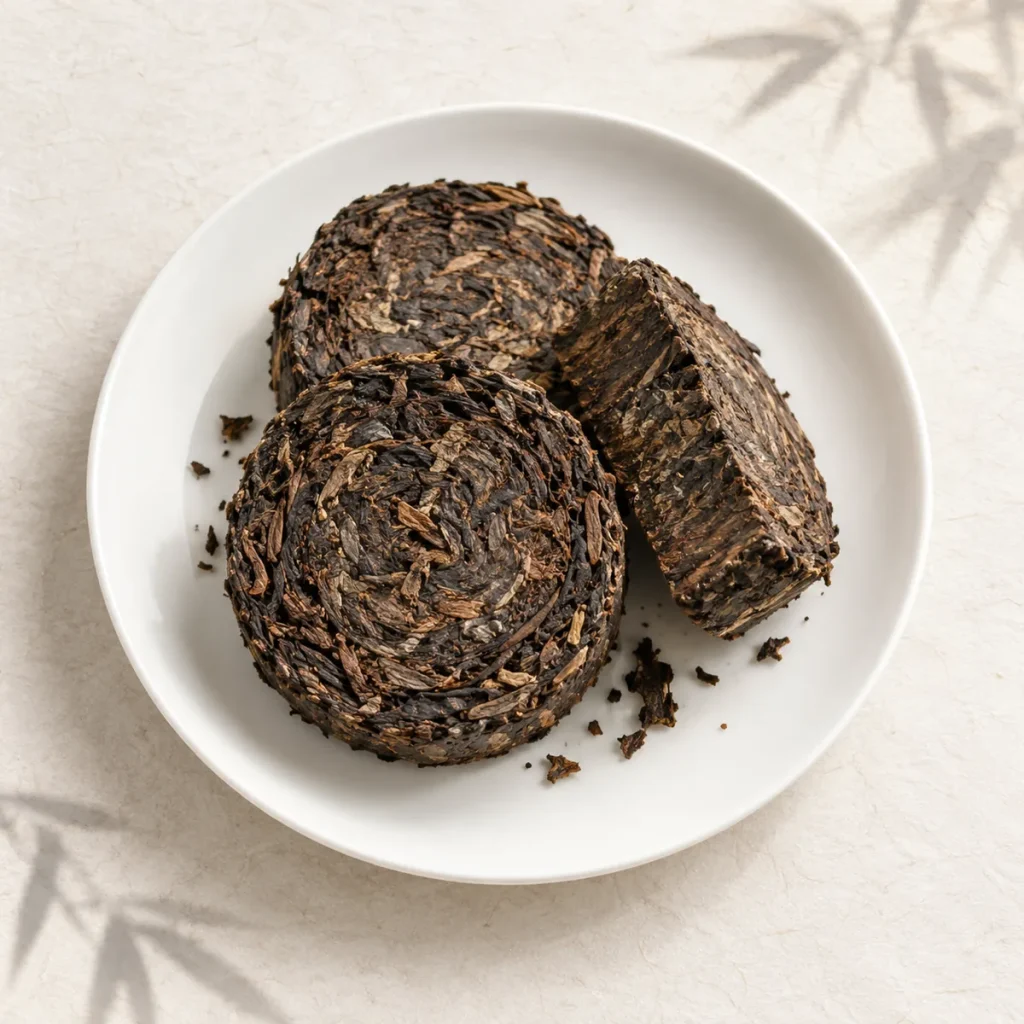
Anhua Qianliang Tea, also known as Huajuan Tea, is one of the most distinctive column-shaped compressed teas in the Anhua Dark Tea geographical-indication system. It is made from Grade 2 and Grade 3 Anhua dark rough tea through screening and sorting, blending, steaming, basket filling, rolling and shaping, followed by sun drying. The current local standard explicitly states that the finished product is not graded and allows many sizes such as Qianliang, Bailiang and Shiliang. The finished tea is tight and dark brown; the liquor is orange-yellow to orange-red, the taste rich and mellow, and with aging it tends toward greater sweetness and smoothness.

Origin
Yiyang, Hunan · Anhua Dark Tea GI protection area
Harvest
Grade 2–3 Anhua dark rough tea · batch dependent
Craft
Screening · blending · steaming · basket filling · rolling · sun drying
Aroma
Clean aroma · Pine-smoke and aged notes
Taste
Rich and mellow, slightly astringent when young · Sweeter and smoother with age
Liquor
Orange-yellow to orange-red · Clear and warm
Dry Leaf
Tight dark-brown teaEven cylindrical form
Liquor Color
Orange-yellow to orange-redClear and warm
Aroma
Clean aromaPine-smoke and aged notes
Taste
Rich and mellow, slightly astringent when youngSweeter and smoother with age
Finish
Sweetness develops graduallyLong, substantial aftertaste
Infused Leaf
Deep brown and fairly evenLeaf pieces relatively intact

Tea Overview

Tea Category
Dark tea · Huajuan tea · column-shaped compressed tea
Cultivar
Suitable cultivars such as Yuntaishan large-leaf and Zhuyeqi
Grade
Finished product: ungraded
Harvest Period
Depends on Grade 2–3 dark rough-tea batch
Plucking Standard
Grade 2–3 Anhua dark rough tea
Processing
Screening · blending · steaming · basket filling · rolling · sun drying
Also Known As
Huajuan Tea
Oxidation / Fermentation
It belongs to the dark-tea post-fermentation system. The rough-tea stage has already undergone pile fermentation, so a fixed black-tea-style oxidation rate is not appropriate.
Aging
DB43/T 657.2—2021 explicitly differentiates sensory characteristics of new tea, tea aged over 5 years and tea aged over 10 years. New tea may be slightly astringent; after 5 years the taste may become mellower and sweeter; after 10 years the aroma may show aged notes. DB43/T 1736—2020 also provides general storage guidance for Anhua Dark Tea, but this still should not be reduced to “the older, the better.”

Origin & Terroir

The legal geographical identity of Anhua Qianliang Tea comes from the broader “Anhua Dark Tea” GI. AQSIQ Announcement No. 29 of 2010 approved Anhua Dark Tea as a geographical-indication product, and Yiyang's 2011 management measures further listed Qianliang Tea as one of the protected product types that must be produced and processed within the 32-township protection area.

Origin
Yiyang, Hunan · Anhua Dark Tea GI protection area
Altitude
No unified published legal value
Climate
Humid central-Hunan mountains · Zi River basin
Soil
Mountain tea gardens · no unverified hard values
Landform
Xuefeng mountains · Zi River valley

Brewing

Gaiwan / clay pot / simmeringWater first, then tea, then top up
Leaf Method
Gaiwan / clay pot / simmering
Teaware
Gaiwan, clay teapot or heat-resistant simmering vessel
Leaf Amount
About 5–8 g
Water Temperature
95–100°C
Tea-to-Water Ratio
About 1:20–1:30 (editorial recommendation)
Time
First infusion about 15–25 s · can also be simmered
Infusions
About 6 or more, depending on the tea
Water
Clean drinking water
Brewing Steps · 4
  1. Take the tea: Work gently along the layers of a Qianliang slice or chunk, preserving larger leaf pieces and avoiding excessive powder.
  2. Warm the vessel: Warm the gaiwan, teapot or simmering vessel thoroughly with boiling water.
  3. Brew hot: Use 95–100°C water. Tightly compressed or older tea can be rinsed briefly.
  4. Decant promptly: Begin around 15–25 seconds, then adjust according to liquor strength and how the tea opens. Later rounds can also be simmered.

Composition & the Body

Anhua Qianliang Tea has direct aroma research on nine finished samples and a multi-omics comparison of several Anhua dark teas made from identical raw material, supporting a tea-specific profile centered on pine-like aroma, aged notes and complex processing transformation.

Composition Profile

Verified · 2026-09-26
  1. 01
    Volatile aroma profile of Qianliang TeaAcross nine samples, the mean relative abundance by volatile class was highest for alcohols at 21.97%, followed by ketones at 20.11%, aldehydes at 18.69%, hetero-oxygen compounds at 18.39%, fatty acids at 12.71%, alkanes at 1.70% and heterocyclic compounds at 1.21%.
    Dry-leaf sample

    Sensory evaluation was dominated by pine-like and aged aroma; some samples also showed bamboo-leaf, smoke or coarser mature-leaf notes. The principal aromatic impression arises from the combined contribution of alcohols, ketones, aldehydes and hetero-oxygen compounds.

  2. 02
    Multi-omics differences among Anhua dark teas made from identical raw materialAnhua Qianliang, Fuzhuan, Hezhuan, Tianjian and other products made from identical raw material developed significantly different metabolite and volatile profiles. Complex processing and longer fermentation strongly altered catechins, amino acids and related compounds and produced distinct flavor profiles.
    Dry-leaf sample

Qianliang volatiles are formed jointly by alcohols, ketones, aldehydes, hetero-oxygen compounds and other classes. Research using identical raw material further shows that processing routes alone can significantly reshape catechins, amino acids, volatiles and final sensory character.

The 2015 volatile percentages are mean relative abundances across nine samples and must not be treated as a fixed ratio for every Qianliang. The identical-raw-material Anhua study is likewise used to explain processing-driven differences rather than fixed product composition. No tea-specific human evidence is included.

View Research Sources

安化千两茶香气品质特点分析

齐冬晴, 周跃斌, 沈程文, 蔡翔, 王晓, 余江意 · 茶叶科学 · 2015

Nine finished Anhua Qianliang Tea samples.

These percentages are mean relative abundances across nine research samples, not a fixed recipe or standard composition for Anhua Qianliang Tea.

DOI: 10.13305/j.cnki.jts.2015.03.002View Source

Insight into the chemical compositions of Anhua dark teas derived from identical tea materials: A multi-omics, electronic sensory, and microbial sequencing analysis

Xiangxiang Huang; Yilong Li; Fang Zhou; Tian Xiao; Bohao Shang; Li Niu; Jianan Huang; Zhonghua Liu; Kunbo Wang; Mingzhi Zhu · Food Chemistry · 2024

Several Anhua dark teas made from fresh leaves of the same batch, tenderness and cultivar, including Qianliang Tea.

Even identical raw material produces clear chemical differences under different processing routes, supporting processing context as central to interpreting Qianliang composition.

DOI: 10.1016/j.foodchem.2024.138367View Source

Tea Culture

Landscapes, people and history within a single leaf.

01

“Qianliang” Is a Size, Not a Grade; the Formal Product Family Is Huajuan Tea

Anhua Qianliang Tea is also known as Huajuan Tea. Current DB43/T 657.2—2021 and GB/T 32719.2—2016 both place it in the Huajuan Tea system and distinguish Wanliang, Wuqianliang, Qianliang, Wubailiang, Sanbailiang, Bailiang, Shiliuliang and Shiliang by dimensions and net weight. The standards also explicitly state that finished Qianliang Tea is not graded and that physical reference samples define only the minimum quality level. “Qianliang” therefore refers first to a traditional weight specification and product form; it does not mean a higher legal grade than Bailiang or Shiliang.

02

From Bailiang to Qianliang: Transport Needs Shaped the Giant Tea Column

China's official heritage materials record that in 1821, the first year of the Daoguang reign, local tea merchants compressed dark tea into small cylindrical bundles weighing 100 liang to make transport easier. By 1863, the second year of the Tongzhi reign, the size had increased to 1,000 liang, giving rise to the name Qianliang Tea.

Traditional Qianliang is famous for its long cylindrical body, lattice-like bamboo wrapping and enormous single-unit weight. Its column form was not created merely as a spectacle; it developed as a practical solution to transport, storage and labor-intensive pressing during the long history of tea trade.

03

Anhua Qianliang Draws Its Regional Identity from the 32-Township Anhua Dark Tea GI System

Qianliang Tea is not an independent geographical-indication name; it is one of the protected products explicitly listed within the Anhua Dark Tea GI system. Yiyang's 2011 management measures define the protected region as 32 townships across Anhua County, Taojiang County, Heshan District and Ziyang District and require production and processing of Anhua Dark Tea within that protection area.

Its raw material returns to the Anhua dark rough-tea system, where suitable cultivars include Anhua Yuntaishan large-leaf tea, Zhuyeqi and Anhua population cultivars.

04

The Hard Part Is Not Simply Pressing It Tight, but “Forging” an Even Tea Column

National intangible-cultural-heritage materials divide Qianliang production into dark rough-tea manufacture and deeper processing. The rough tea first undergoes heat-fixing, rolling, pile fermentation, re-rolling and drying. It is then screened, blended, softened, loaded into bamboo baskets, foot-pressed or lever-pressed, bound with hoops, sealed, cooled and dried.

The current local standard summarizes the finished-product sequence as screening, sorting, semi-finished blending, steaming, basket filling, rolling and shaping, and sun drying. Traditional production then exposes the massive tea column to sun by day and dew by night for more than 50 days or even longer. In this sense, Qianliang is “forged” through both heavy physical compression and a long natural drying and stabilization period.

05

Young Tea May Be Slightly Astringent; After Five Years It Can Sweeten, and Only After Ten Years May “Aged Aroma” Be Appropriate

DB43/T 657.2—2021 writes aging changes directly into Qianliang sensory requirements. The finished tea should have an even form, dense compression and a dark-brown appearance; some pieces may show golden flowers. The liquor is orange-yellow or orange-red. Aroma should be clean and may include pine-smoke or fungal-floral notes; after more than 10 years it may show aged aroma. The taste is rich and mellow; new tea may be slightly astringent, while tea aged for more than 5 years can become mellower and sweeter.

This standard is particularly useful for Cha Yu Jing because it allows different ages to have legitimately different styles rather than forcing every Qianliang to be described as “aged, sweet and mellow.”

06

From National Intangible Heritage to UNESCO and the Anhua Dark Tea Agricultural Heritage System

In 2008, Dark Tea Making Craft (Qianliang Tea Making Craft) entered China's second national intangible-cultural-heritage list, project code VIII-152, item No. 935, with the Anhua County Cultural Center as safeguarding unit. In 2022 it became a Hunan constituent element of UNESCO's “Traditional tea processing techniques and associated social practices in China.”

The broader Hunan Anhua Dark Tea Culture System became one of China's fifth batch of Important Agricultural Heritage Systems in 2020 and entered China's third GIAHS tentative list in 2025. As of this review, it is still not a formally designated FAO GIAHS.

Frequently Asked Questions

Does Anhua Qianliang Tea really weigh one thousand liang?
The name comes from the old Chinese weight system. Traditional Qianliang corresponds to roughly 36.25 kg for 1,000 old-system liang. Current standards also include Wanliang, Wuqianliang, Wubailiang, Sanbailiang, Bailiang, Shiliuliang, Shiliang and other Huajuan sizes.
How many grades does Anhua Qianliang Tea have?
The finished product is not divided into grades. DB43/T 657.2—2021 explicitly states that Qianliang Tea is ungraded and that physical reference samples define the minimum quality level. Grade 2 and Grade 3 refer to the Anhua dark rough-tea raw material, not the finished tea.
What is the relationship between Anhua Qianliang Tea and Huajuan Tea?
Anhua Qianliang Tea is also called Huajuan Tea. The Huajuan Tea standard family includes Qianliang, Bailiang, Shiliang and many other sizes, with Qianliang being the best-known traditional specification.
Does every Qianliang Tea have golden flowers?
No. The current local standard says that some products may have golden flowers, which means they can occur but are not a mandatory universal quality feature. Qianliang should not be illustrated as densely flowered like Fuzhuan Tea.
Why is Qianliang dried by sun in the day and dew at night?
Traditional production uses a long period of natural drying after the tea has been pressed into a column. National heritage materials record more than 50 days of exposure to sun by day and dew by night, allowing the massive compressed column to lose moisture slowly, stabilize its form and continue quality transformation.
Do young and aged Qianliang Tea taste the same?
No. DB43/T 657.2—2021 allows young tea to be slightly astringent; after more than 5 years it may become mellower and sweeter, and after more than 10 years the aroma may show aged notes. Age differences should therefore be preserved rather than flattened.
Is Qianliang Tea Making Craft a national intangible cultural heritage and UNESCO element?
Yes. Dark Tea Making Craft (Qianliang Tea Making Craft) entered China's national intangible-cultural-heritage list in 2008 and in 2022 became a Hunan constituent element of UNESCO's “Traditional tea processing techniques and associated social practices in China.”
Is the Hunan Anhua Dark Tea Culture System a formally designated FAO GIAHS?
Not yet. It is a China Important Agricultural Heritage System and entered China's GIAHS tentative list in 2025. Tentative-list status must remain separate from formal FAO designation.

Tea Conversations

Tea lovers from around the world meet over a cup of tea.

Sign in or register to join the conversation. Your comment account is created automatically the first time you use a connected account.