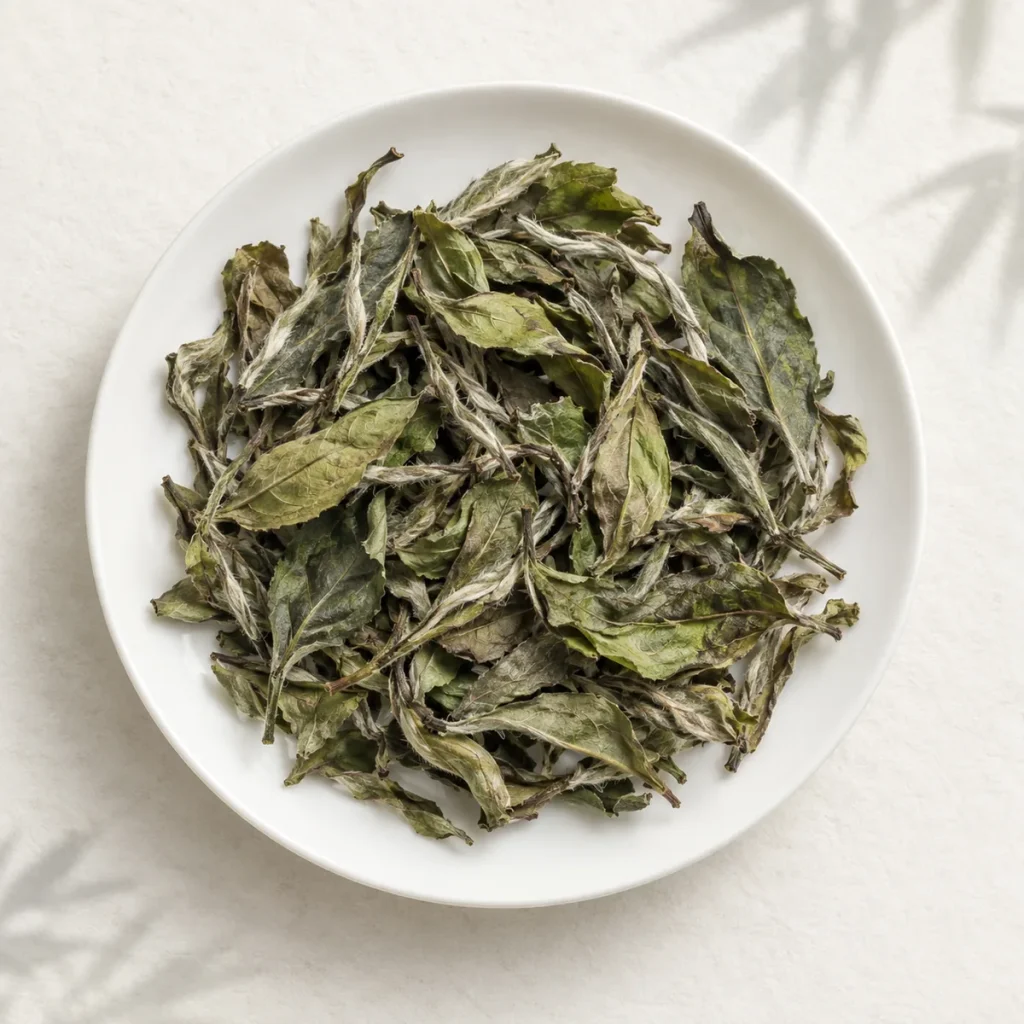
Composition Profile
Verified · 2026-09-26- 01Biochemical changes under different withering processesCompared with traditional white-tea processing, introducing shaking during withering significantly reduced tea polyphenols, flavonoids, caffeine, the phenol-to-amino-acid ratio and the ester/non-ester catechin ratio, while increasing free amino acids and theaflavins.Dry-leaf sample
- 02Volatile profiles under different processing methodsTraditional and shaking-assisted samples contained 104 and 107 aroma compounds respectively, with relative total abundance of 79.72% and 78.33%. Both were dominated by alcohols; shaking reduced green-aroma compounds such as 1-hexanol and increased floral-fruity compounds such as geraniol.Dry-leaf sample
The shaking-assisted sample showed richer floral-fruity aroma and a fuller taste.
Compared with traditional processing, the shaking treatment significantly reduced tea polyphenols, flavonoids and caffeine, increased free amino acids and theaflavins, and reshaped the volatile profile toward stronger floral-fruity aroma.
Tea Conversations
Tea lovers from around the world meet over a cup of tea.
Sign in or register to join the conversation. Your comment account is created automatically the first time you use a connected account.
No comments yet
Share your thoughts with readers around the world.