Skip to content
Tea & Realm
English

Shuixian White Tea

White tea · Jianyang white tea · Fujian Shuixian cultivar white tea

Fujian Shuixian · plump buds and leaves · downy-bud and floral aromas.

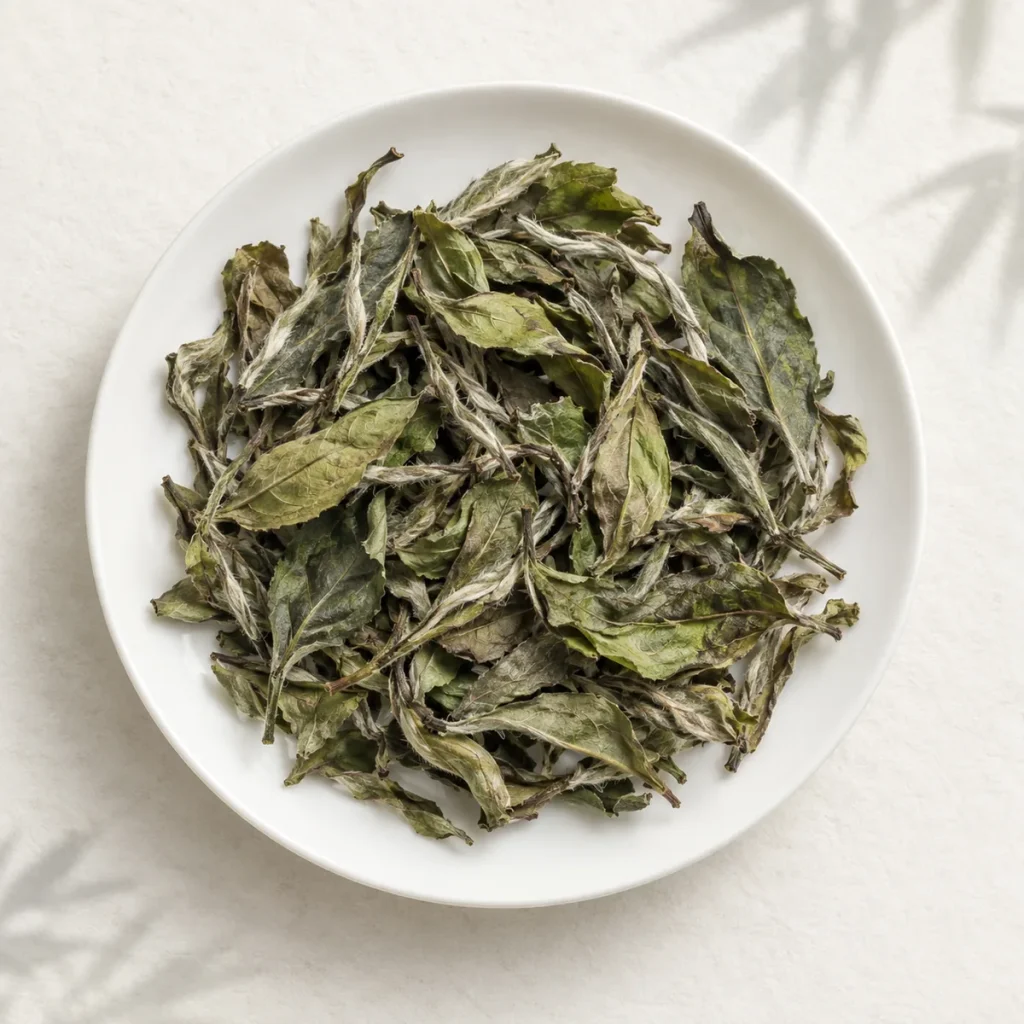
Shuixian White Tea, standardized as Jianyang Shuixian White Tea, is a regional white-tea system made from fresh leaves of the Fujian Shuixian cultivar using white-tea processing. T/CSTEA 00014.1—2020 divides it into Shuixian Silver Needle, Shuixian Peony and Shuixian Shoumei. The buds and leaves are typically substantial, with a clear cultivar character. Special Grade Shuixian Peony is lustrous gray-green with many plump central buds, combining downy-bud and floral aroma; its liquor is clear pale yellow and the taste fresh, mellow, sweet and brisk.

Origin
Jianyang, Nanping, Fujian · Xiaohu and Shuiji as traditional cores
Harvest
Fujian Shuixian fresh leaf · picked separately for Silver Needle, Peony and Shoumei styles
Craft
Natural withering · drying · sorting
Aroma
Fresh tender bud aroma · Cultivar floral fragrance
Taste
Fresh, mellow, sweet and brisk · Pronounced bud character
Liquor
Clear pale yellow · Bright and warm
Dry Leaf
Lustrous gray-greenPlump central buds
Liquor Color
Clear pale yellowBright and warm
Aroma
Fresh tender bud aromaCultivar floral fragrance
Taste
Fresh, mellow, sweet and briskPronounced bud character
Finish
Sweet and cleanPersistent floral resonance
Infused Leaf
Plump, tender, soft and brightMany visible buds

Tea Overview

Tea Category
White tea · Jianyang white tea · Fujian Shuixian cultivar white tea
Cultivar
Fujian Shuixian
Grade
Silver Needle 2 grades · Peony 3 · Shoumei 2
Harvest Period
Mainly spring · varies by product tenderness
Plucking Standard
Picked separately for Silver Needle / Peony / Shoumei
Processing
Natural withering · drying · sorting
Also Known As
Jianyang Shuixian White Tea · Shuixian White
Aging
Shuixian White Tea can be stored under appropriate white-tea storage conditions, but raw material, moisture, packaging and storage jointly determine aging quality. This page avoids the absolute claim that “older is always better.”

Origin & Terroir

Shuixian White Tea is standardized primarily through Jianyang Shuixian White Tea and is traditionally associated with Xiaohu, Shuiji and nearby parts of Jianyang in Nanping, Fujian. Its higher-level regional identity can connect to the Jianyang White Tea geographical-indication certification mark. “Xiaohu Shuixian” has a separate geographical-indication certification mark for Shuixian tea as a regional product, but that identity should not automatically be equated with white-tea processing or with Shuixian White Tea itself.

Origin
Jianyang, Fujian · Xiaohu and Shuiji as traditional cores
Altitude
No single legal value
Climate
Humid mountains of northern Fujian
Soil
Depends on the garden · no unified hard values
Landform
Northern-Fujian hills and mountains · stream valleys and basins

Brewing

Gaiwan / white porcelain cup / clear glassWater first, then tea, then top up
Leaf Method
Gaiwan / white porcelain cup / clear glass
Teaware
White porcelain gaiwan, tasting cup or heat-resistant glass
Leaf Amount
About 5 g
Water Temperature
About 90–95°C
Tea-to-Water Ratio
About 1:20–1:30 (editorial recommendation)
Time
Representative first infusion about 15–25s
Infusions
About 5–7 infusions, adjusted to product form and age
Water
Clean drinking water
Brewing Steps · 4
  1. Identify the product form: First determine whether the tea is Shuixian Silver Needle, Shuixian Peony or Shuixian Shoumei, then adjust water temperature and steeping time accordingly.
  2. Warm the vessel: Warm the gaiwan or clear glass with hot water, then discard the warming water.
  3. Add water: For representative Shuixian Peony, pour water around 90–95°C steadily along the wall of the vessel.
  4. Decant: Start around 15–25 seconds for the first infusion, then adjust later steeps to bud-and-leaf maturity, storage age and preferred strength.

Composition & the Body

Shuixian White Tea has direct biochemical, aroma and sensory research comparing traditional white-tea processing with experimental introduction of shaking during withering.

Composition Profile

Verified · 2026-09-26
  1. 01
    Biochemical changes under different withering processesCompared with traditional white-tea processing, introducing shaking during withering significantly reduced tea polyphenols, flavonoids, caffeine, the phenol-to-amino-acid ratio and the ester/non-ester catechin ratio, while increasing free amino acids and theaflavins.
    Dry-leaf sample
  2. 02
    Volatile profiles under different processing methodsTraditional and shaking-assisted samples contained 104 and 107 aroma compounds respectively, with relative total abundance of 79.72% and 78.33%. Both were dominated by alcohols; shaking reduced green-aroma compounds such as 1-hexanol and increased floral-fruity compounds such as geraniol.
    Dry-leaf sample

    The shaking-assisted sample showed richer floral-fruity aroma and a fuller taste.

Compared with traditional processing, the shaking treatment significantly reduced tea polyphenols, flavonoids and caffeine, increased free amino acids and theaflavins, and reshaped the volatile profile toward stronger floral-fruity aroma.

The research used open-leaf Fujian Shuixian material and represents a defined processing experiment. These trends must not be rewritten as fixed composition values for all Shuixian White Tea, and shaking should not be presented as the standard process for all traditional Shuixian White Tea.

View Research Sources

不同工艺制作水仙白茶的生化成分及感官品质比较

冯花, 王飞权, 张渤, 郑回, 陈荣冰 · 现代食品科技 · 2020

White tea made from open-leaf Fujian Shuixian fresh leaves under traditional processing (CK) and shaking-assisted processing (ST).

Processing pathway significantly affected non-volatile quality compounds in Shuixian White Tea.

DOI: 10.13982/j.mfst.1673-9078.2020.12.0941View Source

Tea Culture

Landscapes, people and history within a single leaf.

01

Shuixian Is Not Only for Oolong: the Same Cultivar, a Different Process, a Different Tea

The name “Shuixian” most often brings Wuyi rock tea or northern-Fujian oolong to mind, but a tea cultivar is not the same thing as a tea category. T/CSTEA 00014.1—2020 explicitly defines Jianyang Shuixian White Tea as white tea made from fresh Fujian Shuixian leaves using white-tea processing, and further divides it into Shuixian Silver Needle, Shuixian Peony and Shuixian Shoumei. GB/T 30357.4—2015, by contrast, standardizes Shuixian as an oolong tea. The two can use the same cultivar yet follow entirely different processing routes and end as different tea categories.

02

Shuixian White Tea Is Deeply Connected with Bai Mudan—but Today's Three-Part System Cannot Be Reduced to “White Peony”

The historical center of Jianyang Shuixian White Tea lies around Shuiji and Xiaohu. Local tea-history materials record that by the early 20th century local makers were already separating needle buds from Shuixian shoots for Silver Needle and using the remaining tender shoots to make Shuixian White Tea. Another local historical narrative identifies early Bai Mudan rough tea directly with Shuixian White Tea raw material. The current group standard has now expanded and standardized the Jianyang Shuixian White Tea system into Shuixian Silver Needle, Shuixian Peony and Shuixian Shoumei. The close historical relationship between Shuixian White Tea and Bai Mudan should therefore be preserved, but it should not be used to collapse the whole modern Shuixian White Tea system into Bai Mudan alone.

03

Xiaohu Is Both an Important Origin of the Shuixian Cultivar and the Most Natural Regional Background for Shuixian White Tea

Public materials from Fujian Province and Jianyang both identify Xiaohu in Jianyang as an important origin of Shuixian tea, and “Xiaohu Shuixian” was registered as a geographical-indication certification mark in 2017. From this source area, the Shuixian cultivar developed an oolong tradition and also entered white-tea production. Shuixian White Tea therefore carries a distinctive dual regional memory: it shares the Jianyang White Tea regional identity while remaining closely tied to Xiaohu Shuixian as a cultivar and origin identity. The database needs to keep “cultivar-origin identity” and “white-tea product identity” separate.

04

The Soul of Shuixian White Tea Is Not Shaking or Firing, but Slowly Withering Its Plump Shuixian Shoots

Fujian Shuixian leaves are generally thicker and more substantial than the seed-propagated Caicha material used for small white tea. When made as oolong, Shuixian undergoes zuoqing, fixation, rolling and baking; when made as Shuixian White Tea, the route changes completely. The group standard requires processing to follow GB/T 32743 and centers on withering and drying with no pan-firing and no rolling. Jianyang local materials especially emphasize indoor natural withering. The cultivar's naturally strong floral potential is preserved through gentle withering and drying, creating a white-tea expression of downy-bud aroma, floral fragrance and fresh mellow sweetness.

05

Three Product Forms, Three Expressions—the Most Representative Shuixian White Tea Remains the “Shuixian Peony”

The group standard sets different sensory requirements for the three Shuixian White Tea forms. Special Grade Shuixian Silver Needle is plump and even, gray-white, with clear downy-bud aroma and a clean fresh sweet taste. Special Grade Shuixian Peony has many plump central buds, connected shoots, a lustrous gray-green appearance, a fresh tender pure aroma with distinct bud and floral notes, and a fresh, mellow, sweet-brisk taste with pronounced bud character. Shuixian Shoumei has more open leaves and some tender stem, with liquor moving toward orange-yellow. Because of the historical relationship between Shuixian White Tea and Bai Mudan and because of its strong visual recognizability, this page uses Special Grade Shuixian Peony as the anchor for the four standard images and six sensory fields while retaining the full data for all three forms.

06

It Has Provincial-Level White-Tea Heritage Protection Above It—and Its Own Local Shuixian White-Tea Craft Tradition

In 2019, White Tea Making Craft (Jianyang) became an extended Fujian provincial intangible-cultural-heritage project, providing an upper-level traditional-craft framework for both Jianyang small white tea and Shuixian White Tea. Jianyang also placed Jianyang Shuixian White Tea Making Craft in its local heritage system and announced the first representative inheritors at the end of 2023. Meanwhile, Xiaohu Shuixian became a geographical-indication certification mark in 2017. The boundaries must remain clear: none of these identities should be upgraded into claims that Shuixian White Tea is itself a national intangible-cultural-heritage or UNESCO project, because there is currently no formal basis for that.

Frequently Asked Questions

What type of tea is Shuixian White Tea?
Shuixian White Tea is white tea made from fresh leaves of the Fujian Shuixian cultivar using white-tea processing. The current Jianyang group standard divides it into Shuixian Silver Needle, Shuixian Peony and Shuixian Shoumei.
Are Shuixian White Tea and Shuixian oolong the same tea?
No. They can use the same Fujian Shuixian cultivar, but Shuixian White Tea is made by white-tea withering and drying, while Shuixian oolong follows oolong processing. They belong to different national-standard systems.
How is Shuixian White Tea graded?
There is no single grading ladder across all three forms. Shuixian Silver Needle has Special Grade and Grade 1; Shuixian Peony has Special Grade, Grade 1 and Grade 2; Shuixian Shoumei has Grade 1 and Grade 2.
Is Shuixian White Tea the same as Bai Mudan?
Historically the two are closely connected, and early Bai Mudan used Shuixian White Tea as an important raw-material background. Modern Jianyang Shuixian White Tea, however, includes Silver Needle, Peony and Shoumei and cannot be equated with Bai Mudan alone.
What is the most representative appearance of Shuixian White Tea?
Using Special Grade Shuixian Peony as the representative example, the tea has numerous plump central buds, connected shoots, a lustrous gray-green appearance, and a fresh tender aroma combining downy-bud and floral notes.
Does Shuixian White Tea have its own geographical indication?
Jianyang Shuixian White Tea can be associated with the higher-level Jianyang White Tea geographical-indication certification mark. Xiaohu Shuixian, an important cultivar and origin identity, has its own certification mark. This should not be turned into a separate invented national GI product called Shuixian White Tea.
Is Shuixian White Tea a national intangible-cultural-heritage or UNESCO project?
No. The directly related upper-level project White Tea Making Craft (Jianyang) is a Fujian provincial intangible-cultural-heritage project, and Jianyang Shuixian White Tea Making Craft also has a local heritage transmission system. There is no basis for upgrading Shuixian White Tea itself to national or UNESCO status.
Does Shuixian White Tea have Chinese Important Agricultural Heritage or FAO GIAHS status?
As of 2026-09-24, this research set did not confirm that Jianyang Shuixian White Tea itself had entered China's Important Agricultural Heritage Systems, China's GIAHS candidate list, or FAO's official GIAHS list.

Tea Conversations

Tea lovers from around the world meet over a cup of tea.

Sign in or register to join the conversation. Your comment account is created automatically the first time you use a connected account.