Skip to content
Tea & Realm
English

Zhangping Shuixian

Oolong tea · Minnan/Western Fujian specialty oolong · compressed tea

A small paper-wrapped square holds orchid and osmanthus fragrance, bright golden liquor and a long Shuixian resonance.

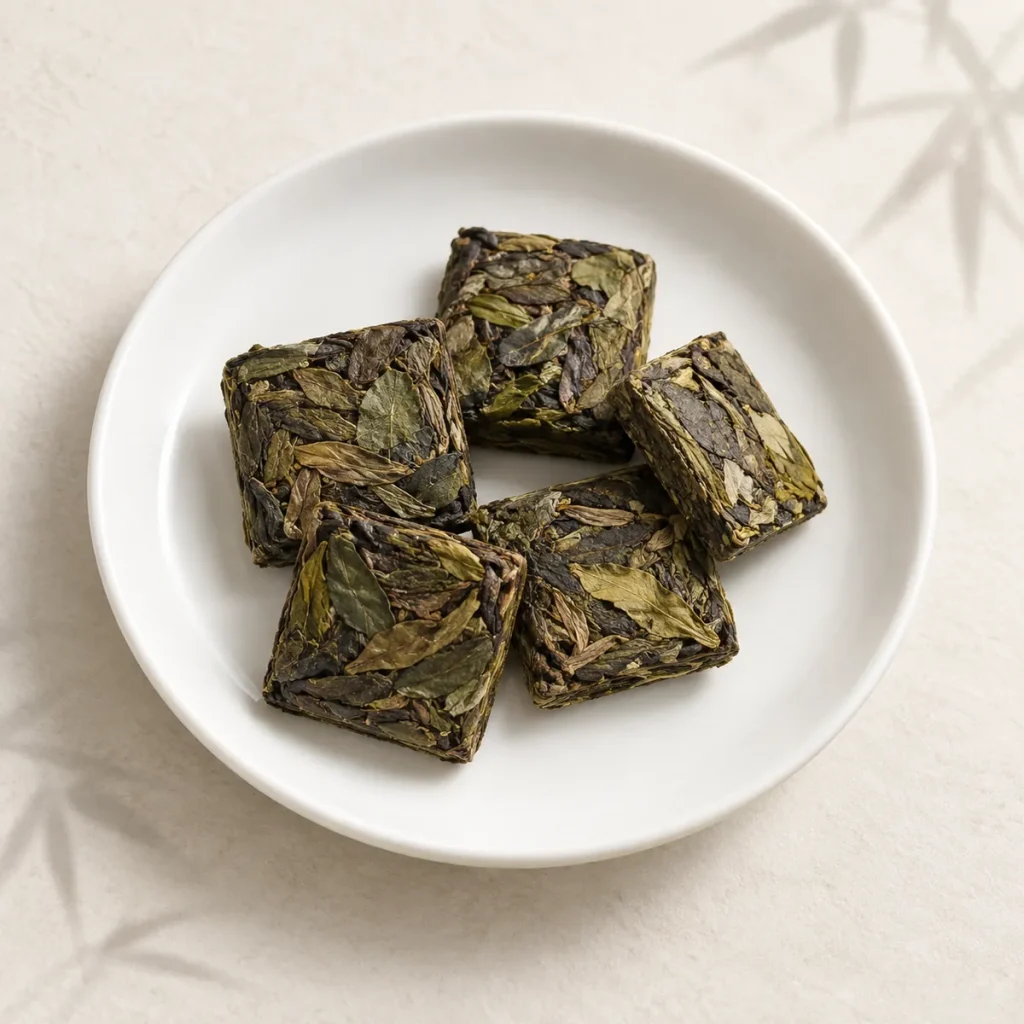
Zhangping Shuixian is produced in Zhangping, Fujian, from fresh leaves of the Fujian Shuixian cultivar and is one of the most distinctive square compressed oolong teas. Traditional cakes are made through sun withering, cooling, zuoqing, heat-fixing, rolling, mold pressing and repeated baking, combining the mellow depth associated with northern Fujian Shuixian with a cleaner Minnan-style zuoqing expression. Classic fresh-aroma square cakes show sandy green interwoven with honey-yellow, a high, fine floral fragrance, bright golden liquor and a rich, mellow, sweet-brisk taste. After brewing, the leaves are thick, soft and glossy with clear red edges, preserving a distinctive Shuixian cultivar aroma and a century-old cake-making tradition inside a small paper wrapper.

Origin
Zhangping, Fujian · nine-township GI area
Harvest
Resting-bud small-to-medium open-face · tender shoots with 2–3 leaves
Craft
Sun withering · zuoqing · rolling · mold pressing · baking
Aroma
High floral fragrance · Rich, fine and lingering
Taste
Rich, mellow and sweet-brisk · Clear cultivar resonance
Liquor
Bright golden yellow · Clear and warm-toned
Dry Leaf
Compressed square cakeSandy green and honey-yellow
Liquor Color
Bright golden yellowClear and warm-toned
Aroma
High floral fragranceRich, fine and lingering
Taste
Rich, mellow and sweet-briskClear cultivar resonance
Finish
Clean returning sweetnessLong floral after-aroma
Infused Leaf
Thick, soft and glossyClear red edges

Tea Overview

Tea Category
Oolong tea · Minnan/Western Fujian specialty oolong · compressed tea
Cultivar
Fujian Shuixian cultivar
Grade
Square cakes: 5 grades · loose tea: 4 grades
Harvest Period
Spring and autumn especially valued · harvested by open-face maturity
Plucking Standard
Resting-bud small-to-medium open-face · tender shoots with 2–3 leaves
Processing
Sun withering → zuoqing → heat-fixing → rolling → mold pressing → baking
Also Known As
Shuixian Tea Cake · square paper-wrapped tea · paper-wrapped tea
Oxidation / Fermentation
Zhangping Shuixian is a partially oxidized oolong tea. Alternating resting and shaking during zuoqing bruises the leaf edges and causes moderate enzymatic oxidation, producing “green leaves with red borders” and natural floral aroma before heat-fixing stops further oxidation. Traditional craft blends relatively heavier northern Fujian and lighter southern Fujian oolong approaches, with fresh- and strong-aroma styles differing in zuoqing and roast treatment.
Roasting
GH/T 1241—2019 defines fresh-aroma style as formed through specific processing including gentle drying over low heat, while strong-aroma style receives further roasting after primary manufacture. DB35/T 1981—2021 explicitly adds re-baking for compressed strong-aroma tea. “Fresh aroma” and “strong aroma” are therefore standardized processing categories, not labels to be assigned casually by smell.

Origin & Terroir

Zhangping lies in southwestern Fujian along the upper reaches of the Beixi River in the Jiulong River system. Mountains and hills dominate the landscape, traditionally summarized as “nine parts mountain, half part water, half part farmland.” A warm humid subtropical monsoon climate, mountain red and yellow soils and high forest cover provide an important ecological foundation for the Fujian Shuixian cultivar to develop floral fragrance and a substantial liquor in Zhangping.

Origin
Nine-township GI area including Nanyang, Zhangping
Altitude
Mountain and hill terrain · no single legal elevation
Climate
16.9–20.7°C · warm and humid
Soil
Slightly acidic loam · pH 4.5–6.5
Landform
Mountain valleys and hills · 'nine mountains, half water, half fields'

Brewing

Small gaiwan/pot · freshly boiled water · rinse square cake firstWater first, then tea, then top up
Leaf Method
Small gaiwan/pot · freshly boiled water · rinse square cake first
Teaware
Gaiwan or pot · about 100–160 mL
Leaf Amount
About one small square cake / 110–150 mL; adjust to cake net weight
Water Temperature
Freshly boiled water · close to 100°C
Tea-to-Water Ratio
The standard provides reference tea-to-water ranges; in daily use, one small cake with a small gaiwan works well
Time
Rinse 10–20 seconds · then add 5–10 seconds per infusion
Infusions
Highly infusible · extend later infusions by about 5–10 seconds
Water
Clean, odor-free drinking water
Brewing Steps · 4
  1. Warm the vessel and place the cake: Warm a 100–160 mL gaiwan or pot with boiling water, empty it, then place in a small Zhangping Shuixian square cake suited to the vessel size.
  2. Rinse with boiling water: Rinse the compressed square tea with freshly boiled water for about 10–20 seconds, then drain completely so the cake begins to loosen.
  3. Begin formal brewing: Add freshly boiled water again and decant once the leaves begin opening, observing the clear golden to orange-yellow liquor and natural floral aroma.
  4. Extend later infusions: Add about 5–10 seconds to each subsequent steep and follow the changes in floral fragrance, body and returning sweetness as the square cake fully opens.

Composition & the Body

Zhangping Shuixian has direct research on aroma precursors and multi-omics changes during processing, clearly showing how sun withering, shaking and seasonal differences alter both volatile and non-volatile metabolites.

Composition Profile

Verified · 2026-09-26
  1. 01
    Glycosidically bound aroma precursorsSix major glycosidically bound aroma precursors were identified: cis-3-hexenol, linalool, methyl salicylate, geraniol, benzyl alcohol and phenethyl alcohol. Precursor levels were markedly higher in autumn tea than in spring tea, increased significantly after cooling, and continued changing dynamically during shaking.
    Other sample

    Glycosidically bound precursors provide material for later floral and sweet volatile formation.

  2. 02
    Stress metabolome during sun withering and shakingAcross enzymatic stages, 980 non-volatile metabolites and 157 volatile metabolites were identified; 40 non-volatiles and 8 volatiles were selected as biomarkers.
    Other sample

Six major glycosidically bound aroma precursors change dynamically through processing and are generally higher in autumn tea than spring tea. Multi-omics research further shows that water-loss stress and mechanical damage jointly reshape amino acids, flavonoids, carbohydrates and volatile-aroma pathways.

The strongest evidence concerns processing dynamics and seasonal differences. Data from one stage should not be rewritten as fixed composition values of finished tea. No tea-specific human evidence was included.

View Research Sources

漳平水仙茶加工过程中香气前体含量的变化

谢运海, 郑德勇, 叶乃兴, 金珊, 曾璞玉 · 茶叶科学 · 2016

Spring and autumn Zhangping Shuixian samples across 12 processing stages from fresh leaf to finished tea.

Processing involves a dynamic balance between glycoside synthesis and enzymatic hydrolysis, while season significantly affects precursor abundance.

DOI: 10.13305/j.cnki.jts.2016.01.002View Source

The stress-induced metabolites changes in the flavor formation of oolong tea during enzymatic-catalyzed process: A case study of Zhangping Shuixian tea

Liangyu Wu, Yahui Wang, Suhui Liu, Yun Sun, Chenxue Li, Jinke Lin, Shu Wei · Food Chemistry · 2022

Zhangping Shuixian during sun withering, shaking and other enzymatic stages, with unprocessed fresh leaves as controls.

Phenylpropanoid, flavonoid and phenylalanine pathways were significantly enriched. Water loss and mechanical damage jointly drove changes in carbohydrates, amino acids, flavonoids and volatile phenylpropanoid/benzenoid compounds.

DOI: 10.1016/j.foodchem.2022.133192View Source

Tea Culture

Landscapes, people and history within a single leaf.

01

A Square of Shuixian

The easiest thing to remember about Zhangping Shuixian is its shape. A small square tea cake, individually wrapped in paper, looks unlike most other traditional oolong teas. GH/T 1241—2019 formally writes this into the product classification: Zhangping Shuixian may be compressed into a square or sold as loose tea, but the paper-wrapped square is the form that built its strongest cultural identity.

The square is not merely decorative. Fujian Shuixian leaves are relatively large, and rough tea can be loose and inconvenient to transport and store. Zhangping tea makers gradually developed the process from hand-forming bundles to wooden-mold pressing, creating a compact square that saved space and helped protect leaf and aroma. This shaping method eventually became the tea's most irreplaceable craft marker.

The standard also divides the tea into fresh-aroma and strong-aroma paths. Special Grade fresh-aroma square cakes can show sandy green interwoven with honey-yellow or glossy darker tones, high and fine floral fragrance and a rich, mellow, sweet-brisk taste. Strong-aroma style receives additional roasting, becoming darker and fuller in aroma and liquor.

02

Tea Origins in Dahui

The history of Zhangping Shuixian reaches back to the early 20th century. Recent Fujian government industry materials state that in Dahui Village—today Dahui Natural Village, Xikou Village, Shuangyang Town—tea farmer Liu Yongfa introduced Shuixian plants from the Shuiji area of northern Fujian, beginning the history of Shuixian cultivation in Zhangping. The cultivar crossed the mountains from northern into western Fujian and gradually developed a new processing identity in its new environment.

What truly separated it from northern Fujian Shuixian was cake making. Local historical sources differ over whether Liu Yongfa or later producer Deng Guanjin should be credited with the first square cake. Ministry of Commerce old-brand materials record Liu Yongfa experimenting with small compressed bundles around 1913 and using wooden molds to make square cakes around 1920, while other local accounts credit Deng Guanjin with fixing the cake specification and advancing commercial promotion. The page therefore does not force one person and year into an uncontested invention story.

What can be stated with confidence is that by the Republican period, square paper-wrapped Shuixian had become a mature commercial form and spread through Zhangzhou, Chaoshan and even Southeast Asian markets. Zhangping Shuixian preserves both the genetic lineage of Fujian Shuixian and a century-long history of local innovation in adapting tea shape for transport, storage and trade.

03

Along the Upper Jiulong River

Zhangping lies in southwestern Fujian along the upper reaches of the Beixi River in the Jiulong River system. The local phrase “nine mountains, half water, half fields” captures the landscape well: mountains and hills dominate, with river valleys and intermontane basins embedded among them, while forests and streams divide tea gardens into small moist ecological units.

The city as a whole has a subtropical monsoon climate, with annual mean temperature around 16.9–20.7°C. The central valley is warmer, while mountains to the north and south show clear vertical climatic differences. Abundant rainfall, humid air and high forest cover provide stable growing conditions for Fujian Shuixian, a large-leaf cultivar rich in internal compounds.

The national GI protection requirements also give unusually specific soil conditions: slightly acidic sandy loam or clay loam, pH about 4.5–6.5, soil depth above 1 m, with good water retention, permeability and aeration. Traditional areas such as Nanyang and Shuangyang combine these deep acidic soils with mountain, water and forest to form the ecological base of Zhangping Shuixian's floral aroma and substantial liquor.

04

A Square from a Wooden Mold

The first half of Zhangping Shuixian processing follows the logic of traditional oolong: sun withering, cooling, zuoqing, heat-fixing and rolling. Fresh leaves lose part of their moisture in sunlight, then alternate between resting and shaking so water redistributes through the leaf. Leaf edges bruise and oxidize during shaking, gradually forming red margins and natural floral aroma. Makers emphasize adjusting the process to the weather and to the leaf, so every round changes with conditions.

The unique part comes after rolling. Compressed cakes are sorted and kept pliable, then packed into wooden square molds and pressed into shape. Traditionally they are wrapped tightly in paper so the leaves maintain a regular square form that still carries visible handwork. This mold-pressing stage is one of the most visually recognizable elements of Zhangping Shuixian's national intangible-cultural-heritage craft.

Baking completes the tea. Fresh-aroma style uses gentler low fire to keep the floral fragrance lifted and lively, while strong-aroma style adds re-baking after primary processing so darker color, fuller body and roast aroma develop further. A true square cake is therefore not simply loose tea compressed afterward; pressing and baking both participate in quality formation.

05

Orchid and Osmanthus Resonance

Zhangping Shuixian fragrance is often described as “like orchid and osmanthus.” GH/T 1241—2019 uses more controlled language for Special Grade fresh-aroma square cakes: floral fragrance should be clear, high, fine and rich, with the cultivar character evident. Fujian promotional materials further use orchid and osmanthus as natural aroma analogies.

The liquor is not thin. Special Grade fresh-aroma tea requires bright golden liquor and a rich, mellow, sweet-brisk taste; strong-aroma Special Grade emphasizes fuller fragrance, mellow returning sweetness and bright golden liquor. This reflects Zhangping Shuixian's unusual position between southern Fujian elegance and northern Fujian depth: it can smell light and clean while drinking with real body.

The infused leaf is especially attractive once the square cake fully opens. The large Shuixian leaves reappear, and Special Grade fresh-aroma tea should be thick, soft and glossy with clear red margins and good evenness. If the tea has only lifted fragrance but a thin liquor, or the infused leaves are dark, stiff and lack bright red edges, it does not fully express the cultivar character described in the standard.

06

The Paper-Wrapped Tea Road

Zhangping Shuixian transformed a practical solution for transport into a cultural symbol. Individual paper wrappers, wooden-mold squares and Shuixian floral fragrance together form its modern visual identity. Official materials therefore describe it as an unusually distinctive compressed tea within the oolong category, standing out even among the many shapes found across China's six major tea types.

In 2021, Oolong Tea Making Craft (Zhangping Shuixian Tea Making Craft) was added as an extension project to China's fifth national list of representative intangible cultural heritage, project VIII-150, No. 933, with Zhangping Cultural Center as the safeguarding unit. In 2022, it became one of Fujian's six national-level tea heritage elements included in “Traditional tea processing techniques and associated social practices in China” on UNESCO's Representative List.

Zhangping Shuixian continues to evolve. Fresh- and strong-aroma standards, brewing and evaluation standards, ecological gardens, tea tourism and regional branding are all being developed. A small square cake that began as a century-old answer to transport and storage has become one of the most recognizable local symbols of this mountain city.

Frequently Asked Questions

What type of tea is Zhangping Shuixian?
Zhangping Shuixian is an oolong tea. Its most representative form is a compressed square cake made from fresh leaves of the Fujian Shuixian cultivar and shaped in a mold, though loose-tea products also exist.
Why is Zhangping Shuixian square?
Early Fujian Shuixian rough tea was relatively loose and inconvenient to transport, package and store. Zhangping tea makers gradually developed wooden-mold pressing and paper wrapping, ultimately creating the square tea cake. Mold shaping later became one of the most recognizable elements of the national heritage craft.
Does Zhangping Shuixian have fresh-aroma and strong-aroma styles?
Yes. GH/T 1241—2019 formally divides Zhangping Shuixian into fresh-aroma and strong-aroma processing styles. Fresh-aroma tea emphasizes gentle drying, clean floral fragrance and liveliness, while strong-aroma tea receives further roasting after primary processing and is fuller and more mellow.
How is Zhangping Shuixian graded?
It depends on shape and aroma style. Compressed square fresh-aroma and strong-aroma teas each have five grades: Special Grade through Grade 4. Loose fresh-aroma and strong-aroma teas each have four grades: Special Grade through Grade 3.
Are the orchid and osmanthus aromas in Zhangping Shuixian added?
No. The industry standard requires no additives. The floral fragrance arises naturally from the Fujian Shuixian cultivar together with zuoqing and baking. Official promotional materials often compare its natural floral character to orchid and osmanthus.
How should I brew a Zhangping Shuixian square cake?
Current DB35/T 2137—2023 calls for freshly boiled water. Before formal brewing, compressed square tea should first be rinsed for about 10–20 seconds and drained. As the cake opens, later infusions can be extended by roughly 5–10 seconds each time.

Tea Conversations

Tea lovers from around the world meet over a cup of tea.

Sign in or register to join the conversation. Your comment account is created automatically the first time you use a connected account.