Skip to content
Tea & Realm
English

West Lake Longjing

Green tea · flat pan-fired green tea

A spring leaf from West Lake, fresh, mellow and sweet in the cup.

West Lake Longjing is produced within the legally protected growing area around West Lake in Hangzhou, using fresh leaves from the Longjing population cultivar, Longjing 43 and Longjing Changye. The finished tea is flat, elegant and tender green, known for its clean, lasting aroma, bright green liquor and a fresh, mellow taste with a sweet finish.

Origin
Hangzhou · West Lake tea area
Harvest
Spring tea · tender buds and leaves
Craft
Spreading · first pan-firing · final pan-firing
Aroma
Rich tender-leaf aroma · Clean and persistent
Taste
Fresh, mellow and sweet · Fine and soft
Liquor
Bright tender green · Clear and luminous
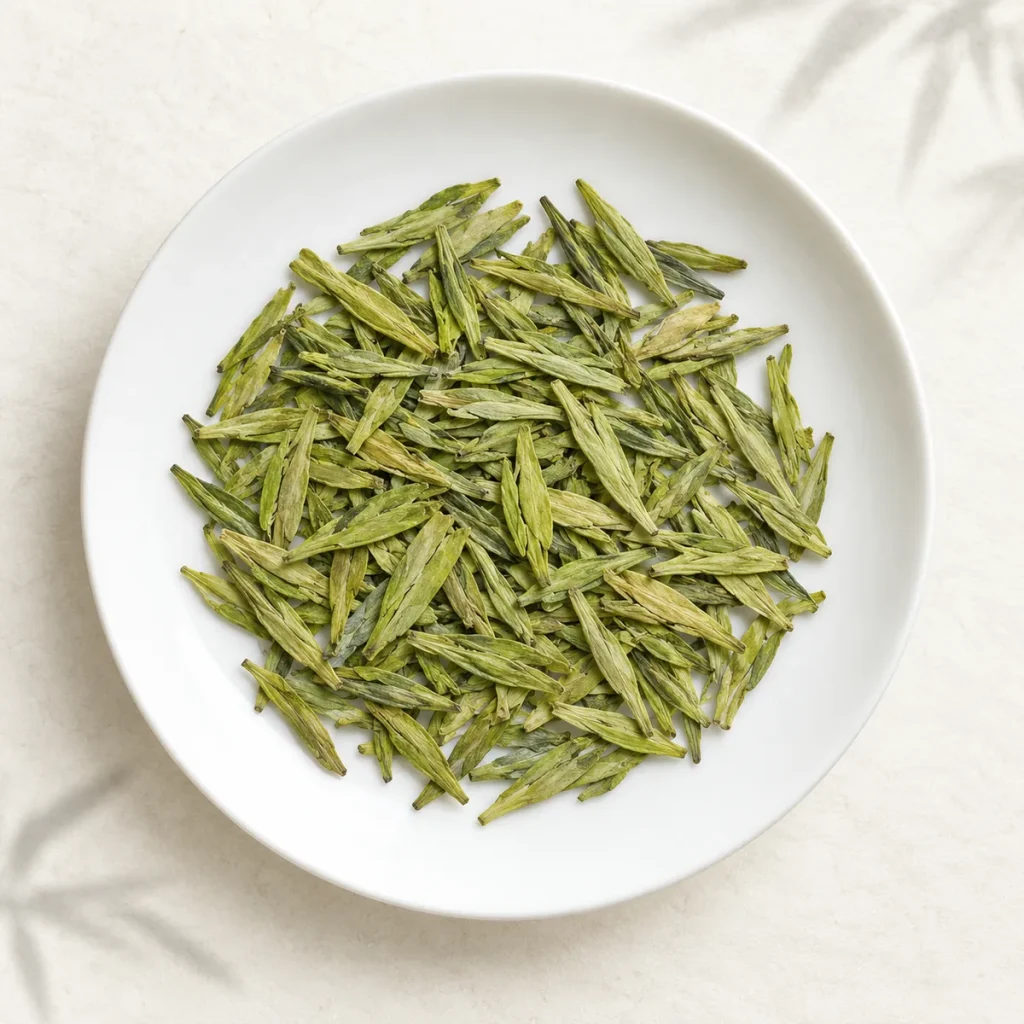
Dry Leaf
Flat and smoothElegant and tender green
Liquor Color
Bright tender greenClear and luminous
Aroma
Rich tender-leaf aromaClean and persistent
Taste
Fresh, mellow and sweetFine and soft
Finish
Clean returning sweetnessFresh, sweet finish
Infused Leaf
Tender leaves opening in intact clustersBright tender green

Tea Overview

Tea Category
Green tea · flat pan-fired green tea
Cultivar
Population cultivar · Longjing 43 · Longjing Changye
Grade
Premium · Special Grade · Grade 1 · Grade 2
Harvest Period
Spring · from mid-to-late March
Plucking Standard
Careful hand plucking · intact, clean buds and leaves
Processing
Spreading → qingguo → resting → huiguo

Origin & Terroir

West Lake Longjing begins with a limited and clearly defined origin around West Lake in Hangzhou. Tea gardens lie among the hills west of the lake, on slopes and in sheltered valleys. A mild, humid climate and well-drained sandy-stony and yellow soils provide an environmental foundation for tender spring shoots with a fresh, sweet and brisk character.

Origin
West Lake District, Hangzhou · West Lake Scenic Area
Altitude
Predominantly low-hill tea gardens
Climate
Mild and humid · four distinct seasons
Soil
Sandy-stony soils · yellow soils
Landform
Sheltered slopes and valleys · lake-and-hill terrain

Brewing

Moisten the leaves, then add waterWater first, then tea, then top up
Leaf Method
Moisten the leaves, then add water
Teaware
Tall, clear glass
Leaf Amount
About 2 g / 200 mL
Water Temperature
≥80°C (Premium and Special Grade)
Tea-to-Water Ratio
About 1:100
Time
First infusion: about 60 seconds
Infusions
About 2–3 infusions
Water
Clean drinking water with no off-odors
Brewing Steps · 4
  1. Warm the glass and add the tea: Warm the glass, empty it, then add about 2 g of West Lake Longjing and let the dry leaves settle naturally at the bottom.
  2. Moisten with a little water: Add just enough hot water to cover the leaves, allowing the flat buds and leaves to absorb water and release their first tender aromas.
  3. Fill and wait: Continue adding water to about 200 mL and let the tea stand for around 60 seconds. Begin drinking once the liquor is bright and clear.
  4. Leave some liquor and refill: Refill when roughly one third of the liquor remains, helping the strength stay more even from one infusion to the next.

Composition & the Body

Research specifically on West Lake Longjing includes studies of biochemical composition, volatile compounds and metabolomics. Existing data show that theanine, free amino acids, caffeine, tea polyphenols, soluble sugars and catechins vary with cultivar, sample and processing method. This page therefore presents values from defined research samples rather than treating any single number as a fixed composition for all West Lake Longjing.

Composition Profile

  1. 01
    Theanine
    Three major cultivars from the West Lake area · values reported separately
  2. 02
    Caffeine
    Same study of 30 Chinese teas · dry-weight basis
  3. 03
    EGCG
    Same study of 30 Chinese teas · dry-weight basis

The reliable evidence included here covers comparative biochemical data for Longjing 43, Longjing Changye and the Longjing population cultivar from the West Lake area; caffeine and EGCG measured within a single analytical study of 30 Chinese teas; volatile-compound research on 55 West Lake Longjing samples made from Longjing 43; and metabolomics comparing four manual and mechanical heat-fixing combinations. Cross-tea comparison is allowed only where the same study directly compares multiple teas using the same method and sample basis.

Component levels vary with cultivar, local environment, harvest season, tenderness, processing, storage and analytical method. The values shown here come from specific research samples and should not be treated as fixed values for every West Lake Longjing product. No eligible human intervention or observational study specifically on West Lake Longjing was included in this research channel; an empty tea-specific health-evidence field means only that no qualifying record was included here, not that such research can never exist.

Tea Culture

Landscapes, people and history within a single leaf.

01

A Spring Leaf from West Lake

West Lake Longjing is not a generic name for every tea called “Longjing.” It is a geographically defined green tea with specific requirements for origin, cultivars and processing. Under the current local standard, it must be made from fresh leaves of the Longjing population cultivar, Longjing 43 or Longjing Changye grown within the legally protected area and processed there according to Longjing methods. Its most recognizable appearance is the flat, smooth, elegant form developed during pan-firing, while its deeper quality identity lies in the balance among tender aroma, freshness, natural sweetness and a fine-textured liquor.

The current standard still summarizes the classic character of West Lake Longjing as “green color, rich aroma, sweet taste and beautiful form.” Premium dry leaf is flat and smooth, elegant and pointed, with a tender, lustrous green color. The liquor is bright tender green; the aroma is delicate yet full; the taste fresh, mellow and sweet; and the infused leaf fine and tender. Unlike teas defined by stronger oxidation, roasting or intense aromatics, West Lake Longjing draws much of its appeal from the freshness of spring leaf and the warm, restrained aromas produced through pan-firing.

For that reason, understanding West Lake Longjing means looking beyond labels such as “pre-Qingming” or “first picking,” and beyond any single aroma type. Legal origin, appropriate cultivars, sound pan-firing, and a finished tea that brings together clean aroma, freshness, mellow sweetness and tidy appearance all contribute to its basic identity.

02

A Long History of Longjing

Tea was produced around West Lake in Hangzhou long before the modern product name “West Lake Longjing” came into use. Materials associated with China's national intangible cultural heritage describe its development as beginning in the Tang, gaining fame through the Song, Yuan and Ming, and flourishing in the Qing. Lu Yu's Classic of Tea already recorded tea production around Tianzhu and Lingyin in Qiantang during the Tang, showing that the West Lake hills entered China's tea-cultural landscape very early. From the Song and Yuan onward, temple tea practices, mountain settings and literati exchange gradually strengthened the local reputation of Longjing tea.

After the Ming, the spread of loose-leaf tea drinking and the maturation of pan-firing techniques helped Longjing tea move closer to the form familiar today. Its reputation expanded further in the Qing, and stories associated with the Qianlong Emperor's southern tours, tea drinking at Longjing, and the “Eighteen Imperial Tea Bushes” became some of its best-known cultural memories. Such stories can be introduced as part of local tea tradition without treating every later detail as fully established by modern historical research.

From the late Qing into the Republican period, the West Lake tea area developed designations such as “Shi, Long, Yun and Hu”; “Mei” was added in the early years of the People's Republic, producing the later familiar set “Shi, Long, Yun, Hu, Mei.” These names were historically connected with different sites, villages and trading practices. They are no longer legal quality grades under modern protected-origin and grading systems, but they remain important historical-geographical symbols in the cultural memory of West Lake Longjing.

03

Between Lake and Hills

The origin is written into the name West Lake Longjing itself. The current local standard limits the protected area to government-recognized tea land within Hangzhou's West Lake District and the West Lake Scenic Area, covering five subdistricts or towns and 66 administrative villages or communities. Tea gardens are scattered across low hills, slopes and sheltered valleys west and southwest of the lake. Water, hills, forest and village life together form an unusually continuous tea-growing landscape within a highly urbanized setting.

The standard records an annual mean temperature of about 16°C, annual rainfall around 1,400 mm and average relative humidity near 80%. Soils are mainly sandy-stony soils and yellow soils, with a pH of roughly 4.0–6.0 and generally good drainage and aeration. These conditions do not mechanically create one fixed aroma, but they influence spring shoot growth, fresh-leaf water status and the accumulation of internal compounds, providing an environmental basis for the tea's fresh, soft and naturally sweet character.

There are also differences within the protected area. Traditional places such as Shifeng, Longjing, Yunqi, Hupao and Meijiawu developed their own local knowledge and style descriptions over time because of differences in slope aspect, shade, soil and cultivation history. Today these traditional names are better understood as cultural and geographical memory than as a modern hierarchy of grades.

04

Ten Techniques in the Pan

The most distinctive part of West Lake Longjing production is pan-firing, where heat-fixing, moisture loss, shaping and aroma development occur together. Freshly picked leaves are first spread so their condition becomes more even. During the first pan-firing stage, qingguo, heat rapidly suppresses enzyme activity while the leaves begin to take on their flat shape. The leaves are then cooled and allowed to redistribute moisture before huiguo, the final pan-firing stage, continues drying, flattening and finishing the form that gives Longjing its smooth, straight or elegant appearance.

The current West Lake Longjing product standard summarizes hand pan-firing through ten traditional techniques—grasping, shaking, spreading, extending, pressing, pushing, clasping, tossing, rubbing and flattening—and emphasizes that they are not performed as a rigid sequence. They are alternated and combined according to the changing state of the leaf. In 2024, Hangzhou also issued a dedicated technical specification for hand pan-firing of West Lake Longjing, bringing fresh-leaf quality, processing conditions and firing stages into a more standardized framework.

What no list of movements can fully replace is the maker's real-time judgment of pan temperature, leaf temperature, moisture, hand feel and shaping speed. The same batch of leaf requires different force, rhythm and contact at different stages. Modern machinery can therefore provide stable production at scale, while hand pan-firing remains an important window into the technical logic and cultural inheritance of West Lake Longjing.
05

Freshness and Sweetness in Balance

When tasting West Lake Longjing, begin with the neatness and tenderness of the dry leaf. Higher grades should be flat and smooth or relatively smooth, with elegant, even buds and leaves in tender to lustrous green tones. Once the cup is warmed, the dry leaf releases a fresh, tender aroma. Depending on cultivar, site and firing, gentle notes reminiscent of bean blossom or young chestnut may also appear. These usually blend with the fresh-leaf character rather than becoming a strong, singular roasted-bean smell.

After brewing, good higher-grade liquor should be bright, clear and tender green. Freshness is often the first impression, followed by soft body and natural sweetness. The standard phrase “fresh, mellow, sweet and brisk” does not mean the liquor tastes like sugar water; it describes an integrated experience in which bitterness and astringency are well controlled, freshness remains clear, and the mouth returns to a clean sweetness with salivation after swallowing. The infused leaf should be tender, bright green and open in intact clusters, revealing both the quality of the raw material and the coordination of processing.

There is also no need to treat “bean aroma” as the only correct benchmark. Tender-leaf, bean-blossom and young-chestnut notes may all occur. Purity and persistence of aroma, and the balance of freshness and mellowness in the liquor, matter more than chasing one fixed aroma type. Obvious scorching, coarse astringency, stale or muffled odors, dull liquor or dark, stiff infused leaves are generally not desirable signs.

06

Tea and Hangzhou

One of the unusual features of West Lake Longjing is that its tea gardens have never been far removed from the city. They are interwoven with Hangzhou's best-known landscapes, cultural sites and village life. Tea villages such as Longjing, Meijiawu and Wengjiashan still maintain the seasonal rhythm of spring picking, tea making, trading and serving tea to guests. Each year's spring harvest is both an agricultural milestone and a seasonal event felt across the city.

In 2008, the green-tea making craft of West Lake Longjing was inscribed on China's second national list of representative intangible cultural heritage projects. In 2022, “Traditional tea processing techniques and associated social practices in China,” which includes West Lake Longjing making, was inscribed on UNESCO's Representative List of the Intangible Cultural Heritage of Humanity. The heritage is not limited to pan-firing techniques: it encompasses tea-garden management, fresh-leaf plucking, processing, drinking, sharing and the broader knowledge and social relationships built around tea.

Today West Lake Longjing also uses digital management, anti-counterfeiting traceability and origin-certification labels to protect the authentic geographical identity of a historic name through modern systems. A cup of West Lake Longjing therefore connects natural environment, craft knowledge, contemporary standards and Hangzhou's urban culture. It is both a green tea and a living local tradition that continues to change.

Frequently Asked Questions

What is the difference between West Lake Longjing and Longjing tea in general?
“Longjing tea” is the broader geographical-indication product category, which includes the West Lake, Qiantang and Yuezhou production areas. “West Lake Longjing” must come from approved tea land within the legally protected West Lake Longjing area in Hangzhou and meet the relevant cultivar, processing and quality requirements.
Which tea-plant cultivars are legally specified for West Lake Longjing?
The current DB3301/T 1135—2023 standard explicitly lists the Longjing population cultivar, Longjing 43 and Longjing Changye. Zhongcha 108 may appear in earlier consultation drafts or breeding materials, but it is not one of the three fresh-leaf materials specified by the current finished-product standard.
Must West Lake Longjing be picked before Qingming?
No. “Pre-Qingming” describes harvest timing before the Qingming Festival; it is not a legal grade of West Lake Longjing. The current finished-product grades are Premium, Special Grade, Grade 1 and Grade 2. Tea picked after Qingming can still be West Lake Longjing if it meets the applicable requirements.
Must West Lake Longjing always be one bud and one leaf?
No single bud-and-leaf structure is required for every grade. The fresh-leaf standard grades material by tenderness and requires successive hand plucking, intact buds and leaves, fresh green color, evenness and cleanliness. Different fresh-leaf grades can have different bud-and-leaf compositions.
What water temperature should I use for West Lake Longjing?
Under the West Lake Longjing brewing guideline issued in 2024, the practical glass method for Premium and Special Grade tea uses a tea-to-water ratio of about 1:100, water at no lower than 80°C, and about 60 seconds before drinking begins.

Tea Conversations

Tea lovers from around the world meet over a cup of tea.

Sign in or register to join the conversation. Your comment account is created automatically the first time you use a connected account.