Skip to content
Tea & Realm
English

Taiping Houkui

Green tea · pointed / broad flat green tea

Two leaves embrace one bud, with high orchid fragrance and a long-lasting Houkui character.

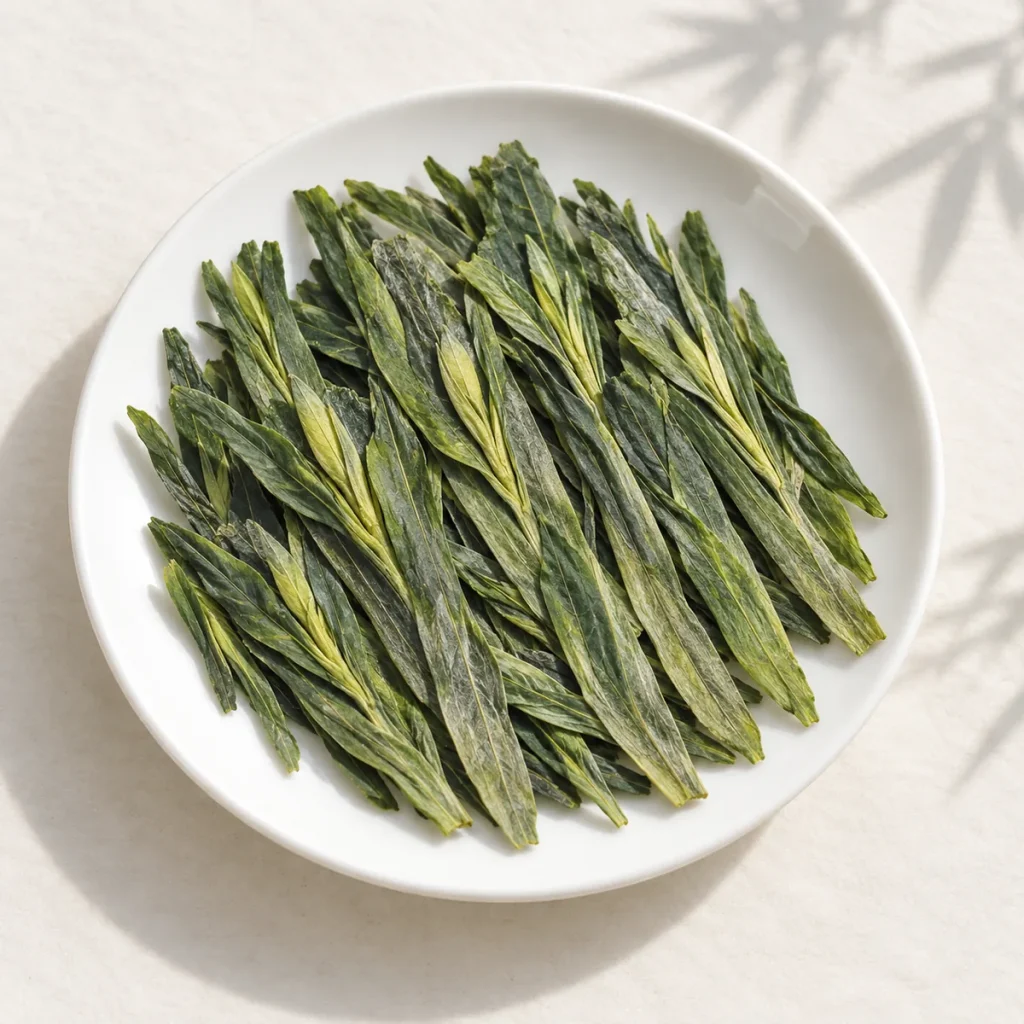
Taiping Houkui is produced in Huangshan District, Huangshan City, Anhui, using Shidacha as its principal tea-plant material. The finished tea carries two leaves embracing one bud, with a flat, straight, broad and weighty form and a deep green surface with fine hairs mostly concealed. It is known for a vivid orchid-like aroma, a fresh yet full-bodied taste, and the lingering sweetness traditionally described as houyun, the “Houkui resonance.”

Origin
Huangshan, Anhui · Huangshan District
Harvest
Around Grain Rain · tip selection before processing
Craft
Tip selection · heat-fixing · shaping · three-stage drying
Aroma
Vivid, high and refreshing · Persistent orchid-like aroma
Taste
Fresh, brisk and full-bodied · Sweet lingering finish
Liquor
Bright tender green · Clear and translucent
Dry Leaf
Two leaves embracing one budBroad, flat and imposing
Liquor Color
Bright tender greenClear and translucent
Aroma
Vivid, high and refreshingPersistent orchid-like aroma
Taste
Fresh, brisk and full-bodiedSweet lingering finish
Finish
Clean returning sweetnessLong Houkui resonance
Infused Leaf
Tender, even and substantialBright and opening in clusters

Tea Overview

Tea Category
Green tea · pointed / broad flat green tea
Cultivar
Primarily Shidacha
Grade
Supreme · Special Grade · Grade 1 · Grade 2 · Grade 3
Harvest Period
From mid-April · before the Start of Summer
Plucking Standard
Pick one bud with 3–4 leaves · select down to one bud with 2 leaves
Processing
Tip selection → spreading → heat-fixing → shaping → first drying → second drying → third drying

Origin & Terroir

Taiping Houkui grows in the mountain tea region between the northern foothills of Huangshan and Taiping Lake. Steep valleys, dense forests, frequent mist and tea gardens on higher slopes and sheltered hollows create a distinctive mountain setting. A humid monsoon climate, acidic mountain soils and high forest cover provide the ecological foundation for the large, substantial Shidacha shoots and the tea's clear, orchid-like fragrance.

Origin
Huangshan, Anhui · all of Huangshan District
Altitude
Core gardens commonly around 350–600 m
Climate
Warm and humid · frequent mist
Soil
Dark sandy loam · yellow-brown soils · acidic soils
Landform
Mountain slopes and hollows · around Taiping Lake

Brewing

Moisten the leaves · pour along the glass wallTea first, then water
Leaf Method
Moisten the leaves · pour along the glass wall
Teaware
Tall clear glass
Leaf Amount
About 3 g / 150 mL
Water Temperature
About 85–90°C
Tea-to-Water Ratio
About 1:50
Time
First infusion: about 2–3 minutes
Infusions
About 3–4 infusions
Water
Clean, low-mineral drinking water
Brewing Steps · 4
  1. Warm the glass and add the tea: Warm a tall clear glass, empty it, and add about 3 g of Taiping Houkui so the long leaves can stand or lean naturally in the vessel.
  2. Moisten with a little water: Pour a small amount of 85–90°C water along the glass wall and let the one-bud-two-leaf shoots absorb water and open slowly.
  3. Fill and wait: Continue pouring along the glass wall to about 150 mL, then steep for roughly 2–3 minutes before drinking.
  4. Leave some liquor and refill: Refill when about one third of the liquor remains and extend later infusions slightly as needed.

Composition & the Body

Research specifically relevant to Taiping Houkui includes studies of volatile and non-volatile metabolites and processing suitability across Shidacha lines, allowing a tea-specific composition profile to be built around its core raw material.

Composition Profile

Verified · 2026-09-25
  1. 01
    CaffeineGreen-tea samples made from seven cultivars or lines showed significant differences in caffeine content.
    Dry-leaf sample
  2. 02
    Floral volatile compoundsInfusions made from Shidacha green-tea samples showed relatively high levels of floral compounds including linalool, linalool oxides, geraniol and jasmone.
    Infusion / tea liquor

    Linalool, geraniol, jasmone and related compounds jointly contribute to floral aromatic direction.

  3. 03
    Physicochemical variation among 54 Shidacha linesAfter 54 Shidacha lines were processed into Taiping Houkui, coefficients of variation were 43.00% for catechins, 25.53% for gallic acid, 24.99% for ECG and 24.98% for theanine.
    Dry-leaf sample

The research focus is not a single fixed concentration but clear differences among Shidacha lines in caffeine, catechins, free amino acids, theanine and floral volatile compounds.

Shidacha is the core raw-material background of Taiping Houkui, but the studies involve multiple lines. Their data should not be collapsed into a single “average Taiping Houkui value.” No tea-specific human evidence was included.

View Research Sources

太平猴魁茶栽培品种‘柿大茶’品系间代谢物及遗传进化分析

周汉琛, 刘亚芹, 王辉, 杨霁虹, 徐玉婕, 雷攀登 · 食品科学 · 2023

Five Shidacha lines and two non-Shidacha cultivars processed using green-tea methods.

Caffeine was one of the important non-volatile variables distinguishing tea samples made from different cultivars in the study.

DOI: 10.7506/spkx1002-6630-20220909-087View Source

54个柿大茶品系加工太平猴魁的适制性评价

杨群, 代修娣, 张熙敏, 朱小元, 胡绍德, 杨天元 · 中国茶叶 · 2025

Shidacha lines grown in the same area and processed into Taiping Houkui using the same method.

Marked physicochemical variation remains within the same raw-material population, further showing that a single fixed composition should not be used to represent the entire product category.

View Source

Tea Culture

Landscapes, people and history within a single leaf.

01

Two Leaves and One Bud

Taiping Houkui is one of the easiest Chinese green teas to recognize by sight. It is neither short and flat like West Lake Longjing nor slender and curled like Biluochun. Instead, one bud and two leaves are opened into a long, broad and imposing form. The current national standard defines its core qualities through “two leaves and one bud, flat and straight, broad and weighty, deep green color, high orchid aroma and mellow sweet taste,” and local protection regulations continue to use these basic characteristics.

Although the leaves look very large, high-grade Taiping Houkui is not made from coarse old material. Makers first pick new shoots at one bud with three or four leaves, then carry out careful tip selection, removing extra leaves and keeping a sturdy, straight one-bud-two-leaf shoot. This pick-then-select method lets the final two leaves align with the bud and creates the famous “two leaves embracing one bud” structure. Fine hairs are abundant but largely concealed, and parts of the main vein on the deep-green leaf may naturally appear dark red, traditionally nicknamed “red silk threads.”

Quality is not only about appearance. Supreme Houkui requires a vivid, high, refreshing aroma with lasting orchid character, together with a fresh, full-bodied taste and sweet finish—the combination traditionally described as houyun, the “Houkui resonance.” Taiping Houkui is therefore visually dramatic, but its true quality still depends on harmony among aroma, liquor texture and returning sweetness.

02

Houkeng and the Birth of Houkui

Huangshan District was historically known as Taiping County, and tea was produced in these mountains long before the name “Taiping Houkui” existed. National intangible-cultural-heritage materials record tea production here by the Tianbao era of the Tang, when local teas were broadly known as Taiping tea. Taiping Houkui in the modern sense emerged much later, from improvements to pointed green tea around the late Qing and early Republican period.

According to national heritage materials, by the 26th year of the Guangxu reign (1900), Taiping pointed tea was already popular in markets along the Yangtze. Some merchants began selecting especially neat shoot tips from finished tea and selling them at higher prices. A Hougang tea farmer named Wang Kuicheng is said to have taken the idea further: rather than selecting after processing, he chose sturdy fresh shoots in the garden and made carefully selected one-bud-two-leaf tea from high-mountain material. Pointed teas from the Houkeng and Hougang area gained a reputation as the “finest among pointed teas,” and the word kui also became associated with Kuicheng's name, eventually producing the modern name Taiping Houkui.

Through the 20th century, Taiping Houkui moved from a local pointed tea into the national famous-tea system and acquired national standards, geographical-indication protection and heritage recognition. In 2008, its green-tea making craft entered China's second national list of representative intangible cultural heritage projects. In 2022, it became part of “Traditional tea processing techniques and associated social practices in China” on UNESCO's Representative List. Local craft from Houkeng and Hougang thus became an important part of China's broader tea heritage.

03

Mountains of Taiping Lake

The terroir core of Taiping Houkui lies between the northern foothills of Huangshan and Taiping Lake. Huangshan District is generally higher in the south and lower in the north, with mountains dominating the landscape, extensive forest and bamboo cover, and a large body of water in Taiping Lake to the north. The national standard describes a humid subtropical monsoon climate with an annual mean temperature of about 15.5–16.4°C, annual rainfall near 1,556 mm, long-term relative humidity above 80%, and frequent mist and diffuse light.

Compared with many low-hill green teas, Taiping Houkui has a more pronounced mountain character. GB/T 19698—2008 records most tea gardens above 300 m, while public Ministry of Agriculture and Rural Affairs tea-culture materials summarize a representative growing range of 350–600 m. Core areas such as Houkeng, Hougang and Yanjia lie on mountains and sheltered hollows around Taiping Lake, where forest vegetation is dense and moist shaded slopes are especially valued in traditional practice.

Soils include dark sandy loams, yellow-brown soils, yellow-red soils and yellow soils, generally around pH 5–6 and relatively rich in humus and organic matter. The traditional “four selections” begin with “choose high mountains, not low; choose shaded slopes, not sunny ones,” showing that tea makers recognized the link between microenvironment and shoot quality long ago. The legal geographical-indication area today is the whole Huangshan District, however, so core high-mountain conditions should not be written as if every garden in the district were identical.

04

Tip Selection and Three Dryings

Traditional Taiping Houkui processing begins shaping the tea's final appearance while the leaf is still fresh. Growers first pick shoots at one bud with three or four leaves, then carry out “tip selection”: sturdy, straight, normally colored, healthy shoots are chosen and extra leaves below the second leaf are removed, leaving a balanced one-bud-two-leaf unit. National heritage materials summarize the selection experience as “four selections and eight rejections,” favoring high mountains, shaded sites, vigorous Shidacha plants and strong straight shoots.

The selected tips are spread, then heat-fixed and straightened. Heat-fixing must rapidly suppress enzyme activity without scorching the thick buds and leaves. Straightening gradually positions the two leaves around the central bud and establishes the basic “two leaves embracing one bud” form. Unlike green teas that are rolled into thin strands, Taiping Houkui places greater emphasis on preserving leaf integrity and longitudinal openness.

The final appearance is completed through continuous drying and shaping. The national standard divides drying into first, second and third drying, the final fire. As moisture decreases, the leaves are dried, gently pressed and straightened so that buds and leaves lie flat and straight without sticking together. Heat is lowered stage by stage, and once the leaves become nearly crisp they are no longer pressed heavily, helping prevent breakage. The result is Houkui's broad yet not coarse, flat yet intact appearance, while the fresh-leaf aroma gradually develops into the characteristic high orchid-like fragrance.

05

Orchid Aroma and Houkui Resonance

The first thing most people notice when tasting Taiping Houkui is the extraordinary size of its shoots. Supreme tea should be broadly spread and straight, substantial and imposing, with two leaves embracing one bud and a neat overall appearance. Fine hairs are present but not excessively exposed, and portions of the main vein on the deep-green leaf may show a natural dark red. As grade decreases, the form becomes more simply flat and reasonably even, with Grade 3 allowing a small amount of curled or broken material.

The liquor moves from bright tender green toward yellow-green as grade decreases. Supreme aroma is described in the standard as “vivid, high and refreshing, with lasting orchid fragrance,” while Special Grade emphasizes a fresh, clean high aroma with orchid character. From Grade 1 onward, the aroma gradually shifts toward high clean or simply clean. The “orchid aroma” here means a clear, lifted and restrained floral impression rather than added fragrance.

Taste also changes by grade. Supreme and Special Grade emphasize brisk freshness, full body and a sweet lingering finish, traditionally called houyun. Grade 1 stresses freshness with returning sweetness, while Grades 2 and 3 move more toward mellow sweetness. A substantial, intact infused leaf opening in clusters indicates good raw material and shaping. Scorched fire notes, extensive breakage, dull cloudy liquor or obvious coarse astringency all move away from the tea's expected balance.

06

Tea Life in Houkeng

The cultural center of Taiping Houkui remains unusually specific: Houkeng, Hougang and Yanjia around Xinming Township in Huangshan District. Huangshan's municipal government recognizes Houkeng Village as the birthplace and a core production area. In 2026, the local spring season was again formally opened in Houkeng Village on April 16, and the opening ceremony has become an important annual tea event in Huangshan District.

Local protection is also moving from traditional knowledge into digital systems. Huangshan District is building a geographical-indication certification system for Taiping Houkui, with one-item-one-code authentication in core areas including Houcun, Hougang and Yanjia. The Huangshan Traditional Famous Tea Protection Regulation, effective from 2025, also requires whole-process protection covering cultivars, cultivation, fresh-leaf plucking, processing and special-use labels so that origin, plant material and production method can all be traced.

At the same time, handcraft remains central to Taiping Houkui's cultural identity. National heritage practitioners and local tea farmers continue to transmit “four selections and eight rejections,” hand straightening and staged drying. Modern machinery can improve efficiency, but the hardest knowledge to replace is still human judgment: whether a shoot is robust enough, how to align two leaves and one bud so they remain natural as well as straight, and how to bring orchid fragrance and mellow sweetness forward through drying.

Frequently Asked Questions

What type of tea is Taiping Houkui?
Taiping Houkui is a green tea and a highly distinctive broad, flat pointed style. Its classic structure is two leaves embracing one bud, with a broad, straight and substantial form and a high, clear orchid-like aroma.
Where is the legal production area of Taiping Houkui?
GB/T 19698—2008 defines the geographical-indication protection area as the current administrative territory of Huangshan District, Huangshan City, Anhui. Houkeng, Hougang and Yanjia are among the best-known traditional core areas.
How many grades does Taiping Houkui have?
The current national standard recognizes five grades: Supreme, Special Grade, Grade 1, Grade 2 and Grade 3. Supreme has the strictest requirements for appearance, persistence of orchid aroma, fresh full body and sweet lingering finish.
Why does Taiping Houkui have two leaves and one bud?
Tea makers first pick shoots at one bud with three or four leaves, then carry out tip selection and remove the extra leaves. A strong, straight one-bud-two-leaf unit remains, which is then heat-fixed, straightened and dried into the characteristic “two leaves embracing one bud” structure.
Why is “pre-Qingming” tea not a typical benchmark for Taiping Houkui?
Core Houkui areas sit at relatively high elevations and spring growth starts later. The national standard uses around mid-April as the usual opening period, and heritage materials describe the main season as around Grain Rain. “Pre-Qingming” is therefore not a central quality benchmark for Taiping Houkui.
What water temperature should I use for Taiping Houkui?
For everyday drinking, use about 85–90°C water and roughly 3 g of tea to 150 mL. A tall clear glass works well: moisten the leaves first, then add water slowly along the side and begin drinking after about 2–3 minutes.

Tea Conversations

Tea lovers from around the world meet over a cup of tea.

Sign in or register to join the conversation. Your comment account is created automatically the first time you use a connected account.