Skip to content
Tea & Realm
English

Lu’an Guapian

Green tea · single-leaf green tea

A single leaf shaped like a melon seed, deepened by fire, fresh and mellow with a long sweet finish.

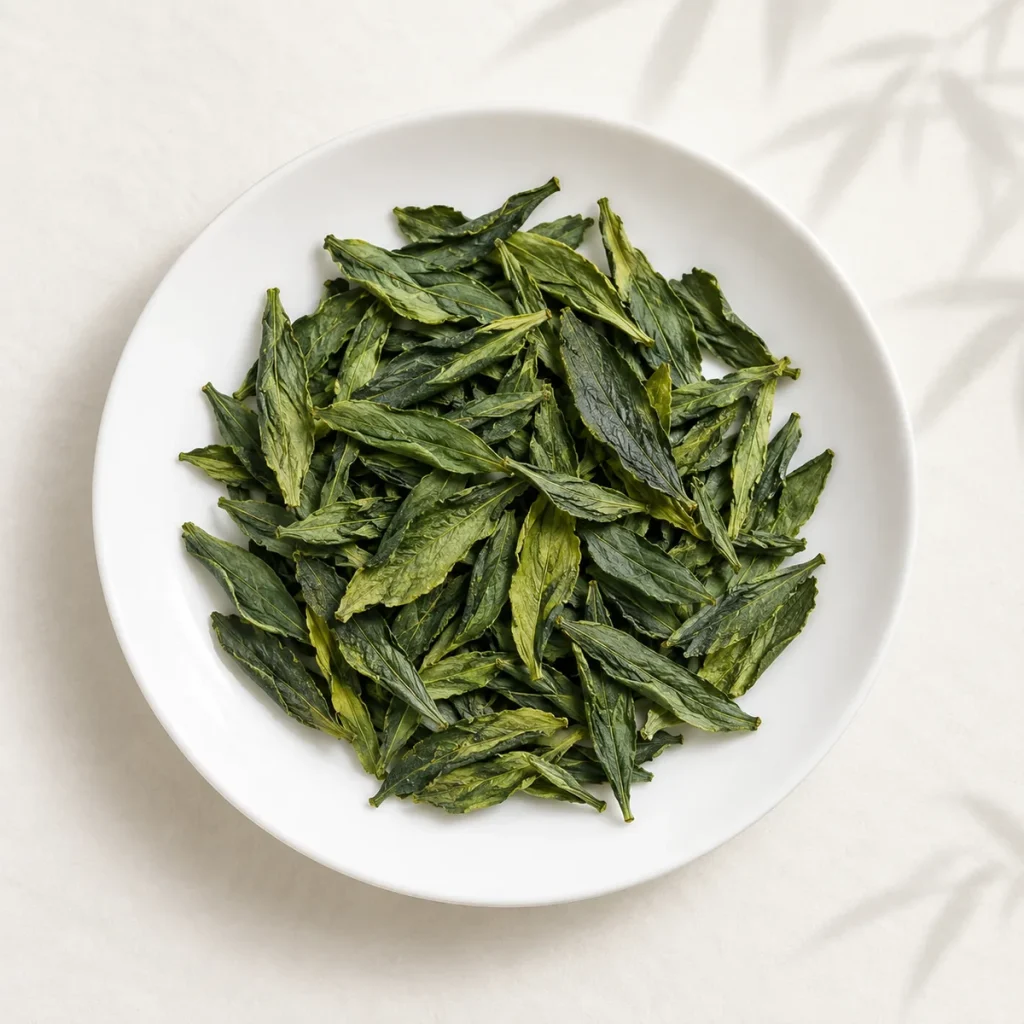
Lu'an Guapian comes from the northern foothills of the Dabie Mountains in Lu'an, Anhui, and is one of China's most distinctive single-leaf green teas. Buds and stems are removed so the finished tea is made from individual leaves alone. The dry leaves resemble melon seeds, with a deep jewel-green color and a natural frosted appearance. Higher grades show high floral or clean aromas, clear liquor, and a fresh, full-bodied taste with lasting returning sweetness.

Origin
Lu'an, Anhui · northern Dabie foothills
Harvest
Spring · single-leaf plucking
Craft
Shengguo · shouguo · maohuo · xiaohuo · laohuo
Aroma
High, lasting floral aroma · Persistent clean aroma
Taste
Fresh, brisk and full-bodied · Pronounced returning sweetness
Liquor
Tender green and clear · Bright and lively
Dry Leaf
Melon-seed shapeJewel green with a frosted surface
Liquor Color
Tender green and clearBright and lively
Aroma
High, lasting floral aromaPersistent clean aroma
Taste
Fresh, brisk and full-bodiedPronounced returning sweetness
Finish
Sweet, smooth and lingeringLong aftertaste
Infused Leaf
Tender yellow-green leavesLively and even

Tea Overview

Tea Category
Green tea · single-leaf green tea
Cultivar
Dushan Xiaoye · Qitoushan Zhongye · suitable cultivars
Grade
Premium · Special 1 · Special 2 · Grade 1 · Grade 2 · Grade 3
Harvest Period
Spring production · traditionally busiest around Grain Rain
Plucking Standard
Direct leaf plucking or leaf stripping · buds and stems removed
Processing
Leaf stripping → shengguo → shouguo → maohuo → xiaohuo → laohuo
Also Known As
Piancha / leaf-slice tea

Origin & Terroir

The legal production area of Lu'an Guapian lies along the northern foothills and eastern edge of the Dabie Mountains, spanning selected townships in Yu'an, Jinzhai, Huoshan, Jin'an and Shucheng. The main mountain zones are often misty, with noticeable day-night temperature differences. Moderately acidic yellow-brown soils and relatively rich organic matter help support the tea's substantial leaf material, full-bodied taste and ability to withstand intensive drying over fire.

Origin
Five Lu'an districts/counties · 26 protected townships
Altitude
Main mountain areas average above 500 m
Climate
Humid transitional climate · misty mountain conditions
Soil
Yellow-brown soils · pH 5.0–6.5
Landform
Northern Dabie foothills · mountains and hills

Brewing

Place tea first, then pour gentlyWater first, then tea, then top up
Leaf Method
Place tea first, then pour gently
Teaware
Clear glass or white porcelain cup
Leaf Amount
About 3 g / 150 mL
Water Temperature
About 85–90°C
Tea-to-Water Ratio
About 1:50
Time
First infusion: about 2–3 minutes
Infusions
About 3 infusions
Water
Clean, low-mineral drinking water
Brewing Steps · 4
  1. Warm the glass and add the tea: Warm the glass, empty it, and add about 3 g of Lu'an Guapian, letting the single leaves spread naturally.
  2. Pour gently: Pour 85–90°C water slowly along the side of the glass, avoiding a hard stream that would scatter or break the intact leaves.
  3. Let the flavor open: Steep for about 2–3 minutes and begin drinking once the liquor is clear and bright and the aroma has opened.
  4. Leave some liquor and refill: Refill when about one third of the liquor remains and extend later infusions as the flavor softens.

Composition & the Body

Research specifically on Lu'an Guapian includes studies of leaf maturity, the formation of the laohuo “frost,” and aroma chemistry, allowing a tea-specific profile closely tied to processing to be presented.

Composition Profile

Verified · 2026-09-25
  1. 01
    Leaf-maturity metabolomic profileAcross Lu'an Guapian made from the first, second and third leaves below the bud, tea polyphenols, free amino acids and total flavonoids generally decreased as leaf maturity increased, while soluble sugars and total chlorophyll increased. Twenty-four differential compounds were identified.
    Dry-leaf sample
  2. 02
    EGCGThe first-leaf sample was significantly higher than the second- and third-leaf samples and was one of the key metabolites associated with stronger bitterness, astringency and taste intensity in the more tender material.
    Dry-leaf sample
  3. 03
    Chemical composition of laohuo “frost”The “frost” is a complex mixture containing caffeine, catechins, flavonoid glycosides, terpenes and other non-volatile and volatile substances.
    Other sample

Current evidence shows especially clearly that Lu'an Guapian chemistry changes with leaf position and maturity and with laohuo processing. Its “frost” is a complex mixture formed from the tea's own compounds under high heat, friction and related conditions.

In vitro antioxidant and enzyme-inhibition experiments are not human evidence and therefore are not included as tea-specific health evidence. In studies comparing leaf grades, quantitative metabolite tables on public pages did not display stable unit headers; this batch therefore retains only trends explicitly supported by the abstract and does not guess units.

View Research Sources

基于叶片等级差异的六安瓜片体外生物活性及滋味特性分析

张积鑫, 李铁汉, 张雨萱, 蒋艳群, 李宗辉, 宁井铭, 张正竹 · 农业工程学报

The first, second and third leaves below the bud were processed separately into Lu'an Guapian.

Leaf maturity significantly changed the abundance of taste-related metabolites and sensory intensity in Lu'an Guapian.

View Source

六安瓜片拉老火“起霜”的形成机制及其对茶叶品质的影响

江俞蓉, 刘思彤, 高静, 李大祥, 夏涛, 戴前颖 · 茶叶科学 · 2018

Surface “frost” collected during traditional laohuo processing together with frosted and non-frosted Lu'an Guapian samples.

Friction is a key factor in frost formation. The frost is neither a single substance nor an externally added powder.

DOI: 10.13305/j.cnki.jts.2018.05.006View Source

Tea Culture

Landscapes, people and history within a single leaf.

01

A Single Leaf Becomes Guapian

Lu'an Guapian occupies a highly unusual place among China's famous green teas: its identity is built not from tender buds, but from a single leaf made into tea on its own. The current local standard explicitly requires finished tea with no stems and no buds, using individual fresh leaves obtained either by direct single-leaf plucking or by stripping leaves from a picked shoot. Through distinctive pan-firing and repeated drying, the leaf takes on a melon-seed form. Higher-grade tea lies naturally flat with the back slightly rolled, jewel green with a frosted appearance; Premium tea is expected to show a high floral aroma, with a fresh, full-bodied taste and returning sweetness.

This “leaf only” structure sets Lu'an Guapian apart from many famous green teas that emphasize increasingly tender buds. Growers wait until the shoot reaches around one bud and three leaves, then either pluck suitable single leaves directly or pick the whole shoot and remove the bud and stem. The leaf has accumulated more material and can withstand the shengguo and shouguo pan stages together with repeated firing.

The tea's true identity is therefore a complete combination: single leaves shaped like melon seeds, no buds or stems, jewel-green color with natural frosting, plus clean or floral aroma, a fresh full body and clear returning sweetness. Reducing Lu'an Guapian to “a green tea with larger leaves” misses the way raw-material selection and fire craft work together to produce its distinctive style.

02

The Old Lineage of Leaf Tea

The tradition of leaf tea in the Lu'an region appears early in Chinese tea history. Lu'an cultural authorities cite a line in Xu Guangqi's Ming-dynasty Nongzheng Quanshu describing “Lu'an Prefecture leaf tea” as among the finest teas, showing that Lu'an leaf tea already enjoyed a strong reputation in the Ming. In the Qing, Lu'an tea entered tribute systems, and the Mabu area became an important production and trading center. Historical “Lu'an leaf tea,” however, should not be equated without qualification with modern Lu'an Guapian in its fully standardized form. A more careful reading is that modern Guapian evolved gradually out of a long western-Anhui leaf-tea tradition.

Local tradition preserves several different stories about exactly when and by whom modern Lu'an Guapian was first modified into its current form. Materials from the China National Tea Museum connect it with the evolution of “Qishan Yunwu” around the mid-Qing period, while popular accounts tell of tea merchants selecting tender leaves out of larger green tea and firing them separately until Guapian emerged. Because names, dates and details differ among these versions, it is safer to treat them as local tea history and oral tradition rather than force a single uncontested inventor.

What can be stated with confidence is that by the modern era Lu'an Guapian had developed a stable single-leaf method and distinctive fire craft. In 2008, the green-tea making craft of Lu'an Guapian entered China's second national list of representative intangible cultural heritage projects. In 2022, it was included in “Traditional tea processing techniques and associated social practices in China” on UNESCO's Representative List of the Intangible Cultural Heritage of Humanity. A mountain tea from western Anhui thus moved from local tea markets into a modern heritage-protection system.

03

A Leaf from the Dabie Mountains

The legal protection area of Lu'an Guapian does not cover all of Lu'an City. It consists of 26 townships across five districts and counties along the northern foothills and eastern edge of the Dabie Mountains. Mountains, hills, valleys, reservoirs and rivers form a complex terrain. From Qishan and Xianghongdian in Jinzhai to Dushan in Yu'an and selected mountain areas in Huoshan and Shucheng, each subregion has its own elevation, slope aspect, forest cover and water systems.

DB34/T 237—2017 gives a regional climatic baseline of about 16°C annual mean temperature, roughly 1,109.2 mm annual rainfall and around 234 frost-free days. Yellow-brown soils are representative, with a pH of about 5.0–6.5. Lu'an heritage materials also note that the main production mountains average above 500 m, with deep valleys, dense streams, day-night temperature differences and forest shade creating a more distinctive mountain microenvironment.

Core areas and the legal production area still need to be distinguished. Qishan and Xianghongdian in Jinzhai have long held strong historical reputations, and in 2026 Jinzhai reported traceability coding across about 5,000 mu of tea gardens in the Qishan core. Yu'an identifies Dushan as a center of tea-industry concentration. These areas help explain classic Guapian terroir, but they should not be presented as the only places with legitimate geographical-indication status.

04

Three Firings Shape the Leaf

The first distinctive step in Lu'an Guapian processing happens before the leaf reaches the pan. In direct single-leaf plucking, growers take leaves of similar size and tenderness from shoots around the one-bud-three-leaf stage. In traditional leaf stripping, the whole shoot is picked first and the bud and stem are removed afterward, with leaves separated by tenderness. This selection is what allows the finished tea to remain a true single leaf with no bud and no stem.

The leaves then enter the shengguo and shouguo pans. Shengguo fixes the leaf and begins moisture loss; shouguo continues heating and shaping so the leaf edges roll naturally backward into the characteristic melon-seed form. Tender and more mature leaves respond differently to temperature, batch size and hand pressure, so the maker must adjust heat and movement to the condition of the leaf.

After pan-firing, Lu'an Guapian goes through maohuo, xiaohuo and laohuo. Laohuo is the most visually dramatic and technically distinctive stage: bamboo roasting baskets are repeatedly placed over fierce charcoal heat for short bursts, then lifted away as the tea is quickly tossed before the next firing. High heat, short exposure and frequent movement gradually dry the leaf completely, raise the aroma and create the frosted surface while avoiding scorched edges or heavy fire taste. Guapian's celebrated “fire work” does not turn it into a roasted oolong; it deepens and stabilizes aroma and taste while preserving the lively character of green tea.

05

Jewel Green with Natural Frost

When tasting Lu'an Guapian, begin with the “leaf.” Higher-grade tea should show a clear melon-seed form, a slightly rolled but orderly leaf back, a relatively flat and even shape, and a jewel-green color with a natural frosted appearance. This “frost” is not mold and is not added powder; it is an appearance produced through specific pan-firing, repeated drying and finishing. Premium and Special 1 grades especially require the absence of coarse floating leaves.

Aroma and taste vary with grade. The current standard describes Premium tea as having a high, lasting floral aroma with a fresh, full-bodied taste and returning sweetness. Special 1 is described with a persistent clean aroma and a fresh, mellow, brisk taste with returning sweetness. By Grades 1 and 2, more obvious chestnut-like notes may emerge and the taste moves toward greater richness. Lu'an Guapian can therefore range from refined high-grade floral character to the deeper body produced by more mature single leaves and intensive fire work.

The liquor should be tender green or yellow-green and bright, especially clear at higher grades. The infused leaves should be tender, yellow-green, lively and fairly even. Obvious scorching, smoke, dark-brown liquor or coarse, hard infused leaves usually point to problems with fire, leaf maturity or storage. Good Guapian often gives the impression of “weight on entry, cleanliness in the finish”—a style jointly created by single-leaf material and the three-stage firing sequence.

06

The Old Fire Craft of Western Anhui

The cultural memory of Lu'an Guapian is closely tied to tea villages, mountain sites and fire craft in the Dabie region of western Anhui. The national heritage project was originally submitted by Yu'an District, whose related materials identify Dushan, Huangjianhe, Tongxinsi, Longmenchong, Yingjiangchong and Hongshigeng among important traditional production areas. Mabu, Qishan and Xianghongdian in Jinzhai likewise preserve deep Guapian histories and processing traditions. Today Lu'an Guapian is not the product of a single village but a regional brand maintained across multiple legal production zones.

Laohuo is the scene in which this culture is most visible. Two people lift a bamboo roasting basket repeatedly over high charcoal heat while another quickly turns the tea; firelight, bamboo and coordinated human rhythm form one of the craft's most recognizable images. National heritage recognition in 2008 and UNESCO inscription in 2022 transformed this embodied knowledge from an everyday production practice into a public cultural heritage that must be continuously transmitted, demonstrated and documented.

At the same time, Lu'an Guapian is entering an era of digital management. Core gardens such as those at Qishan have begun mapping, traceability and coding, while industrial internet platforms monitor tea-garden growth and production information. On April 2, 2026, Lu'an held a new-tea opening event in Dushan, Yu'an. From stripping a single leaf, to laohuo firing, to one-item-one-code traceability, the tradition continues not as a frozen “ancient method” but as a western-Anhui tea culture still being updated.

Frequently Asked Questions

What type of tea is Lu'an Guapian?
Lu'an Guapian is a green tea and a highly distinctive single-leaf style. The finished tea contains no buds or stems and is made from intact individual leaves, shaped like melon seeds and usually jewel green with a natural frosted surface.
Why does Lu'an Guapian have no buds or stems?
Leaves can be picked directly from developing shoots, or the whole one-bud-three-leaf shoot can be harvested first and then stripped. In the stripping method, the bud and stem are removed and the leaves are sorted by maturity, so the finished tea remains a complete single leaf.
How many grades does Lu'an Guapian have?
DB34/T 237—2017 recognizes six grades: Premium, Special 1, Special 2, Grade 1, Grade 2 and Grade 3. Higher grades have stricter requirements for melon-seed shape, jewel-green color, aromatic persistence, freshness and infused-leaf tenderness.
Where are the core production areas of Lu'an Guapian?
The legal protection area spans 26 townships across Yu'an, Jinzhai, Huoshan, Jin'an and Shucheng. Qishan, Xianghongdian and Mabu in Jinzhai and Dushan in Yu'an are especially representative in traditional quality discourse, but these core locations do not replace the full legal protection area.
Why is laohuo firing important in Lu'an Guapian?
Laohuo is the final and most distinctive traditional firing stage. The tea is repeatedly exposed to intense charcoal heat for short periods, lifted away and tossed, further drying and setting the aroma while helping create the jewel-green frosted surface, rich body and returning sweetness.
What water temperature should I use for Lu'an Guapian?
For everyday brewing, start around 85–90°C with about 3 g of tea to 150 mL of water. More tender leaves can use slightly cooler water, while more mature material can take somewhat hotter water. Begin drinking after about 2–3 minutes and refill when roughly one third of the liquor remains.

Tea Conversations

Tea lovers from around the world meet over a cup of tea.

Sign in or register to join the conversation. Your comment account is created automatically the first time you use a connected account.