Skip to content
Tea & Realm
English

Dongting Biluochun

Green tea · curled pan-fired green tea

Spring from Lake Tai curls into a spiral, tender and fresh with gentle sweetness in the cup.

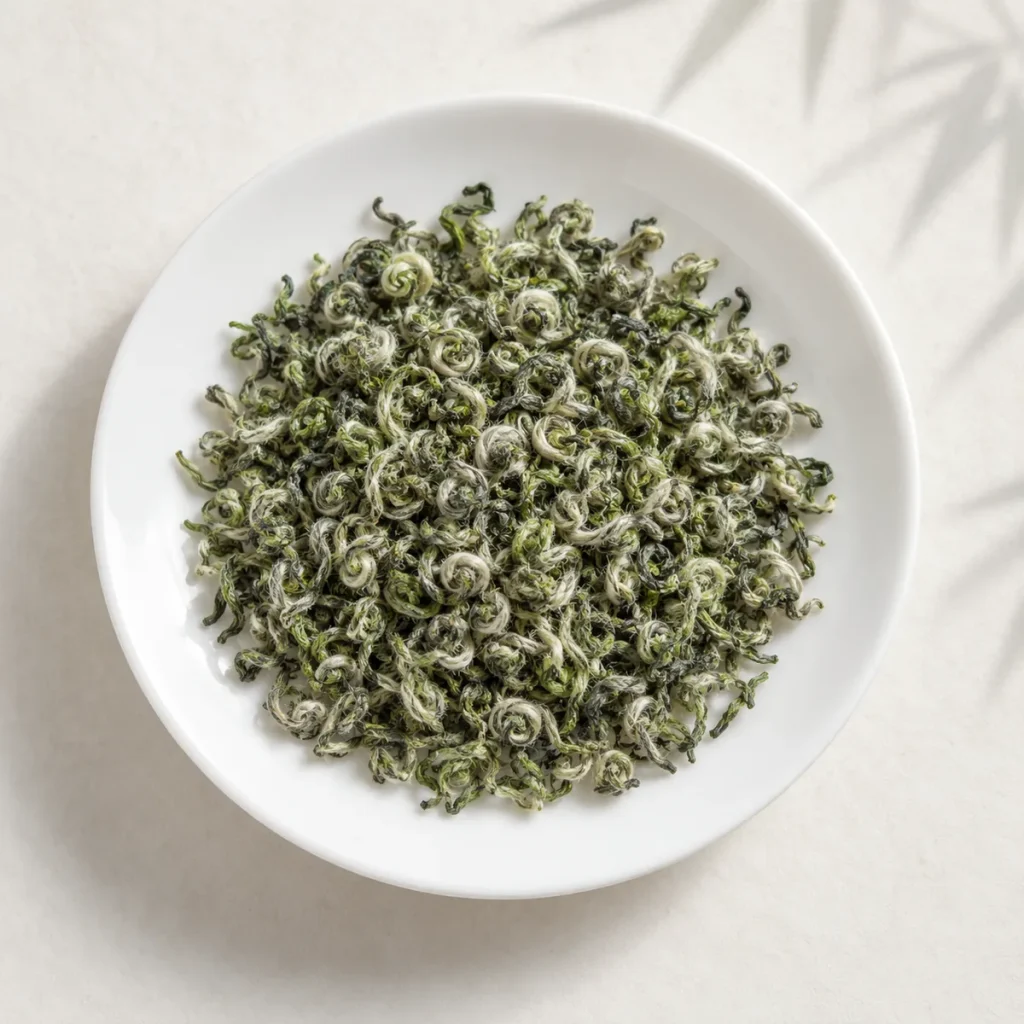
Dongting Biluochun is produced on Dongting East Hill and Dongting West Hill in Lake Tai, Suzhou, primarily from local small-leaf population tea plants grown in the traditional tea-fruit intercropping system. The finished tea is slender and tightly curled like a spiral, densely covered with fine hairs, and prized for a tender, clean aroma, a fresh mellow sweetness and the distinctive character of Jiangnan spring tea.

Origin
Lake Tai, Suzhou · Dongting East and West Hills
Harvest
Around Spring Equinox to before Grain Rain · tender buds and leaves
Craft
Heat-fixing · hot rolling · ball-rolling to raise hairs · low-fire drying
Aroma
Tender and clean · Persistent and elegant
Taste
Fresh, mellow and sweet · Clean with returning sweetness
Liquor
Bright tender green · Slight natural haze from fine hairs
Dry Leaf
Slender and tightly curledSilvery green with dense fine hairs
Liquor Color
Bright tender greenSlight natural haze from fine hairs
Aroma
Tender and cleanPersistent and elegant
Taste
Fresh, mellow and sweetClean with returning sweetness
Finish
Sweet, moist and salivatingLong after-aroma
Infused Leaf
Very tender with many budsLively tender green

Tea Overview

Tea Category
Green tea · curled pan-fired green tea
Cultivar
Primarily Dongtingshan small-leaf population plants
Grade
Special Grade 1 · Special Grade 2 · Grade 1 · Grade 2 · Grade 3
Harvest Period
Around Spring Equinox to before Grain Rain
Plucking Standard
Tender buds and leaves · meticulous sorting
Processing
Sorting → heat-fixing → hot rolling → ball-rolling to raise hairs → low-fire drying
Also Known As
Dongting (Shan) Biluochun Tea

Origin & Terroir

Dongting Biluochun grows on Dongting East Hill and Dongting West Hill in Lake Tai. The large lake moderates temperature and humidity, while tea bushes grow among loquat, bayberry, citrus, chestnut, plum and other fruit trees across hills and sheltered valleys. This creates one of the most distinctive tea-fruit intercropping systems among China's famous teas.

Origin
Wuzhong, Suzhou · Dongshan and Jinting
Altitude
Low-hill tea gardens around Lake Tai
Climate
Lake-moderated · warm and humid
Soil
Yellow-brown soils · red soils · rich organic matter
Landform
Lake-island hills · sheltered orchard valleys

Brewing

Top-drop method · water first, then teaWater first, then tea
Leaf Method
Top-drop method · water first, then tea
Teaware
Clear glass or white porcelain cup
Leaf Amount
About 3 g / 150 mL
Water Temperature
About 80–85°C
Tea-to-Water Ratio
About 1:50
Time
About 1–2 minutes
Infusions
About 3–5 infusions
Water
Clean, low-mineral drinking water
Brewing Steps · 4
  1. Warm the glass and let the water cool: Warm a clear glass, then fill it to about seventy percent with hot water and let the temperature fall to around 80–85°C.
  2. Add the tea from above: Gently place about 3 g of dry tea onto the water surface, avoiding a direct stream of water on the delicate hairy leaves.
  3. Watch and wait: Let the tea stand for about 1–2 minutes while the curled strands sink, open and release a fine natural haze of leaf hairs.
  4. Leave some liquor and refill: Refill when about one third of the liquor remains so later infusions continue smoothly.

Composition & the Body

Research includes finished-tea biochemical data from candidate Dongtingshan Biluochun lines and comparative studies of physicochemical and volatile compounds across Biluochun and other famous green teas.

Composition Profile

Verified · 2026-09-25
  1. 01
    Total amino acidsChawan 1: 4.22%; Chawan 7: 3.89%; Chawan 9: 4.15%
    Dry-leaf sample
  2. 02
    CaffeineChawan 1: 3.98%; Chawan 7: 3.64%; Chawan 9: 3.86%
    Dry-leaf sample
  3. 03
    Volatile compound profileIn the same study comparing Biluochun, Anji Baicha and Longjing, 20 shared volatile compounds were extracted and their relative abundances could help distinguish the three famous green teas.
    Dry-leaf sample

    Several alcohols, ketones and aldehydes in the shared profile are associated with floral and clean aromatic qualities.

The most reliable quantitative evidence currently comes from cultivar-line trials conducted with local Dongting material. These show differences in tea polyphenols, amino acids and caffeine among candidate lines, but they do not define fixed composition values for all Dongting Biluochun.

Candidate-line trials concern tea-plant resource selection within the Dongting origin area and do not establish legal composition standards for the product. A 2019 comparative study supports differences in physicochemical and volatile profiles among famous green teas, but its publicly available abstract does not provide all individual Biluochun values, so no missing values are invented. No tea-specific human evidence was included.

View Research Sources

洞庭碧螺春茶树品系比较试验及其栽培模式初步研究

阮旭 · 2011

Comparison among candidate Biluochun tea-plant lines within the same trial.

Total amino-acid levels differed among the three candidate lines, so the original point values are retained separately.

View Source

不同品种名优绿茶理化品质及挥发性成分分析

王海利, 杨秀芳, 孔俊豪, 成玉梁, 谢云飞, 姚卫蓉, 郭亚辉, 钱和 · 食品工业科技 · 2019

Biluochun, Anji Baicha and Longjing compared within the same study.

Tea polyphenols, the phenol-to-amino-acid ratio, ascorbic acid, EGCG and relative abundances of shared volatiles contributed to distinguishing the three famous green teas.

DOI: 10.13386/j.issn1002-0306.2019.18.035View Source

Tea Culture

Landscapes, people and history within a single leaf.

01

A Spiral of Spring

Dongting Biluochun is a Jiangnan famous tea with unusually clear geographical boundaries. The “Dongting” in its name does not refer to Dongting Lake in Hunan, but to Dongting East Hill and Dongting West Hill in Lake Tai, Suzhou. Current local protection regulations still make this explicit: only tea whose fresh leaves come from protected gardens in Dongshan and Jinting, primarily from Dongtingshan local small-leaf population plants and meeting the relevant cultivation and processing requirements, belongs within the protected-origin system for Dongtingshan Biluochun.

Its appearance is highly distinctive among Chinese green teas: the strands are slender, tightly curled like tiny spirals, densely covered with fine hairs, and silvery green with jade tones beneath. After high-grade tea enters the water, some of those hairs naturally suspend in the liquor and create a fine, even haze. This is not dirty or poorly clarified tea; it is a visual characteristic of very tender, hairy material. A 2024 sensory-evaluation group standard for Biluochun even introduced a dedicated term for this “hair haze” so the quality could be described more precisely.

Good Dongting Biluochun is not defined by appearance alone. Its core lies in the balance among tender aroma, freshness, mellow body and sweetness. The slender curled form provides visual identity, the fine hairs reflect raw-material tenderness, and the tea only becomes complete when the cup remains clean, fresh and gently sweet without excessive bitterness.

02

From “Frighteningly Fragrant” to Biluochun

Tea was grown on Suzhou's Dongting hills long before the name “Biluochun” appeared. National intangible-cultural-heritage materials trace Suzhou tea cultivation back to the Jin and Northern-Southern Dynasties, and Lu Yu's Tang-dynasty Classic of Tea already mentioned tea from Dongting Hill in Changzhou County. In the Northern Song, Zhu Changwen's Continuation of the Gazetteer of Wu Commandery recorded that “Dongting produces fine tea, formerly entered as tribute.” These references show that the Dongting hills of Lake Tai had a long tea-producing tradition before Biluochun received its later name.

The most widely circulated origin story for the name is connected with the phrase “xia sha ren xiang,” roughly “fragrance startling enough to shock people.” National heritage materials state that early Qing tea from Dongting was popularly known by that name. In the 38th year of the Kangxi reign (1699), during the emperor's southern tour of Lake Tai, the tea's green color, curled snail-like form and early-spring harvest were said to inspire the name “Biluochun.” This story is now one of the tea's central cultural memories and can be presented as local historical tradition without adding legendary details that lack reliable support.

In the modern period, Biluochun moved through several identities: local famous tea, national geographical-indication product and intangible cultural heritage. In 2011, the Biluochun making craft entered China's national list of representative intangible cultural heritage projects. In 2022, it became part of “Traditional tea processing techniques and associated social practices in China” on UNESCO's Representative List. The old tea culture of Lake Tai continues through modern public heritage systems.

03

Tea and Fruit by Lake Tai

The most distinctive terroir of Dongting Biluochun is not high elevation but the low-hill lake ecology created by Lake Tai together with the tea-fruit intercropping system. Dongting East Hill is surrounded by water on three sides, while Dongting West Hill stands within the lake. The large body of water continuously moderates temperature and humidity. The 2026 Dongtingshan Biluochun industry development plan describes the region as humid northern-subtropical monsoon climate, with an annual mean temperature near 16.5°C and annual rainfall around 1,200–1,400 mm, while the lake noticeably softens winter and summer extremes.

The hills and sheltered valleys add another layer of microenvironment. Natural yellow-brown soils, red soils and long-cultivated soils are relatively loose and rich in organic matter. More importantly, tea bushes rarely stand isolated in uniform monoculture. Loquat, bayberry, citrus, chestnut, plum and other fruit trees are interplanted among tea, their canopies producing varying degrees of shade and creating a multilayered agricultural ecosystem with tea bushes and surrounding vegetation.

Local tradition has long connected this environment with Biluochun's floral-fruity character, often saying that “tea absorbs fruit fragrance and fruit perfumes the tea.” Scientifically, it is better not to describe fruit-tree aroma as if it physically scents the tea in the manner of jasmine scenting. A more careful interpretation is that intercropping alters shade, humidity, soil conditions and biodiversity, while local cultivars, leaf maturity and traditional processing together shape the finished aroma.

04

Spring Made in a Single Pan

Traditional Dongting Biluochun pan-firing is a classic handcraft among curled green teas. From fresh leaf onward, the process includes sorting, spreading, high-temperature heat-fixing, hot rolling and shaping, ball-rolling to raise the fine hairs, and low-fire drying. National heritage materials describe the complete production sequence as picking, sorting, spreading, high-temperature heat-fixing, rolling and shaping, ball-rolling to raise hairs, and low-fire drying.

Once the tea enters the pan, these key steps are not fully separate. The traditional saying—“hands never leave the tea, tea never leaves the pan; rolling within firing and firing within rolling; continuous operation until the tea leaves the pan finished”—captures the way heat-fixing, rolling, shaping, hair-raising and drying flow into one another. Pan temperature, hand movement, force and timing all change as moisture leaves the leaf. During ball-rolling, the maker must curl the fine strands into spirals and bring the natural hairs to the surface without crushing the tender buds.

Low-fire drying brings the process to a close. Heat is gradually reduced so the tea can reach stable moisture while retaining green color and tender aroma. This continuous hand process demands considerable experience, which is why heritage protection is not simply about preserving a written sequence of steps, but also about preserving the maker's real-time judgment of pan temperature, leaf condition, moisture and hand feel.

05

Fine Hairs, Freshness and Sweetness

Four visual ideas are useful when evaluating Dongting Biluochun: fine, spiral, hairy and green. Higher-grade dry leaf should be slender and tightly curled, shaped like tiny snails, densely covered with fine hairs and silvery green with jade tones beneath. The white hairs are not an added material; they are natural trichomes on tender buds and leaves, made more visible during the ball-rolling stage. The higher the grade and the more tender the material, the more apparent they usually become.

The brewed liquor should be bright tender green, but it does not always look like perfectly filtered water. Fine hairs from high-grade tea can create a delicate, even natural haze. Aroma begins with tender, clean freshness, and fine material may show gentle floral-fruity notes. The taste should be fresh and mellow with natural sweetness, relatively restrained bitterness, and a clean, moist returning sweetness after swallowing.

The infused leaf should likewise reflect raw material and craft: higher grades should be very tender, bud-rich, soft, intact and lively green. Dry leaf that is blackened, coarse or loosely curled, liquor that is dull yellow, muffled aromas, or obvious burnt bitterness and rough astringency all depart from Dongting Biluochun's core direction of tenderness, freshness and sweetness.

06

Tea Life on East and West Hills

Dongting Biluochun remains closely interwoven with rural life around Lake Tai. Each early spring, growers on East and West Hills pick tender buds and leaves in repeated rounds. The fresh leaves then require time-consuming hand sorting before continuous pan-firing begins. Because the season is short, the material is very tender and the labor input high, the annual tea harvest reshapes daily life across the hills for an intense period.

The tea-fruit intercropping system extends Biluochun culture beyond tea processing alone. In 2020, the “Jiangsu Wuzhong Biluochun Tea-Fruit Intercropping System” was included among China's Important Agricultural Heritage Systems. The 2024 Suzhou protection regulation brought tea gardens, cultivars, branding, intangible heritage and agricultural heritage into one protection framework. The 2025 base-management measures further advanced surveys of planted area, unified coding and digital management, giving traditional tea gardens more complete modern records.

Hand-firing competitions, heritage transmission, spring opening ceremonies and tea-cultural tourism continue alongside these systems. On March 12, 2026, a new Dongtingshan Biluochun season formally opened at Shuiyuewu in Jinting. Such annual events have become part of Suzhou's cultural image of spring. The tradition no longer lives only in old tea books, but across gardens, households, markets and contemporary urban culture.

Frequently Asked Questions

Does the “Dongting” in Dongting Biluochun refer to Dongting Lake?
No. Dongting Biluochun comes from Dongting East Hill and Dongting West Hill in Lake Tai, Suzhou, Jiangsu, today within Dongshan and Jinting in Wuzhong District. It is not geographically related to Dongting Lake in Hunan.
What is the difference between Dongting Biluochun and other teas called Biluochun?
Dongting Biluochun is a protected-origin product under geographical-indication rules and local legislation. Its fresh leaves must come from protected tea gardens in Dongshan and Jinting and meet the relevant cultivar and processing requirements. Curled green teas made elsewhere and sold under the broader name “Biluochun” do not automatically qualify as Dongtingshan Biluochun.
How many grades does Dongting Biluochun have?
GB/T 18957—2008 divides Dongting (Shan) Biluochun into five grades: Special Grade 1, Special Grade 2, Grade 1, Grade 2 and Grade 3.
Why does Dongting Biluochun often show floral-fruity aromas?
Dongting tea gardens have long used tea-fruit intercropping, with tea growing alongside loquat, bayberry, citrus, chestnut, plum and other fruit trees. This system changes shade, humidity, soil and the biological environment. Together with local cultivars and traditional pan-firing, it helps shape the tea's characteristic clean and floral-fruity style.
What water temperature should I use for Dongting Biluochun?
Around 80–85°C is a good everyday range. Very tender higher-grade tea works especially well with the top-drop method: add water to the glass first, then gently add about 3 g of tea and begin drinking after roughly 1–2 minutes.
If Biluochun liquor looks slightly hazy, does that mean poor quality?
Not necessarily. Higher-grade Dongting Biluochun is rich in fine natural leaf hairs, and those hairs can create a delicate, even haze after brewing. This is different from dirty or particulate turbidity and is a recognized sensory characteristic of fine Biluochun.

Tea Conversations

Tea lovers from around the world meet over a cup of tea.

Sign in or register to join the conversation. Your comment account is created automatically the first time you use a connected account.