Skip to content
Tea & Realm
English

Junshan Yinzhen

Yellow tea · yellow-bud tea · needle-shaped Yueyang yellow tea

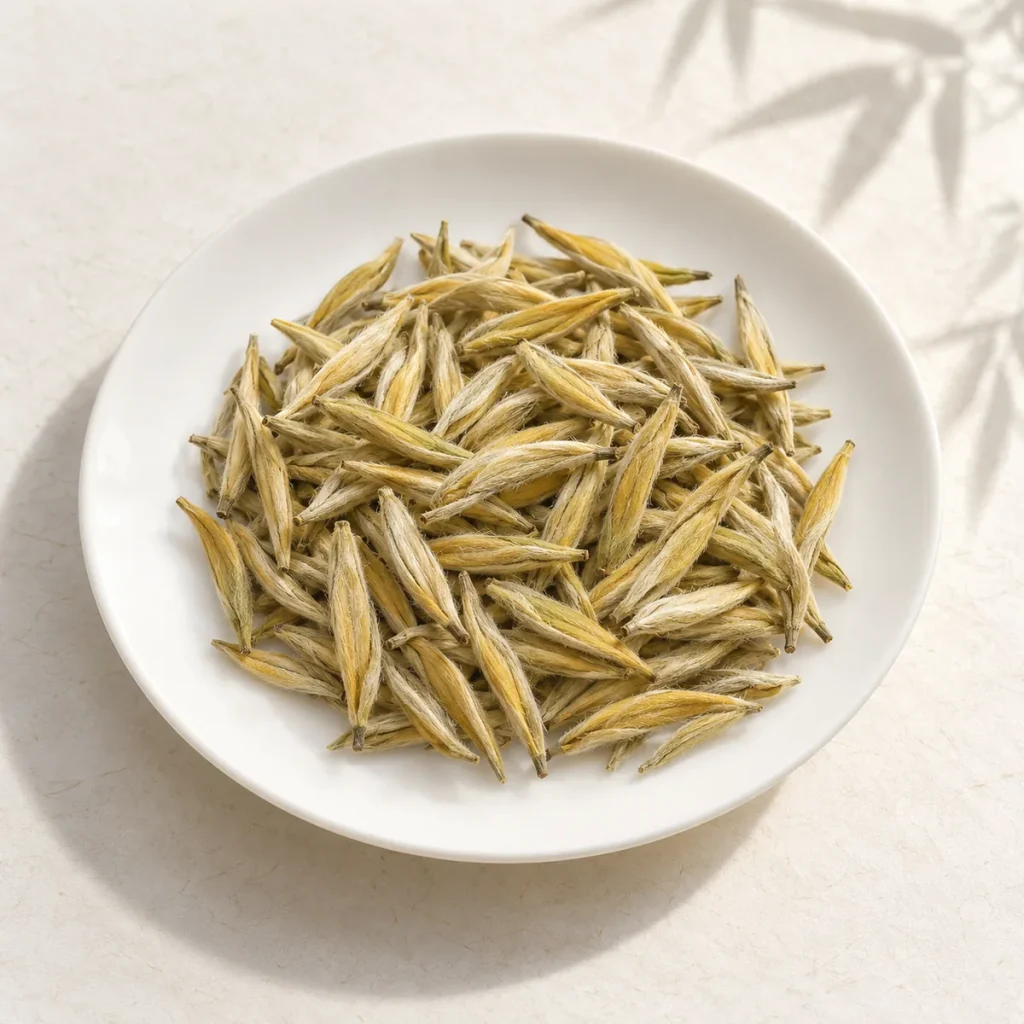
Golden buds wrapped in pale hairs · double menhuang · upright shoots like bamboo sprouts.

Junshan Yinzhen is Yueyang's most representative needle-shaped yellow-bud tea, made from spring tea buds with a short stem. The current standard divides it into Special Grade and Grade 1. Special Grade buds are full and show golden hairs, and more than 90% of the buds should stand upright in a glass after five minutes of brewing with boiling water. Traditional production centers on two menhuang stages, first wrapping and second wrapping. The finished tea is moist yellow with visible hairs, the liquor clear apricot-yellow, the aroma fresh and persistent, and the taste fresh, mellow and returning sweet.

Origin
Yueyang, Hunan · Junshan Island as the historical core
Harvest
First spring round of stemmed tea buds · single-bud style
Craft
Heat-fixing · first drying · first wrapping · re-drying · second wrapping · final firing
Aroma
Fresh and persistent · Pekoe and tender-bud aroma
Taste
Fresh, mellow and returning sweet · Sweet-brisk and gentle
Liquor
Clear apricot-yellow · Bright and transparent
Dry Leaf
Full plump budsMoist yellow with visible golden hairs
Liquor Color
Clear apricot-yellowBright and transparent
Aroma
Fresh and persistentPekoe and tender-bud aroma
Taste
Fresh, mellow and returning sweetSweet-brisk and gentle
Finish
Long sweet freshnessClean sweet aftertaste
Infused Leaf
Tender yellow and brightThick, plump buds

Tea Overview

Tea Category
Yellow tea · yellow-bud tea · needle-shaped Yueyang yellow tea
Cultivar
Yueyang medium- and small-leaf tea · no single cultivar required
Grade
Special Grade / Grade 1
Harvest Period
First spring buds · pre-Qingming as core timing
Plucking Standard
Spring stemmed single buds
Processing
Heat-fixing · first drying · first wrapping · re-drying · second wrapping · final firing
Also Known As
Golden-inlaid-jade (poetic epithet)

Origin & Terroir

The historical core of Junshan Yinzhen is Junshan Island in Dongting Lake and the traditional tea areas of Junshan District, but current product standards and the regional public-brand system extend to designated production areas across Yueyang. Legally, three identities need to be distinguished: the broader “Yueyang Yellow Tea” GI, the Junshan Yinzhen regional public brand, and the still-pending Junshan Yinzhen geographical-indication certification trademark.

Origin
Yueyang, Hunan · Junshan Island as historical core
Altitude
No independent unified legal value · Yueyang Yellow Tea GI 60–800 m
Climate
Humid Dongting Lake moisture · also includes high-mountain misty areas
Soil
GI: red/yellow-brown soils · pH 4.0–6.0
Landform
Lake island and waterside · also hills and mountains

Brewing

Tall clear glass for appearance · gaiwan also suitableWater first, then tea, then top up
Leaf Method
Tall clear glass for appearance · gaiwan also suitable
Teaware
Tall clear glass; white porcelain gaiwan also suitable
Leaf Amount
3 g
Water Temperature
90–95°C; near-boiling water can be used for the standard visual test
Tea-to-Water Ratio
About 1:50 (3 g / 150 mL)
Time
Glass about 3–5 min
Infusions
About 3–4 infusions
Water
Clean soft or low-mineral water
Brewing Steps · 4
  1. Warm the glass: Warm a tall clear glass and discard all warming water so the walls remain transparent.
  2. Add the tea: Use about 3 g of Junshan Yinzhen per 150 mL, leaving enough room for the needle-like buds to rise and fall.
  3. Pour and observe: For everyday drinking, use water around 90–95°C; for the standard visual effect, near-boiling water can be used so the buds roll, absorb water and gradually stand upright.
  4. Observe, then drink: After about 3–5 minutes, observe suspended and upright buds, then taste the clear apricot-yellow liquor with its fresh mellow returning sweetness.

Composition & the Body

Junshan Yinzhen has national intangible-cultural-heritage documentation, product standards and publicly cited physicochemical testing, but this batch did not obtain enough complete, field-auditable, tea-specific peer-reviewed composition research.

Available evidence is insufficient to build a tea-specific composition profile. Only verified basics and drinking notes are retained; unsupported values or effects are not added.

Composition Profile

Verified · 2026-09-26
Data in progress

No tea-specific featured composition data can be displayed safely at present.

This batch does not convert product-standard limits, secondary government references to historical test values or generic yellow-tea menhuang mechanisms into research-style Junshan Yinzhen composition records.

Tea-specific chemistry, aroma or metabolomics research can be added incrementally once suitable peer-reviewed Junshan Yinzhen studies are obtained.

Tea Culture

Landscapes, people and history within a single leaf.

01

What Exactly Is a “Silver Needle” Product Today?

Junshan Yinzhen's fame can easily obscure how clearly defined its modern product identity now is. T/YYSCX 006—2022 gives a very contemporary definition: spring stemmed tea buds from medium- and small-leaf tea trees grown within Yueyang, processed through heat-fixing, menhuang, drying and selection, with finished tea required to show yellow liquor, yellow buds and the characteristic upright needle form after brewing. The standard recognizes only Special Grade and Grade 1 and even incorporates upright-bud rate into sensory evaluation.

At the same time, “Yueyang Yellow Tea” already has national geographical-indication product and certification-trademark systems, while Junshan Yinzhen's own GI certification trademark was still under application in 2026. The most accurate positioning is therefore not “Junshan Yinzhen has an independent GI,” but “independent Junshan Yinzhen product standard + broader Yueyang Yellow Tea GI + Junshan Yinzhen regional public brand.”

02

Ancient Junshan Tea Does Not Need to Be Forced into Today's Needle-Shaped Yellow-Tea Definition

Tea history on Junshan Island is very old. Local documents, heritage materials and tribute-tea narratives trace Junshan tea back through the Tang and Song periods, with a stable memory of tribute tea in the Qing. But “Junshan has an ancient tea history” and “today's exact needle-shaped yellow-bud process has remained unchanged since antiquity” are not the same claim.

Tea processing changed over the centuries through steamed-green methods, loose tea, pan-firing and modern yellow-tea techniques. Modern Junshan Yinzhen, by contrast, has a sharply defined identity: robust needle buds, golden hairs on yellow leaves, double menhuang, apricot-yellow liquor and upright buds in the cup. This page therefore preserves the Tang–Song–Qing regional and tribute-tea history while treating modern product standards, the 2021 national heritage listing and the 2022 UNESCO inscription as separate modern institutional identities.

03

From Junshan Island to Today's Yueyang Regional Brand

Historically, Junshan Yinzhen is inseparable from Junshan Island in Dongting Lake. China's official intangible-cultural-heritage materials still treat Junshan Island, Xushi Town and nearby traditional tea areas as the main places where the craft is practiced. Water on all sides, humidity and lake mist form the classic ecological narrative.

Modern industry, however, no longer consists only of island gardens. T/YYSCX 006—2022 extends the raw-material range to medium- and small-leaf tea trees grown within Yueyang, and in 2025 Yueyang formally recognized Junshan Yinzhen regional public-brand planting areas covering 51 townships and 8 subdistricts. The site should therefore show both scales at once: Junshan Island as the historical and cultural core, and today's standardized Junshan Yinzhen as a regional brand jointly built across designated Yueyang production areas.

04

How “Double Menhuang” Turns Green Buds into Golden-Inlaid-Jade

The soul of Junshan Yinzhen is not the needle shape alone, but the warm-humid transformation that the buds undergo during two wrapping stages. The 2014 Yueyang Yellow Tea GI describes the silver-needle process as spreading, heat-fixing, cooling, first drying, cooling, first wrapping, re-drying, cooling, second wrapping and final drying. First and second wrapping each use their own controlled temperature and time ranges. The national intangible-cultural-heritage description organizes traditional handcraft into ten steps and calls the two wrapping stages “double menhuang.”

If menhuang is too light, the buds remain green; if too heavy, they darken. At the right point, the bud body turns moist yellow, green odor retreats and clean freshness develops into sweetness and mellowness. Pale outer hairs contrast with the golden bud beneath, creating the famous image described as “golden-inlaid-jade.”
05

The Standard Even Counts How Many Buds “Stand Up”

Many famous teas have beautiful movement in water, but Junshan Yinzhen is unusual in writing that visual behavior into a current product standard. T/YYSCX 006—2022 requires Special Grade to have full buds with visible golden hairs and a moist yellow appearance, fresh persistent aroma, fresh mellow returning sweetness and clear apricot-yellow liquor; after five minutes in boiling water, more than 90% of the buds should stand upright in the glass. For Grade 1 the threshold is more than 70%.

This turns expressions such as “three rises and three falls” or “a forest of bamboo shoots” from pure literary imagery into an observable quality characteristic. The representative cup image therefore needs to show genuinely upright single buds rather than ordinary yellow-bud tea placed loosely in a glass.

06

One of Yellow Tea's Most Direct National-Heritage-to-UNESCO Chains

Junshan Yinzhen has an unusually direct cultural-heritage identity. In 2021, Yellow Tea Making Craft (Junshan Yinzhen Tea Making Craft) entered China's fifth national list of representative intangible cultural heritage projects, item No. 1513, code VIII-267, safeguarded by the Junshan District Cultural Center in Yueyang.

In 2022, the craft became one of the 44 constituent elements of “Traditional tea processing techniques and associated social practices in China” on UNESCO's Representative List of the Intangible Cultural Heritage of Humanity, and it is the only yellow-tea making craft among those 44 elements. This UNESCO identity belongs to the making craft, not as an automatic “UNESCO certification” on every retail package, but unlike Beigang Maojian it can legitimately appear directly in this page's top-level heritage and UNESCO context.

Frequently Asked Questions

Is Junshan Yinzhen yellow tea or white tea?
It is yellow tea. It shares a needle-like bud appearance and the word “Yinzhen” with Fujian Baihao Yinzhen, but the tea category and processing are entirely different. Junshan Yinzhen undergoes heat-fixing and menhuang and is a needle-shaped yellow-bud tea; Baihao Yinzhen is white tea centered on withering and drying.
How many grades does Junshan Yinzhen have today?
T/YYSCX 006—2022 divides it into Special Grade and Grade 1. After five minutes of brewing with boiling water, more than 90% of Special Grade buds should stand upright in the glass; for Grade 1 the threshold is more than 70%.
Is Junshan Yinzhen made from single buds or one bud with one leaf?
Current product standard T/YYSCX 006—2022 defines the raw material as spring “stemmed tea buds,” and Yueyang's regional-brand text also calls it single-bud tea. The national intangible-cultural-heritage project page describes traditional raw material as “one bud with one leaf.” The two texts differ. This page prioritizes the current product standard and treats the product as stemmed single buds, while preserving the heritage wording in research context.
Why does Junshan Yinzhen show “three rises and three falls”?
As the buds absorb water, release air and change in density, they rise, sink and stand upright in the cup. The current product standard even includes upright-bud rate in sensory evaluation, so this is not only a visual legend but part of product-quality recognition.
Does Junshan Yinzhen already have its own independent GI product or certification trademark?
As of September 2026, it should not be summarized that way. The broader “Yueyang Yellow Tea” has been a nationally protected GI product since 2014 and has a certification-trademark system. Yueyang officials still stated in 2026 that registration work for the Junshan Yinzhen GI certification trademark was ongoing. Junshan Yinzhen already has its own product standard and regional public brand, but the pending trademark should not be described as registered.
Can today's Junshan Yinzhen only come from Junshan Island?
No. Junshan Island and traditional Junshan District tea areas are the historical core and the main heritage setting, but current T/YYSCX 006—2022 allows raw material from medium- and small-leaf tea trees grown within Yueyang, and in 2025 Yueyang formally recognized regional-brand planting areas covering 51 townships and 8 subdistricts. Junshan Island should therefore be presented as the historical core rather than the only current origin.
Is Junshan Yinzhen a national intangible cultural heritage and UNESCO project?
More precisely, Yellow Tea Making Craft (Junshan Yinzhen Tea Making Craft) entered China's national intangible-cultural-heritage list in 2021 and in 2022 became a constituent element of UNESCO's “Traditional tea processing techniques and associated social practices in China.” This is the identity of the making craft and should not be written as if every retail product automatically carries UNESCO certification.
Why is Junshan Yinzhen called “golden-inlaid-jade”?
Traditional heritage materials describe the bud body as glossy golden-yellow while pale hairs wrap the outside, creating a visual contrast between the golden bud and light-colored trichomes that inspired the poetic epithet “golden-inlaid-jade.”

Tea Conversations

Tea lovers from around the world meet over a cup of tea.

Sign in or register to join the conversation. Your comment account is created automatically the first time you use a connected account.