Skip to content
Tea & Realm
English

Baihao Yinzhen

White tea · bud-style white tea

Snowy silver hairs on whole buds, with a pale apricot liquor like early spring light.

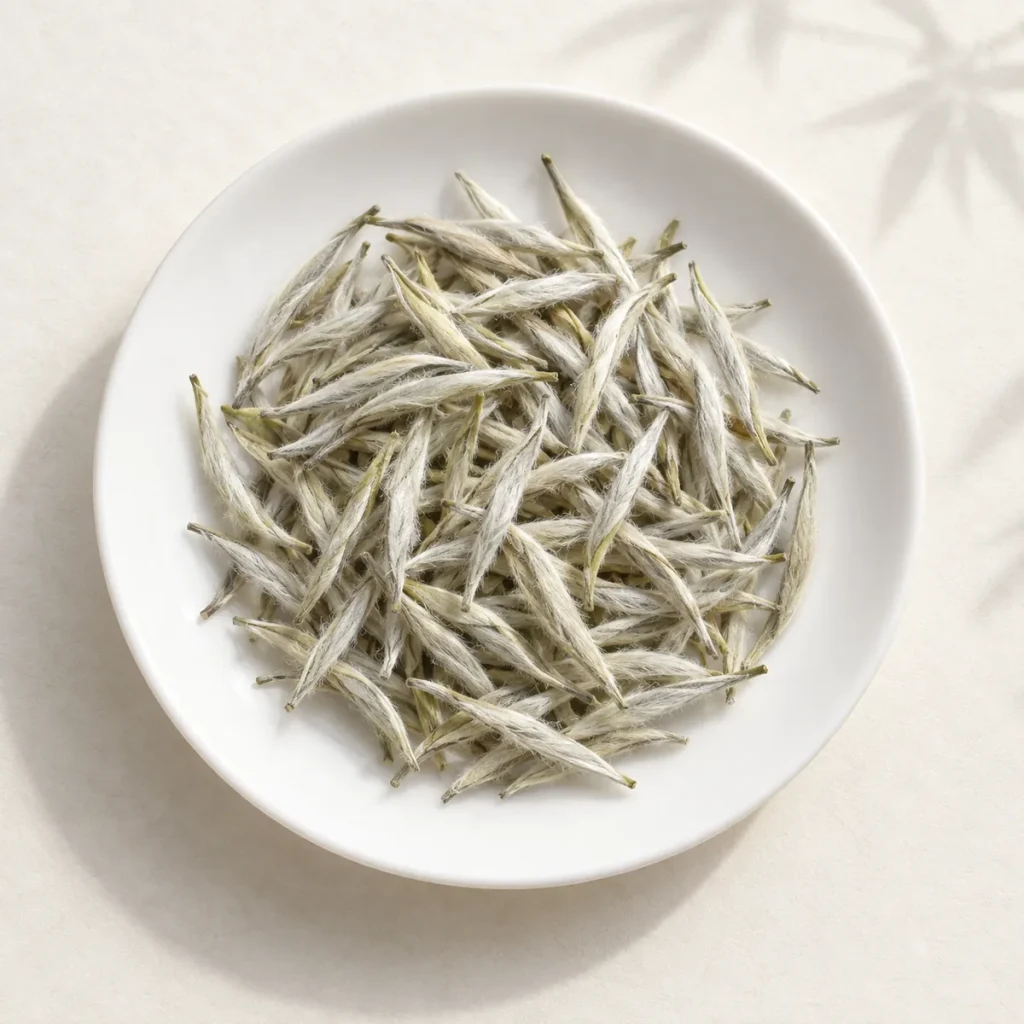
Baihao Yinzhen is a bud-style white tea made only from single buds. Under the current national standard, the raw material must be single buds from Dabai tea or Shuixian tea cultivars. Finished buds are plump, straight and needle-like, densely covered with silvery-white trichomes and a glossy silver-gray appearance. After brewing, the liquor is pale apricot-yellow, clear and bright, with a pure fresh aroma, distinct pekoe character, and a clean, mellow, brisk taste with pronounced fine-bud sweetness. The process appears simple—centering on withering and drying—but depends heavily on bud tenderness, spreading conditions, moisture loss and drying control.

Origin
Traditional core areas include Fuding and Zhenghe in Fujian
Harvest
Plump single buds · mainly early spring
Craft
Withering · drying · sorting · re-drying
Aroma
Pure, fresh and delicate · Distinct pekoe aroma
Taste
Clean, fresh and mellow · Pronounced fine-bud sweetness
Liquor
Pale apricot-yellow · Clear and bright
Dry Leaf
Plump needle-like budsDense silvery trichomes
Liquor Color
Pale apricot-yellowClear and bright
Aroma
Pure, fresh and delicateDistinct pekoe aroma
Taste
Clean, fresh and mellowPronounced fine-bud sweetness
Finish
Clean returning sweetnessLong fresh finish
Infused Leaf
Plump, soft and tenderLively and bright

Tea Overview

Tea Category
White tea · bud-style white tea
Cultivar
Dabai tea or Shuixian tea cultivars
Grade
Special Grade · Grade 1
Harvest Period
Mainly early-spring single buds · no fixed nationwide date
Plucking Standard
Intact single buds · direct plucking or bud separation
Processing
Withering → drying → sorting → homogenizing → re-drying
Also Known As
Silver Needle · Baihao
Aging
White tea can be stored under suitable conditions and undergo flavor change. NY/T 4859—2025, White Tea Storage Technical Specification, took effect on 2026-05-01. Age is not a quality grade for Baihao Yinzhen, and storage time alone does not guarantee quality improvement.

Origin & Terroir

Baihao Yinzhen is a nationally defined white-tea product type rather than a tea tied to one single geographical indication. Historically, the most important traditional production centers are Fuding and Zhenghe in Fujian, representing the coastal hills of northeastern Fujian and the inland mountains of northern Fujian respectively. This page therefore uses “traditional core areas” for geographic background and does not treat the climate, altitude or soil of one county as a universal standard.

Origin
Fuding and Zhenghe, Fujian · traditional core areas
Altitude
No single legal altitude · substantial hill and mountain variation
Climate
Humid subtropical · traditional areas differ in climate
Soil
Mostly acidic mountain soils · no nationwide uniform indicator
Landform
Coastal hills and inland mountains

Brewing

Glass cup or white porcelain gaiwan · 90–95°CWater first, then tea, then top up
Leaf Method
Glass cup or white porcelain gaiwan · 90–95°C
Teaware
Clear glass cup or white porcelain gaiwan
Leaf Amount
About 3–4 g / 150 mL
Water Temperature
90–95°C
Tea-to-Water Ratio
About 1:38–1:50
Time
Glass: about 2–3 min · gaiwan: start around 20–30 s
Infusions
About 4–6 infusions, or multiple top-ups in a glass
Water
Clean low- to medium-mineral drinking water
Brewing Steps · 4
  1. Warm the cup and admire the buds: Warm a glass cup or white porcelain gaiwan and empty it. Add Baihao Yinzhen and observe the plump needle-like buds and dense silvery trichomes.
  2. Cool the water slightly: Let freshly boiled water cool to about 90–95°C and pour gently along the wall, reducing harsh impact on the delicate buds and fine hairs.
  3. Wait for the buds to settle: In a glass, begin drinking after about 2–3 minutes. Watch the buds float, suspend and gradually sink as the liquor shifts from nearly colorless to pale apricot-yellow.
  4. Top up and follow the fine-bud character: Leave roughly one-third of the liquor before topping up, or extend gaiwan infusions gradually, following pekoe aroma, freshness, returning sweetness and the unfolding buds.

Composition & the Body

Baihao Yinzhen has direct research on aroma composition, terpene enantiomers, anthocyanin glycosides and storage metabolomics in specific cultivar contexts.

Composition Profile

Verified · 2026-09-26
  1. 01
    Aroma composition of Baihao YinzhenAlcohols accounted for 70.74% of the aroma extract. Major components included β-linalool and its oxides, geraniol, methyl salicylate, phenethyl alcohol and benzyl alcohol, with relative proportions of about 35.70%, 23.47%, 5.87%, 7.06% and 2.02% respectively.
    Dry-leaf sample
  2. 02
    Total anthocyanin glycosidesSpecial Grade Baihao Yinzhen: 83.80±3.64 μg/g; Grade 1: 88.70±8.62 μg/g.
    Dry-leaf sample
  3. 03
    Storage metabolome in Rucheng Baimaocha Baihao YinzhenA total of 349 differential metabolites were identified. Compared with one-year storage, seven-year samples showed overall increases in alkaloids, amino acids and derivatives, lipids, nucleotide derivatives, organic acids and terpenes, while flavonoids tended to decline.
    Dry-leaf sample

Alcohols and linalool-related compounds are important parts of its aroma profile. Anthocyanin glycosides differ by grade, and storage can significantly reshape the metabolome in specific Baihao Yinzhen made from Rucheng Baimaocha material.

Aroma percentages are relative abundances in study extracts. Anthocyanin values are retained as reported by grade. Findings from Rucheng Baimaocha must not be generalized to all Baihao Yinzhen.

View Research Sources

顶空固相微萃取-气质联用法分析白茶的香气成分

王力, 蔡良绥, 林智, 钟秋生, 吕海鹏, 谭俊峰, 郭丽 · 茶叶科学 · 2010

Finished Baihao Yinzhen samples in the study.

The volatile profile of Baihao Yinzhen differed clearly from green and black teas made from the same source material.

DOI: 10.13305/j.cnki.jts.2010.02.007View Source

白茶花青素苷的结构鉴定与分析

胡金祥, 叶钰珊, 蔡梅生, 张青碧, 李博, 吴媛媛, 屠幼英, 何普明 · 浙江大学学报(农业与生命科学版) · 2022

Special Grade and Grade 1 Baihao Yinzhen.

Anthocyanin-glycoside composition and total amount differed among white-tea product types and grades.

DOI: 10.3785/j.issn.1008-9209.2021.03.181View Source

贮藏时间对‘汝城白毛茶’白茶化学成分与滋味特征的影响研究

谢明威, 丁树洽, 聂晴, 周玲红, 文海涛, 蔡淑娴 · 茶叶科学 · 2025

Baihao Yinzhen made from Rucheng Baimaocha at different storage ages.

Storage significantly reshaped the metabolomic profile of Baihao Yinzhen made from this specific cultivar.

DOI: 10.13305/j.cnki.jts.20250319.001View Source

Tea Culture

Landscapes, people and history within a single leaf.

01

Silver Needles Covered in Pekoe

Baihao Yinzhen is the most minimal white tea in terms of raw material: only buds are used. GB/T 22291—2017 defines it as white tea made from single buds of Dabai tea or Shuixian tea cultivars through withering, drying and sorting.

The beauty of Special Grade Yinzhen comes entirely from the bud itself. The needles are plump, densely covered with white trichomes and glossy silver-gray. There is no flattening as in green tea and no rolling into strips as in black tea; processing aims to preserve the natural form of the fresh bud.

Once infused, the liquor remains restrained in color: pale apricot-yellow, clear and bright. The taste is clean, fresh, mellow and brisk. The so-called fine-bud or pekoe character is a delicate sweet-fresh sensation created jointly by the tender bud, its trichomes, internal compounds and white-tea processing.

02

The Early Making of Silver Needle

Modern Baihao Yinzhen took shape during the modern development of Fujian white tea. Historical investigations by Zhang Tianfu record that early Silver Needle was once made from buds of local population tea. After Fuding Dabai was discovered and propagated, around the 1880s producers began using its fuller, hairier buds to make more substantial Yinzhen, while Zhenghe later developed its own Silver Needle production.

Fuding and Zhenghe therefore both played major roles in shaping the historical identity of Baihao Yinzhen. Modern GB/T 22291 no longer divides grades according to old historical labels such as “northern route” and “southern route.”

03

Spring Buds of the Fujian Mountains

Baihao Yinzhen is often misunderstood as a tea from only one place. In fact, the national white-tea product standard does not restrict it to a single county, while the most important traditional historical centers are Fuding and Zhenghe in Fujian.

Fuding lies on the northeastern Fujian coast, while Zhenghe is in the inland mountains of northern Fujian. Buds from related Dabai tea material can show subtle differences in shape, aroma and liquor texture when grown in these distinct environments.

For that reason this page does not invent a single “standard altitude” or “standard soil pH.” For generic Baihao Yinzhen, the truly unified elements are single-bud raw material and white-tea processing.

04

No Firing, No Rolling

Baihao Yinzhen processing is often summarized as “no firing, no rolling.” That does not mean the tea is easy to make. Almost all quality change is concentrated in withering. Fresh buds are spread evenly and thinly, lose water slowly, shed grassy odor and undergo gentle transformation.

GB/T 32743—2016 permits natural, heated and combined withering. Once withering is appropriate, the tea is dried, then sorted, blended, homogenized and re-dried during refining. Because there is no rolling, tea juice is not forced out in large quantities. This helps explain the pale liquor, relatively slow extraction and delicate pekoe aroma.

05

Pekoe Aroma and Apricot Liquor

To judge Baihao Yinzhen, first look at the buds rather than how dark the liquor is. Special Grade requires plump needles with thick trichomes, good evenness and cleanliness. Grade 1 buds are relatively longer and more slender, with somewhat thinner trichomes.

Then smell for pekoe aroma. It often combines the freshness of tender buds with a soft sweet impression. Fine new tea can be very fresh without smelling raw or grassy, and it does not need loud floral perfume to be convincing.

Finally consider the liquor texture. Special Grade is described as clean, fresh, mellow and brisk with pronounced fine-bud character. Although the pale apricot liquor looks light, it should still show delicate body, fresh sweetness and returning sweetness. A small amount of suspended tea hair is natural and should not be mistaken for murkiness when the liquor is otherwise clear.

06

White Tea's First Needle

Baihao Yinzhen has become one of white tea's strongest visual symbols through its intact single buds and silvery white hairs.

Its cultural identity, however, requires separating product from place. Baihao Yinzhen itself is not a standalone national intangible-cultural-heritage project. The national project is White Tea Making Craft (Fuding White Tea Making Craft), announced in 2011 as VIII-203, No. 1183, with the Fuding Tea Industry Association as safeguarding unit. The Fuding craft includes products such as Baihao Yinzhen, but that does not make every Baihao Yinzhen from every origin part of this national project.

In 2022, Fuding White Tea Making Craft became part of “Traditional tea processing techniques and associated social practices in China” on UNESCO's Representative List. This page therefore treats it as related heritage rather than assigning the heritage and UNESCO status directly to Baihao Yinzhen itself.

Frequently Asked Questions

What type of tea is Baihao Yinzhen?
Baihao Yinzhen is a white tea and one of the four white-tea products defined by GB/T 22291—2017. It is made from single buds of Dabai tea or Shuixian tea cultivars.
Must Baihao Yinzhen be made entirely from single buds?
Yes. The national product definition requires single buds. Processing rules allow either direct plucking of single buds or plucking one-bud-one-leaf shoots and then separating the buds by a “drawing the needles” method.
How many grades does Baihao Yinzhen have?
Current GB/T 22291—2017 recognizes two grades: Special Grade and Grade 1. Special Grade has fuller buds, thicker trichomes and more prominent pekoe aroma.
Can Baihao Yinzhen only be produced in Fuding?
No. “Baihao Yinzhen” is a national product type and is not legally restricted to Fuding alone. Fuding and Zhenghe are the two most important traditional production centers.
Why is Baihao Yinzhen liquor so pale?
The tea is made without heat-fixing or rolling, so the bud cells are less disrupted and soluble compounds extract more slowly. Under the national standard, pale apricot-yellow, clear liquor is typical of Special Grade.
What water temperature should I use for Baihao Yinzhen?
For everyday drinking, about 90–95°C works well. In a clear glass, use about 3–4 g per 150 mL and begin drinking after 2–3 minutes; in a gaiwan, start around 20–30 seconds and extend gradually.

Tea Conversations

Tea lovers from around the world meet over a cup of tea.

Sign in or register to join the conversation. Your comment account is created automatically the first time you use a connected account.