Skip to content
Tea & Realm
English

Ya’an Tibetan Tea

Dark tea · post-fermented tea · Ya'an Tibetan Tea

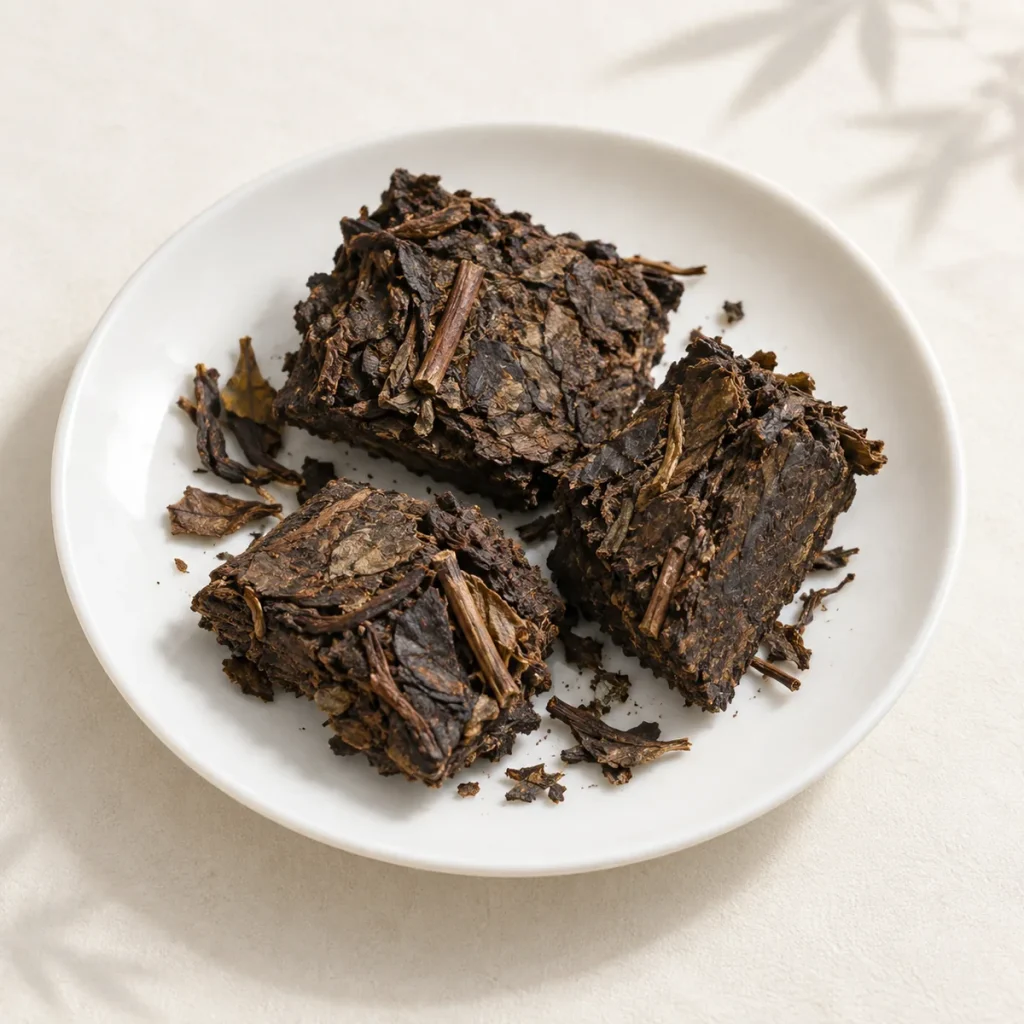
Glossy dark brown · warm aged aroma · mellow and returning sweet.

Ya'an Tibetan Tea is a representative dark tea from Ya'an, Sichuan. Modern products are made from Ya'an Tibetan Tea raw tea through refining, blending, drying or steam pressing and shaping, while continuing the heavily fermented and post-fermented technical lineage of Southern Route Border Tea. Current industry standards cover both finished Ya'an Tibetan Tea and its raw-material system. Typical quality ranges from dark brown to brown, with bright red to orange-red liquor, a pure aged aroma and a rich or mellow taste.

Origin
Ya'an, Sichuan · Ya'an Tibetan Tea GI certification-trademark region
Harvest
Raw tea from shoots within one bud and five leaves · commonly early summer to early autumn
Craft
Spreading · heat-fixing · rolling · baking/firing · wet piling · refining/steam pressing
Aroma
Pure aged aroma · Warm and substantial
Taste
Rich and returning sweet · Gentle and easy-drinking
Liquor
Bright clear red · Warm orange-red
Dry Leaf
Glossy dark brownFlat and tightly compressed
Liquor Color
Bright clear redWarm orange-red
Aroma
Pure aged aromaWarm and substantial
Taste
Rich and returning sweetGentle and easy-drinking
Finish
Sweetness develops graduallyLong aged resonance
Infused Leaf
Brown and softStems and leaves fairly intact

Tea Overview

Tea Category
Dark tea · post-fermented tea · Ya'an Tibetan Tea
Cultivar
Suitable Ya'an tea raw material · no single cultivar required
Grade
Maojian / Yaxi / Jinyu
Harvest Period
Commonly early summer to early autumn · depends on raw-material grade
Plucking Standard
Within one bud and five leaves · depends on raw-material grade
Processing
Spreading · heat-fixing · rolling · baking/firing · wet piling · refining/steam pressing
Also Known As
Tibetan Tea · Southern Route Border Tea (historical/traditional context, not fully identical standard names)
Oxidation / Fermentation
Ya'an Tibetan Tea belongs to a dark-tea post-fermentation system and should not be described with a fixed black-tea-style enzymatic oxidation percentage.
Aging
Ya'an Tibetan Tea has a long storage tradition, but quality depends on raw material, processing, moisture, packaging and storage environment. The page avoids the absolute claim “the older, the better.”

Origin & Terroir

The clearest current geographical-indication identity for Ya'an Tibetan Tea is the registered geographical-indication certification trademark “Ya'an Tibetan Tea,” not an old-style national GI product announcement. Sichuan market-regulation authorities confirm that both “Ya'an Tibetan Tea” and “Ya'an Southern Route Border Tea” have registered GI certification trademarks. The origin of Ya'an Tibetan Tea is generally described as covering two districts and six counties of Ya'an.

Origin
Ya'an, Sichuan · two districts and six counties
Altitude
No unified published legal value
Climate
Western basin edge · humid and rainy
Soil
Mountain tea gardens · no unverified hard values
Landform
Western basin edge · mountains and river valleys

Brewing

Gaiwan / clay pot / simmeringWater first, then tea, then top up
Leaf Method
Gaiwan / clay pot / simmering
Teaware
Gaiwan, clay teapot or heat-resistant simmering vessel
Leaf Amount
About 5–8 g
Water Temperature
95–100°C
Tea-to-Water Ratio
About 1:20–1:30 (editorial recommendation)
Time
First infusion about 15–25 s · can also be simmered
Infusions
About 6 or more, depending on the tea
Water
Clean drinking water
Brewing Steps · 4
  1. Take the tea: Work gently along the layers of compressed Tibetan Tea; measure loose tea directly and avoid excessive crushing.
  2. Warm the vessel: Warm the gaiwan, teapot or simmering vessel thoroughly with boiling water.
  3. Brew hot: Use 95–100°C water. Compressed tea can be rinsed briefly depending on storage condition.
  4. Decant promptly: Start around 15–25 seconds, then adjust according to strength and leaf opening. Later rounds can also be simmered.

Composition & the Body

Ya'an Tibetan Tea has direct studies tracking quality changes during manufacture and composition changes across different storage ages, supporting a tea-specific chemical profile centered on pile processing and subsequent aging.

Composition Profile

Verified · 2026-09-26
  1. 01
    Changes in major quality compounds during manufactureAfter fresh leaves were processed into Ya'an Tibetan Tea, catechins, tea polyphenols, free amino acids, caffeine and soluble sugars decreased by 69.88%, 46.39%, 68.53%, 25.85% and 7.11% respectively. Thearubigins, theaflavins and theabrownins increased to 24.33, 53 and 5.67 times their fresh-leaf levels respectively.
    Other sample
  2. 02
    TheabrowninsAs storage time increased from 4 to 10 years, theabrownins rose from 5.95 g/100 g to 8.54 g/100 g.
    Dry-leaf sample
  3. 03
    Total polyphenolsAcross 4–10 years of storage, total polyphenols declined significantly; total flavonoids, caffeine, total catechins and multiple catechin monomers also declined significantly.
    Dry-leaf sample

From fresh leaf to finished tea, catechins, tea polyphenols, free amino acids and caffeine decrease substantially while the tea-pigment system changes dramatically. During further storage, theabrownins rise while polyphenols, flavonoids, caffeine and catechins generally decline.

The existing canonical boundary is preserved strictly: generic dark-tea data, Southern Route Border Tea in general, low-fluoride border tea or single-company sample results are not generalized into fixed Ya'an Tibetan Tea composition. ABTS/DPPH results in the cited papers are in-vitro assays and are not entered as tea_specific_health_evidence.

View Research Sources

雅安藏茶制作工艺的品质变化

陈昌辉, 郭金龙, 汪艳霞, 杜晓, 赵涛, 赵正来 · 林产化学与工业 · 2011

Samples across the Ya'an Tibetan Tea process from fresh leaf to finished tea.

Ya'an Tibetan Tea processing substantially reshapes polyphenols, amino acids, caffeine and the tea-pigment system.

View Source

贮藏时间对雅安藏茶中活性成分及其抗氧化活性的影响

向卓亚, 夏陈, 朱永清, 罗棵濒, 邓俊琳, 陈建, 施刘刚 · 食品工业科技 · 2021

Ya'an Tibetan Tea samples with different storage ages.

Theabrownins increased significantly with storage age in the study.

DOI: 10.13386/j.issn1002-0306.2020080081View Source

Tea Culture

Landscapes, people and history within a single leaf.

01

Today's “Ya'an Tibetan Tea” Is No Longer Just a Traditional Border-Trade Brick

Ya'an Tibetan Tea and Southern Route Border Tea have deep historical continuity, but the modern standards system has expanded beyond one traditional brick form. GH/T 1120—2024 is the current direct industry product standard for Ya'an Tibetan Tea, while a 2024 local group standard further divides products into compressed, loose and bagged forms. Traditional Kangzhuan and Jinjian continue under their own national standards, and the new GH/T 1505—2025 Southern Route Border Tea came into force in 2026. The page therefore preserves the Tea Horse Road and border-tea tradition without treating “Ya'an Tibetan Tea,” “Southern Route Border Tea,” “Kangzhuan” and “Jinjian” as completely interchangeable standard names.

02

From Southern Route Border Tea to Ya'an Tibetan Tea: the Name Changed, but the Tea Horse Road Remained the Main Thread

Ya'an has long been an important eastern starting point of the Sichuan–Tibet Tea Horse Road and a major production center for Southern Route Border Tea. In the Qing period, “Southern Route Border Tea” mainly referred to border tea produced in Ya'an, Tianquan, Yingjing and related areas and shipped toward Kham and Tibet; in modern times it was also commonly called border-sales tea or Tibetan tea.

Today “Ya'an Tibetan Tea” has become a regional public brand and a modern product-standard name, while the national intangible-cultural-heritage project retains the historically more stable name Dark Tea Making Craft (Southern Route Border Tea Making Craft). This page therefore preserves the different historical contexts of the two names rather than projecting the modern brand name backward onto all historical records.

03

Ya'an Tibetan Tea's GI Identity Is a Certification Trademark, Not an Old-Style GI Product Announcement

Sichuan market-regulation authorities confirm that the geographical-indication certification trademarks “Ya'an Tibetan Tea” and “Ya'an Southern Route Border Tea” are both registered and support qualified enterprises in using the GI special mark. Public GI materials describe the Ya'an Tibetan Tea origin as two districts and six counties: Yucheng, Mingshan, Yingjing, Tianquan, Lushan, Baoxing, Hanyuan and Shimian.

The database therefore records Ya'an Tibetan Tea specifically as a “geographical-indication certification trademark,” avoiding the fabrication of an approval announcement as if it were a conventional national GI product.

04

Wet Piling Is Only One Stage of the Modern Standard; Traditional Southern Route Border Tea Preserves a More Complex Fermentation Lineage

GH/T 1448—2024 gives a clear raw-tea sequence: shoots within one bud and five leaves are spread, heat-fixed, first-rolled, first-dried or fired, re-rolled, second-dried or fired, wet-piled, and finally dried or fired to form dark rough tea. Finished tea is then refined, blended and dried, or steam-pressed according to product form.

The Southern Route Border Tea craft preserved as national intangible heritage places greater emphasis on heavy fermentation, post-fermentation, repeated fermentation, non-enzymatic fermentation and color-turning fermentation. These descriptions are not contradictory; they belong to different levels of language—modern standardization on one side and traditional craft knowledge on the other.

05

High-Grade Ya'an Tibetan Tea Is Not Simply “Coarse, Old and Very Dark”

The 2024 Ya'an Tea Society group standard describes the three quality grades—Maojian, Yaxi and Jinyu—quite clearly. High-grade compressed Maojian should have a flat surface, defined edges, a glossy dark-brown appearance, a rich aroma with aged notes, a full-bodied taste with returning sweetness and bright red liquor. Loose Maojian is characterized by relatively tight fine strips, a moist dark-brown appearance and deep bright red liquor. Lower grades may shift from bright red toward orange-yellow.

The page therefore does not illustrate every Tibetan Tea as huge coarse black stems in an opaque soy-sauce-dark liquor, but uses a higher-grade representative style of glossy dark-brown leaf and clear bright red liquor.

06

Its World-Heritage Identity Comes from Southern Route Border Tea Making Craft, Not from a Commercial Trademark

In 2008, Dark Tea Making Craft (Southern Route Border Tea Making Craft) entered China's second national intangible-cultural-heritage list, project code VIII-152, item No. 935. The current safeguarding institution is the Ya'an Intangible Cultural Heritage and Tea Horse Road Research and Protection Center. In 2022, the craft became a Sichuan constituent element of UNESCO's “Traditional tea processing techniques and associated social practices in China.”

The boundary must remain clear: UNESCO protects the making craft and related culture, not the “Ya'an Tibetan Tea” certification trademark itself.

Frequently Asked Questions

Are Ya'an Tibetan Tea and Southern Route Border Tea exactly the same concept?
They are very closely connected historically and technically, but they are not identical modern standard objects. Ya'an Tibetan Tea has the GH/T 1120—2024 product standard, while Southern Route Border Tea is covered by GH/T 1505—2025, effective in 2026, and the national intangible-cultural-heritage project uses the official name Southern Route Border Tea Making Craft.
What product forms does Ya'an Tibetan Tea have?
T/YACX 004—2024 divides Ya'an Tibetan Tea into compressed tea, loose tea and bagged tea. Compressed and loose tea are graded Maojian, Yaxi and Jinyu; bagged tea is ungraded.
Is Ya'an Tibetan Tea raw material always very coarse and mature?
No. GH/T 1448—2024 defines raw material as tea shoots within one bud and five leaves and also allows green rough tea to be converted into Tibetan dark rough tea through pile fermentation. Tenderness differs clearly among product grades.
What is the core fermentation process of Ya'an Tibetan Tea?
Modern raw-tea standards use wet piling or pile fermentation as post-fermentation technology. The traditional Southern Route Border Tea heritage system also includes heavy fermentation, repeated fermentation, non-enzymatic fermentation and color-turning fermentation.
Is Ya'an Tibetan Tea a national geographical-indication product?
The more accurate verified identity is the geographical-indication certification trademark “Ya'an Tibetan Tea.” Sichuan market-regulation authorities confirm that both this trademark and the “Ya'an Southern Route Border Tea” GI certification trademark are registered. They should not be rewritten as old-style national GI product announcements.
Are Kangzhuan and Jinjian the same as Ya'an Tibetan Tea?
They belong to the traditional Southern Route Border Tea/Tibetan Tea product lineage and are respectively covered by GB/T 9833.4—2013 Kangzhuan Tea and GB/T 9833.7—2013 Jinjian Tea. They are related to the modern GH/T 1120 Ya'an Tibetan Tea system but are not the same standard names.
Is Southern Route Border Tea Making Craft a national intangible cultural heritage and UNESCO element?
Yes. Dark Tea Making Craft (Southern Route Border Tea Making Craft) entered China's national intangible-cultural-heritage list in 2008 and in 2022 became a constituent element of UNESCO's “Traditional tea processing techniques and associated social practices in China.”
Does Ya'an Tibetan Tea have a China Important Agricultural Heritage System or FAO GIAHS identity?
As of 2026-09-22, this dedicated review did not verify a China Important Agricultural Heritage System or FAO GIAHS directly named for Ya'an Tibetan Tea or Southern Route Border Tea. Ya'an's Mount Mengding Tea Culture System does have China Important Agricultural Heritage status, but that identity must not be transferred to Ya'an Tibetan Tea.

Tea Conversations

Tea lovers from around the world meet over a cup of tea.

Sign in or register to join the conversation. Your comment account is created automatically the first time you use a connected account.