Skip to content
Tea & Realm
English

Ripe Pu’er Tea

Dark tea · Pu'er Tea (ripe) · post-fermented tea

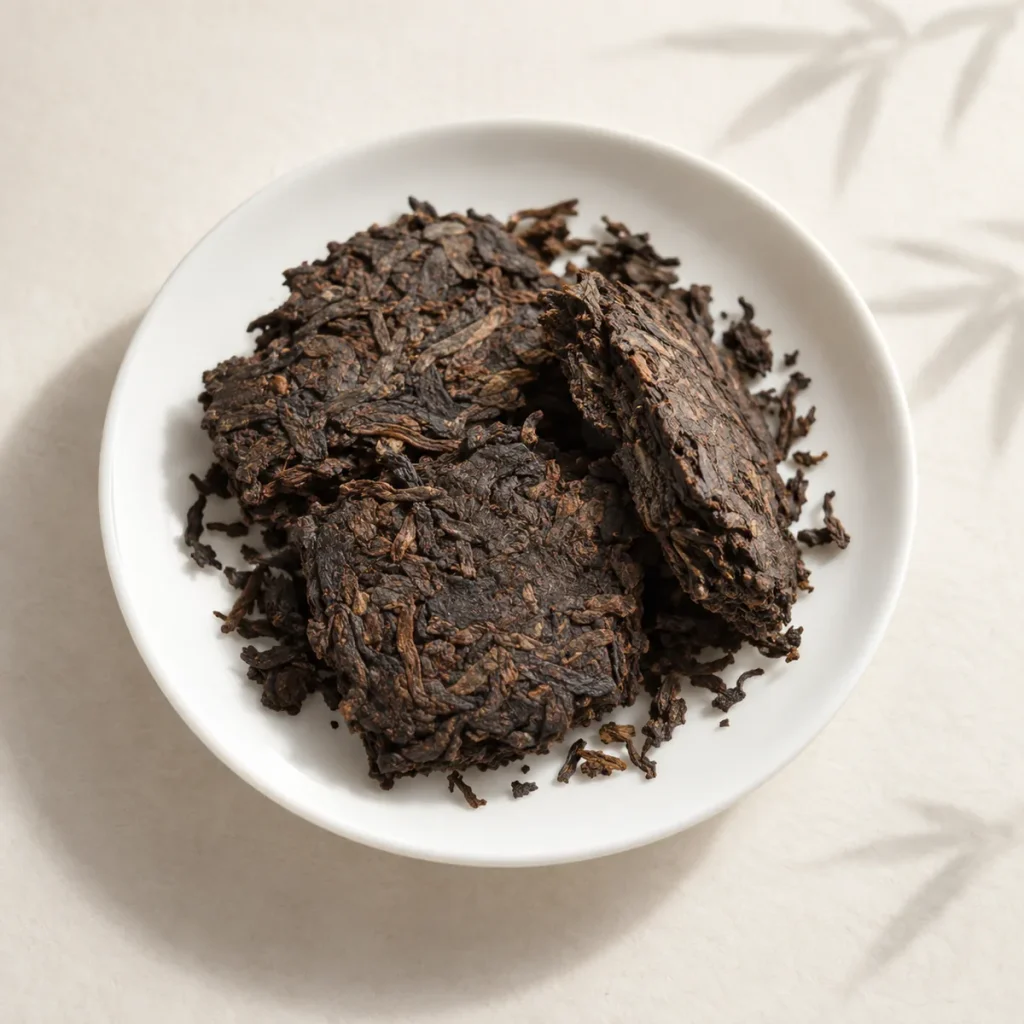
Glossy reddish-brown leaves · rich pure aged aroma · full-bodied and returning sweet.

Ripe Pu'er Tea is the post-fermented type within the Pu'er Tea geographical-indication system. It is made from sun-dried green tea of Yunnan large-leaf cultivars grown within the protected area and undergoes controlled artificial post-fermentation. The current national standard divides Pu'er Tea into raw and ripe types, with ripe tea available as loose or compressed tea. Its typical style is glossy reddish brown with a pure aged aroma, a bright deep-red liquor and a full, mellow taste with returning sweetness.

Origin
GI area across 11 prefecture-level regions of Yunnan · ripe Pu'er
Harvest
Yunnan large-leaf sun-dried green tea raw material · depends on raw-material grade
Craft
Sun-dried rough tea · artificial post-fermentation · drying · refining
Aroma
Rich pure aged aroma · Calm and deep
Taste
Full-bodied and returning sweet · Smooth and sweet
Liquor
Deep red and bright · Warm and translucent
Dry Leaf
Tightly twisted leavesGlossy reddish brown
Liquor Color
Deep red and brightWarm and translucent
Aroma
Rich pure aged aromaCalm and deep
Taste
Full-bodied and returning sweetSmooth and sweet
Finish
Long moist sweetnessAged resonance develops gradually
Infused Leaf
Reddish brown and softFairly even leaf texture

Tea Overview

Tea Category
Dark tea · Pu'er Tea (ripe) · post-fermented tea
Cultivar
Yunnan large-leaf cultivars
Grade
Loose tea: Special Grade, Grade 1–10 · compressed tea uses a different system
Harvest Period
Depends on the sun-dried rough-tea batch
Plucking Standard
Depends on sun-dried rough-tea grade
Processing
Sun-dried rough tea · artificial post-fermentation · drying · refining
Also Known As
Shu Pu (colloquial name)
Oxidation / Fermentation
Ripe Pu'er is post-fermented tea and should not be described by a fixed black-tea-style oxidation percentage.
Aging
Ripe Pu'er can continue to evolve under suitable storage, but not every tea improves simply with age. Cleanliness, humidity, ventilation, raw material and the initial fermentation degree all affect later quality.

Origin & Terroir

The direct geographical-indication object for Ripe Pu'er is “Pu'er Tea.” Announcement No. 60 of 2008 defined the protected area as parts of the current administrative territories of 11 prefecture-level regions in Yunnan: Kunming, Chuxiong, Yuxi, Honghe, Wenshan, Pu'er, Xishuangbanna, Dali, Baoshan, Dehong and Lincang.

Origin
GI area across 11 prefecture-level regions of Yunnan
Altitude
GI: 1,000–2,100 m
Climate
Low latitude, high elevation · diverse monsoon tea regions
Soil
GI: red/yellow soils · pH 4.5–6.0
Landform
Yunnan plateau mountains · river valleys

Brewing

Gaiwan / clay pot / simmeringWater first, then tea, then top up
Leaf Method
Gaiwan / clay pot / simmering
Teaware
Gaiwan, clay teapot or heat-resistant simmering vessel
Leaf Amount
About 5–8 g
Water Temperature
95–100°C
Tea-to-Water Ratio
About 1:20–1:30 (editorial recommendation)
Time
First infusion about 10–20 s · extend gradually
Infusions
About 6 or more, depending on the tea
Water
Clean drinking water
Brewing Steps · 4
  1. Take the tea: Measure loose tea directly; for compressed ripe tea, work gently along the natural layers.
  2. Warm the vessel: Warm the teaware thoroughly with boiling water.
  3. Brew hot: Use 95–100°C water. Older or tightly compressed tea can be rinsed briefly.
  4. Decant promptly: Start around 10–20 seconds and adjust later steeps according to strength, fermentation degree and how the leaves open.

Composition & the Body

Ripe Pu'er has direct research covering the full 0–56 day pile-fermentation process using non-volatile chemistry and metabolomics, clearly showing how catechins, flavonoids, caffeine and the broader metabolome change during post-fermentation.

Composition Profile

Verified · 2026-09-26
  1. 01
    Total catechinsTotal catechins were 163.65 mg/g at day 0 of pile fermentation and declined to 76.38 mg/g by day 56.
    Other sample
  2. 02
    CaffeineCaffeine rose continuously from day 0 through day 35, reached the highest value observed in the process at 29.25 mg/g on day 42, then gradually declined from day 49 to day 56.
    Other sample
  3. 03
    Non-volatile metabolome during pile fermentationAcross fermentation, 238 significantly differential metabolites were screened, with 154 upregulated and 84 downregulated. Catechins, flavonoids and some amino acids declined, while theabrownins increased alongside the change in liquor color from yellow-green toward reddish brown and the shift from fresh, slightly astringent taste toward mellowness.
    Other sample

Research shows large declines in total catechins and total flavonoids, while caffeine rises and then falls rather than changing in only one direction. Hundreds of differential metabolites participate in the development of reddish-brown liquor, reduced bitterness and a mellower taste.

All values are process time points from one fermentation batch. Values at day 0, the day-42 peak or the day-56 endpoint must not be presented as fixed composition for all Ripe Pu'er. No tea-specific human evidence is included here.

View Research Sources

基于代谢组学与化学计量法的普洱熟茶发酵过程中非挥发物质变化研究

沙艮, 王藤, 陈秋月, 伯年国, 赵松年, 蔺佳, 贺洁, 赵明, 马燕 · 中国酿造 · 2025

A single batch of sun-dried rough tea sampled throughout 0–56 days of pile fermentation for Ripe Pu'er.

Total catechins declined substantially through fermentation, consistent with reduced bitterness/astringency and a shift toward a mellower taste.

DOI: 10.11882/j.issn.0254-5071.2025.10.012View Source

Tea Culture

Landscapes, people and history within a single leaf.

01

Ripe Pu'er Is Not Simply “Raw Pu'er That Has Been Stored for a Long Time”

GB/T 22111—2008 clearly divides Pu'er Tea into raw and ripe types. The key to ripe tea is not storage time alone but post-fermentation. Long-aged raw Pu'er therefore cannot simply be equated with ripe tea under the national standard.

02

Pu'er Tea Is Ancient, but Modern Ripe Tea Is a Technology of the Late 20th Century

Pu'er Tea history is much older than modern ripe tea. The Yunnan Provincial Department of Agriculture and Rural Affairs explicitly notes that Ning'er tribute-tea making craft does not include the artificial post-fermentation process invented in the 1970s. More directly related to modern ripe tea is Dayi Tea Making Craft, whose core includes blending and fermentation.

03

Ripe Pu'er Is Not Exclusive to Pu'er City: the GI Spans Parts of 11 Yunnan Regions

The Pu'er Tea GI defined by Announcement No. 60 of 2008 spans parts of 11 prefecture-level regions in Yunnan. The standard requires sun-dried green tea from Yunnan large-leaf cultivars grown within the protected area and requires the specified processing to be completed within the protection system. Pu'er City is an important center, but it is not the only legal origin of Ripe Pu'er.

04

Pile Fermentation Is Not “Making the Tea Wet and Leaving It There,” but Controlled Post-Fermentation

GB/T 22111 defines post-fermentation as a transformation driven jointly by microorganisms, enzymes, warm moisture and oxidation. Modern artificial pile fermentation organizes these interacting factors into a more controllable and reproducible production stage.

05

Ripe Tea Should Not Be Reduced to “Black and Strong”: the Standard Emphasizes Deep Red, Aged Aroma and Full Mellowness

The sensory grading of ripe tea in GB/T 22111 centers on a moist brown appearance, aged aroma, bright deep-red liquor and a rich mellow taste with returning sweetness. This page therefore keeps the liquor deep red yet translucent and the dry leaf glossy reddish brown. Jujube, woody or sticky-rice-like aromas may occur in particular products, but they are not universal legally defined aromas for all ripe Pu'er.

06

For Ripe Tea, the Heritage Main Line Is Modern Fermentation Craft—not Forcing Tribute-Tea Craft onto It

Among the Pu'er Tea making crafts listed as national heritage in 2008, Dayi Tea Making Craft has the more direct relationship with modern ripe-tea fermentation. Official materials explicitly state that tribute-tea making craft does not include the artificial post-fermentation developed in the 1970s. Related Pu'er Tea making crafts became part of UNESCO's 2022 “Traditional tea processing techniques and associated social practices in China.”

The Pu'er Ancient Tea Plantations and Tea Culture System is both a China Important Agricultural Heritage System and a formally designated FAO GIAHS from 2012, but that heritage identity belongs to a specific regional agricultural system and does not mean that all Ripe Pu'er comes from that site.

Frequently Asked Questions

Is Ripe Pu'er Tea a dark tea?
Within the six-tea-category structure of this website, it is generally placed under dark tea and post-fermented tea. The national standard, however, uses “Pu'er Tea” as the geographical-indication product name and divides it internally into raw and ripe types.
What is the most important difference between ripe and raw Pu'er?
Ripe tea undergoes artificial post-fermentation to form its characteristic quality; raw tea does not undergo the same artificial ripe-tea post-fermentation process.
How many grades does Ripe Pu'er have?
GB/T 22111—2008 divides loose ripe tea into Special Grade and Grade 1 through Grade 10, a total of 11 grades. Compressed ripe tea does not directly use that loose-tea grading system.
Can Ripe Pu'er only be produced in Pu'er City?
No. The Pu'er Tea GI protection area includes parts of 11 prefecture-level regions in Yunnan.
Which national intangible-cultural-heritage project is most directly related to modern Ripe Pu'er?
Pu'er Tea Making Craft (Dayi Tea Making Craft) is the most directly related to modern ripe-tea artificial fermentation. Official descriptions explicitly state that tribute-tea making craft does not include the artificial post-fermentation developed in the 1970s.
Is the Pu'er Ancient Tea Plantations and Tea Culture System a formally designated FAO GIAHS?
Yes. It received formal FAO GIAHS recognition in 2012 and is also a China Important Agricultural Heritage System, but it does not mean every Ripe Pu'er product comes from that heritage area.
Does Pu'er Tea have geographical-indication protection in the European Union?
Yes. Pu'er Tea is registered in the EU as Pu'er Cha, PGI-CN-2668.
Does the Jingmai Mountain World Heritage identity apply to all Ripe Pu'er?
No. The Cultural Landscape of Old Tea Forests of the Jingmai Mountain in Pu'er, inscribed as World Heritage in 2023, is a specific cultural landscape and cannot be automatically applied to all Ripe Pu'er products.

Tea Conversations

Tea lovers from around the world meet over a cup of tea.

Sign in or register to join the conversation. Your comment account is created automatically the first time you use a connected account.