Skip to content
Tea & Realm
English

Guangxi Liubao Tea

Dark tea · post-fermented tea · Liubao Tea

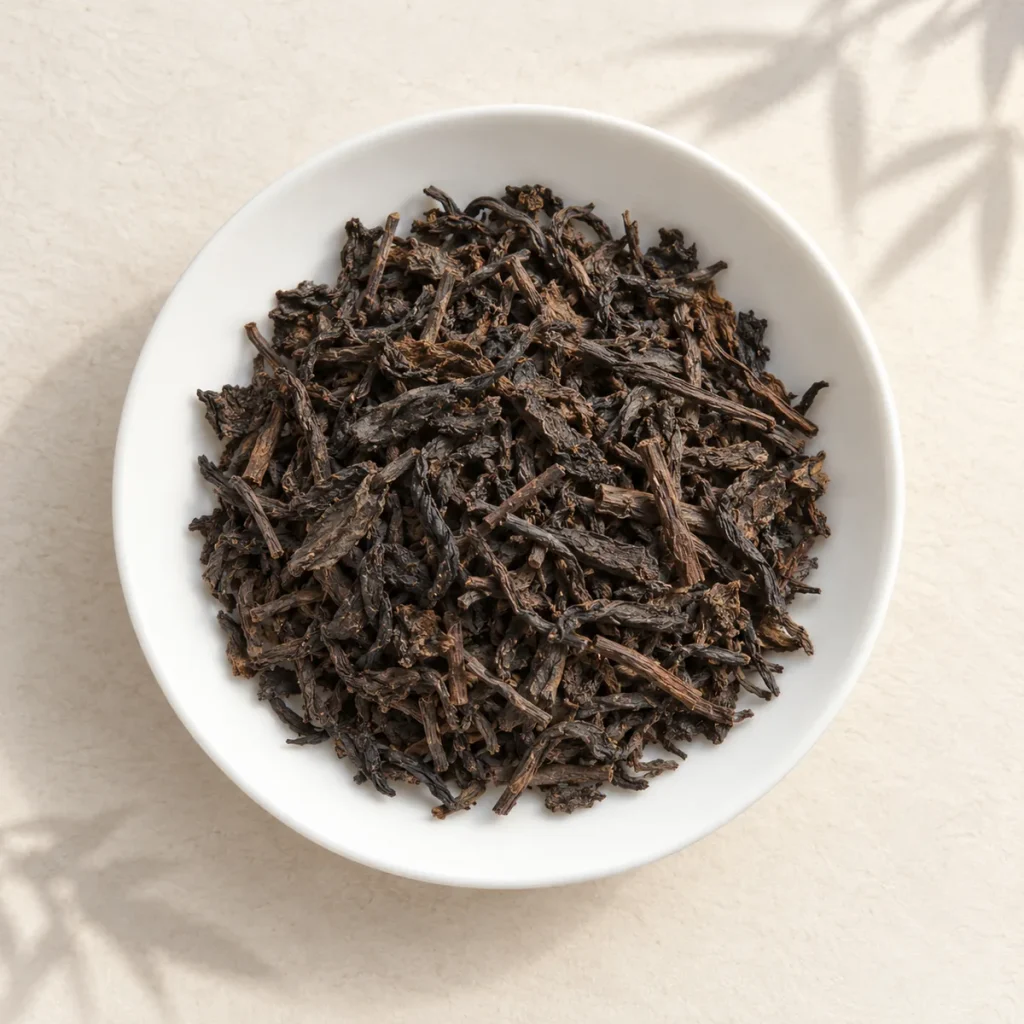
Glossy dark-brown leaves · pure aged aroma · rich, mellow and sweet-brisk.

Guangxi Liubao Tea is a representative dark tea with Liubao in Wuzhou as its historical core and a broad production system across Guangxi. The national geographical-indication product “Liubao Tea” is protected within the current administrative territory of Wuzhou, while the agricultural geographical indication “Guangxi Liubao Tea” covers a wider area. Finished tea is commonly glossy dark brown, with bright red liquor, a pure aged aroma and a rich mellow taste. Well-aged traditional products may develop the distinctive betel-nut aroma for which Liubao is famous.

Origin
Guangxi · Wuzhou as the historical and GI core
Harvest
One bud with one leaf to three or four leaves · depends on grade and process
Craft
Spreading · heat-fixing · rolling · piling · refining · aging
Aroma
Pure aged aroma · Calm and deep
Taste
Rich, mellow and sweet-brisk · Smooth and gentle
Liquor
Bright clear red · Warm amber tone
Dry Leaf
Tightly twisted leavesGlossy dark brown
Liquor Color
Bright clear redWarm amber tone
Aroma
Pure aged aromaCalm and deep
Taste
Rich, mellow and sweet-briskSmooth and gentle
Finish
Moist sweetness continuesAged resonance develops gradually
Infused Leaf
Red-brown and softStems and leaves fairly even

Tea Overview

Tea Category
Dark tea · post-fermented tea · Liubao Tea
Cultivar
Cangwu population cultivars · Guangxi medium/large-leaf types and others
Grade
Special Grade / Grade 1 / Grade 2 / Grade 3 / Grade 4
Harvest Period
Multiple seasons · depends on grade and process
Plucking Standard
One bud with one leaf to three or four leaves
Processing
Spreading · heat-fixing · rolling · piling · refining · aging
Also Known As
Liubao Tea · Wuzhou Liubao Tea (regional-brand context)
Oxidation / Fermentation
It belongs to the dark-tea post-fermentation system and should not be described by a fixed black-tea-style enzymatic oxidation percentage.
Aging
Aging is an important quality-forming stage. DB45/T 2437—2022 regulates warehouse management, and the 2026 autonomous-region regulation requires temperature/humidity control, ventilation, hygiene and traceability. This page avoids “the older, the better” and emphasizes that raw material, process and storage jointly determine aging quality.

Origin & Terroir

Liubao Tea has two geographical-indication ranges that must remain separate. The 2011 geographical-indication product “Liubao Tea” is protected within the current administrative territory of Wuzhou. The 2020 agricultural geographical indication “Guangxi Liubao Tea” covers multiple cities and counties across Guangxi. This page treats the former as the direct product GI and records the latter alongside it as a separate agricultural GI.

Origin
Guangxi · Wuzhou as historical and GI core
Altitude
Liubao Tea GI: ≥100 m
Climate
Humid subtropical · warm and rainy
Soil
GI: red-yellow/lateritic red soils · pH 4.2–6.5
Landform
Eastern Guangxi hills · Xijiang River system

Brewing

Gaiwan / clay pot / simmeringWater first, then tea, then top up
Leaf Method
Gaiwan / clay pot / simmering
Teaware
Gaiwan, clay teapot or heat-resistant simmering vessel
Leaf Amount
About 5–8 g
Water Temperature
95–100°C
Tea-to-Water Ratio
About 1:20–1:30 (editorial recommendation)
Time
First infusion about 10–20 s · can also be simmered
Infusions
About 6 or more, depending on the tea
Water
Clean drinking water
Brewing Steps · 4
  1. Warm the vessel: Warm the gaiwan, teapot or simmering vessel thoroughly with boiling water.
  2. Add the tea: Use about 5–8 g according to vessel size and tea age. Loose tea does not need to be broken excessively.
  3. Brew hot: Use 95–100°C water. Older or long-stored tea can be rinsed briefly.
  4. Decant promptly: Start around 10–20 seconds, then extend gradually according to strength and leaf opening. Later rounds can also be simmered.

Composition & the Body

Liubao Tea has direct research on non-volatile composition before and after refining, continuous aging metabolomics, and tea-specific human drinking interventions.

Composition Profile

Verified · 2026-09-26
  1. 01
    Tea polyphenols7.05 %
    Dry-leaf sample
  2. 02
    Non-volatile metabolome before and after refiningAcross Liubao Tea and its rough-tea raw material, 569 compounds were identified and 146 differential metabolites were screened. In finished Liubao Tea, 32 metabolites were upregulated and 114 downregulated, with significant declines in multiple taste- and color-related compounds including catechins, amino acids, theaflavins and flavonoid glycosides.
    Dry-leaf sample
  3. 03
    Non-volatile metabolome during agingFrom unaged tea through six months of aging, tea polyphenols, free amino acids, caffeine and flavonoids generally declined while theabrownins increased significantly. A total of 164 non-volatile compounds were identified and 48 key differential metabolites screened, with 9 upregulated and 39 downregulated.
    Dry-leaf sample

During post-fermentation, refining and aging, tea polyphenols, amino acids, catechins, flavonoids, caffeine and tea-pigment systems continue to change. Research values can therefore be shown only when the raw-material/finished-product context and aging stage are kept explicit.

All values come from specific study groups or aging stages and do not represent fixed composition for every Liubao Tea. Human research is presented only according to its actual design: both groups received Liubao-tea interventions, so it must not be described as a placebo-controlled tea-vs-no-tea trial.

View Research Sources

六堡茶及其原料毛茶的非挥发性成分差异分析

杨应, 马婉君, 尤秋爽, 杨高中, 林智, 吕海鹏 · 食品工业科技 · 2025

Finished Liubao Tea group compared in the same study with its rough-tea raw-material group.

Tea polyphenols in the finished Liubao group were 7.05±1.48%, significantly lower than 18.00±0.86% in the raw rough-tea group. This is a study-group statistic rather than a universal product value.

DOI: 10.13386/j.issn1002-0306.2024070306View Source

六堡茶陈化过程中非挥发性成分的变化规律

龙志荣, 张悦, 邱北连, 杨应, 杨高中, 农寿华, 林智, 吕海鹏 · 食品科学 · 2026

Liubao Tea sampled before aging and continuously from 1 to 6 months of aging.

Aging time continuously changes the non-volatile profile of Liubao Tea, so time in storage must remain part of the context for interpreting composition values.

DOI: 10.7506/spkx1002-6630-20251117-118View Source

Tea Culture

Landscapes, people and history within a single leaf.

01

“Liubao Tea” and “Guangxi Liubao Tea” Do Not Share One Geographic Boundary

Liubao Tea today exists under several institutional identities. The “Liubao Tea” protected by Announcement No. 33 of 2011 is a geographical-indication product whose legal area is the current administrative territory of Wuzhou. The agricultural geographical indication “Guangxi Liubao Tea,” registered in 2020, covers multiple cities and counties across Guangxi. The Guangxi Liubao Tea Development Regulation, effective in 2026, defines the industry at the autonomous-region level.

Cha Yu Jing therefore retains “Guangxi Liubao Tea” as the page name, but the database keeps the Liubao Tea GI, the Guangxi Liubao Tea agricultural GI and the broader regional industry concept as separate objects. The wider agricultural-GI range must not be allowed to overwrite the legal boundary of the Wuzhou Liubao Tea GI.

02

From Liubao Town to the Tea Boat Road: Why It Became an Overseas Chinese Trade Tea

Liubao Tea takes its name from Liubao Town in Cangwu County. Qing local gazetteers already record tea production in Liubao and describe its mellow taste. In modern times, tea traveled from the Liubao River into the Xijiang system, then through Guangzhou, Hong Kong and Macao to Southeast Asia, forming the famous Tea Boat Road and a strong history of overseas Chinese trade.

Modern Liubao processing later evolved through traditional hand primary manufacture, basket aging and more standardized modern pile-fermentation refining. This page therefore does not project every present-day standardized process backward into antiquity, but separates Liubao Town's origin culture, its export network and modern industrial processing.

03

Wuzhou Is the Historical Core, but Today's “Guangxi Liubao Tea” Is Broader

The hills of eastern Guangxi, the Xijiang River system and the humid subtropical environment around Liubao Town form the classic terroir narrative of Liubao Tea. The Liubao Tea GI technical requirements impose elevation, soil pH and organic-matter conditions within the Wuzhou protected area, while the 2020 Guangxi Liubao Tea agricultural GI expands planting and production into multiple Guangxi cities and counties.

The 2026 autonomous-region regulation likewise uses wording centered on “Guangxi local population cultivars represented by Wuzhou Liubao and other areas,” preserving Liubao as the historical core while acknowledging that the contemporary Guangxi industry has expanded geographically.

04

Traditional and Modern Liubao Tea Share a Name but Do Not Follow Exactly the Same Route

Liubao Tea is easily oversimplified into one “pile-ferment then age” process, but current regional standards explicitly distinguish traditional and modern refining. Primary manufacture typically includes spreading, heat-fixing, first rolling, piling, re-rolling and drying. Traditional refining may rely mainly on screening, blending, steaming, pressing and aging, while modern refining commonly adds pile fermentation and opening/cooling.

The national intangible-cultural-heritage tradition preserves the older Cangwu Liubao making route, while today's Liubao industry has developed more standardized control over fermentation, warehousing and aging.

05

“Red, Rich, Aged and Mellow” Is Classic, but Not Every Liubao Must Taste the Same

Liubao Tea has long been famous for the phrase “red, rich, aged and mellow” and for betel-nut aroma, yet different raw materials, traditional or modern processes, storage and aging periods produce clear variation. During Guangxi's 2025 legislative review, language that would have turned “red, rich, aged and mellow” into a universal legal definition was specifically removed because not every product shows those traits in exactly the same way.

This page therefore uses more stable standard features—dark-brown twisted leaves, bright red liquor, aged aroma and rich mellow taste—as the main sensory profile. Betel-nut aroma is presented as a representative aroma that may emerge in well-aged or specific traditional products, not as something every infusion must display.

06

National Heritage, UNESCO and Agricultural Heritage: Three Different Cultural Lines

In 2014, Dark Tea Making Craft (Liubao Tea Making Craft) entered the fourth batch of national intangible-cultural-heritage extension projects, project code VIII-152, with the Cangwu County Cultural Center as safeguarding unit. In 2022 it became a Guangxi constituent element of UNESCO's “Traditional tea processing techniques and associated social practices in China.”

Separately, the Guangxi Cangwu Liubao Tea Culture System entered China's seventh batch of Important Agricultural Heritage Systems in 2023 and entered China's third GIAHS tentative list in 2025. Tentative-list status is not the same as formal FAO GIAHS designation.

Frequently Asked Questions

Are Liubao Tea and Guangxi Liubao Tea the same geographical indication?
Not exactly. The 2011 Liubao Tea geographical-indication product is protected within the current administrative territory of Wuzhou. The 2020 Guangxi Liubao Tea agricultural geographical indication covers multiple cities and counties in Guangxi. The two systems need to be recorded separately.
How many grades does Liubao Tea have?
DB45/T 1114—2014 divides both loose and compressed Liubao Tea into five grades: Special Grade, Grade 1, Grade 2, Grade 3 and Grade 4.
What is the difference between traditional and modern Liubao processing?
Both begin with Liubao rough tea, but traditional refining places more emphasis on screening, blending, steaming or pressing and aging, while modern refining commonly adds pile fermentation and opening/cooling. Standards should use the terms “traditional process” and “modern process” rather than mechanically relabeling them raw and ripe.
Does every Liubao Tea have betel-nut aroma?
No. Betel-nut aroma is a famous traditional Liubao profile, especially in certain raw materials, processes and aging conditions, but it should not be written as a mandatory universal aroma for every Liubao product.
Is Liubao Tea a national geographical-indication product?
Yes. Former AQSIQ Announcement No. 33 of 2011 approved geographical-indication product protection for Liubao Tea, with the legal protected area covering the current administrative territory of Wuzhou, Guangxi.
Is Liubao Tea Making Craft a national intangible cultural heritage and UNESCO element?
Yes. Dark Tea Making Craft (Liubao Tea Making Craft) entered China's national intangible-cultural-heritage extension list in 2014 and became a Guangxi constituent element of UNESCO's 2022 “Traditional tea processing techniques and associated social practices in China.”
Is the Guangxi Cangwu Liubao Tea Culture System an FAO GIAHS?
Not at present. It is a China Important Agricultural Heritage System and entered China's GIAHS tentative list in 2025. Tentative-list status is not formal FAO designation.
Did the 2026 Guangxi Liubao Tea Development Regulation expand the Liubao Tea GI to all of Guangxi?
No. The regulation governs Liubao-tea industry development within the Guangxi autonomous region, but it does not automatically expand the legal protection area of the 2011 Liubao Tea geographical-indication product from Wuzhou to the whole of Guangxi.

Tea Conversations

Tea lovers from around the world meet over a cup of tea.

Sign in or register to join the conversation. Your comment account is created automatically the first time you use a connected account.