Skip to content
Tea & Realm
English

Anhua Fuzhuan Tea

Dark tea · Fu tea · flowering compressed tea

Abundant golden flowers · pure fungal-floral aroma · rich and mellow sweetness.

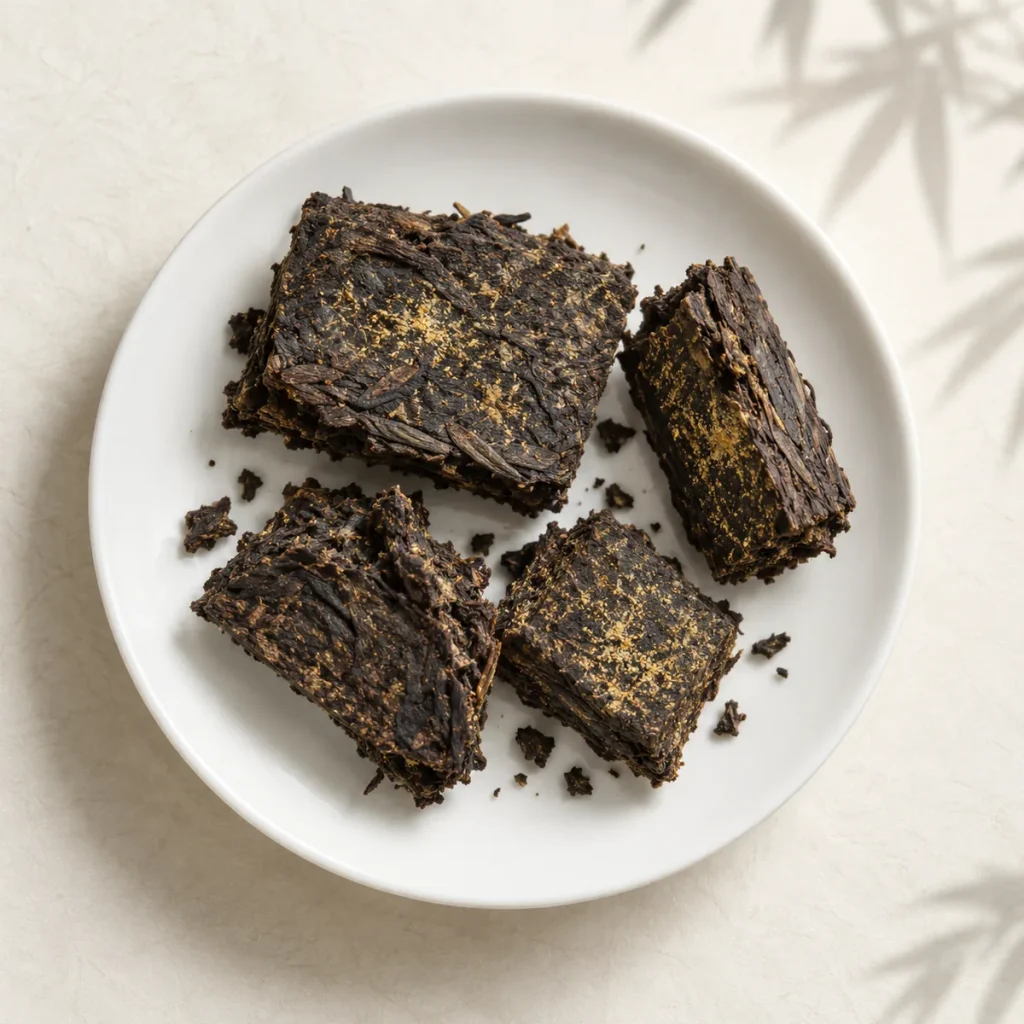
Anhua Fuzhuan Tea is one of the most distinctive flowering compressed teas in the Anhua dark-tea system. It is made from Anhua dark rough tea through screening, blending, pile fermentation, steaming, pressing, flowering and drying. Its signature quality marker is the “golden flower” that develops inside the brick: golden ascocarps formed by Eurotium cristatum. The liquor is typically bright orange-yellow to orange-red, with a pure fungal-floral aroma and a rich or mellow taste.

Origin
Yiyang, Hunan · Anhua Dark Tea GI protection area
Harvest
Made from Anhua dark rough tea · tenderness depends on raw-material grade
Craft
Screening · blending · pile fermentation · steaming · pressing · flowering · drying
Aroma
Pure fungal-floral aroma · Gentle aged aroma
Taste
Rich, mellow and sweet · Smooth with little astringency
Liquor
Bright orange-yellow · Warm and translucent
Dry Leaf
Flat brick surfaceAbundant golden flowers
Liquor Color
Bright orange-yellowWarm and translucent
Aroma
Pure fungal-floral aromaGentle aged aroma
Taste
Rich, mellow and sweetSmooth with little astringency
Finish
Slow returning sweetnessLingering fungal-floral aroma
Infused Leaf
Yellow-brown and softStems and leaves fairly intact

Tea Overview

Tea Category
Dark tea · Fu tea · flowering compressed tea
Cultivar
Anhua dark rough tea · no single cultivar required
Grade
Compressed: Super / Special / Standard
Harvest Period
Depends on dark rough-tea batch
Plucking Standard
Depends on dark rough-tea grade
Processing
Screening · blending · pile fermentation · steaming · pressing · flowering · drying
Also Known As
Fu tea
Oxidation / Fermentation
It belongs to a dark-tea post-fermentation system and should not be described by a black-tea-style oxidation percentage.
Aging
It can be stored for long periods under suitable conditions. DB43/T 1736—2020 is the current general storage guideline, but this page does not use the absolute claim “the older, the better.”

Origin & Terroir

Anhua Fuzhuan Tea derives its GI identity from the broader “Anhua Dark Tea” geographical indication. Former AQSIQ Announcement No. 29 of 2010 approved geographical-indication product protection for Anhua Dark Tea, covering 32 townships in Anhua County, Taojiang County, Heshan District and Ziyang District of Yiyang.

Origin
Yiyang, Hunan · Anhua Dark Tea GI protection area
Altitude
No unified published legal value
Climate
Humid central-Hunan mountains · Zi River basin
Soil
Mountain tea gardens · no unverified hard values
Landform
Xuefeng mountains · hills and river valleys

Brewing

Gaiwan / Yixing-style clay pot / simmeringWater first, then tea, then top up
Leaf Method
Gaiwan / Yixing-style clay pot / simmering
Teaware
Gaiwan, clay teapot or heat-resistant simmering vessel
Leaf Amount
About 5–8 g
Water Temperature
95–100°C
Tea-to-Water Ratio
About 1:20–1:30 (editorial recommendation)
Time
First infusion about 15–25 s · can also be simmered
Infusions
About 6 or more, adjusted to raw material and leaf dose
Water
Clean drinking water
Brewing Steps · 4
  1. Break off the tea: Work along the brick's natural layers, preserving intact chunks and the internal golden flowers as much as possible.
  2. Warm the vessel: Warm the teaware thoroughly with boiling water.
  3. Brew hot: Use 95–100°C water. A tightly compressed brick can be rinsed briefly.
  4. Decant promptly: Start the first infusion around 15–25 seconds, extend later steeps gradually, and switch to simmering in later rounds if desired.

Composition & the Body

Anhua Fuzhuan has direct research within multi-origin Fuzhuan flavor comparisons and multi-omics studies comparing several Anhua dark teas made from the same raw material, supporting a tea-specific profile centered on fermentation, processing and aroma.

Composition Profile

Verified · 2026-09-26
  1. 01
    Volatile flavor profile of Anhua FuzhuanIn a study comparing Jingyang Fuzhuan, Anhua Fuzhuan and four other dark teas, the volatile profile of Anhua Fuzhuan could be distinguished. Benzaldehyde, nerolidol, methyl salicylate and 1,2,3-trimethoxybenzene were relatively abundant in the Anhua samples.
    Dry-leaf sample

    These compounds are associated with almond-like, sweet, wintergreen-like and aged-aroma directions respectively, although actual fungal-floral and aged aroma emerges from multiple compounds acting together.

  2. 02
    Multi-omics chemical profile of Anhua FuzhuanA multi-omics study of several Anhua dark teas made from identical raw material found significant chemical differences among Fuzhuan, Qianliang, Hezhuan, Tianjian and related products. Longer fermentation and complex processing particularly altered catechins and other compounds, and 18 aroma contributors with OAV>1 were identified.
    Dry-leaf sample

Current evidence is most useful for describing Anhua Fuzhuan's volatile flavor combinations and its chemical differences from other Fuzhuan teas and other Anhua dark teas rather than for assigning one fixed composition value independent of producer, year and flowering conditions.

The existing canonical boundary is retained strictly: general dark-tea components, isolated Eurotium cristatum culture studies, Jingyang Fuzhuan values and other regional Fuzhuan data are not rewritten as fixed Anhua Fuzhuan composition or human health effects. No tea-specific human study is included here.

View Research Sources

基于GC-IMS和HS-SPME-GC-MS分析泾阳茯砖茶的特征风味物质

侯晓慧, 张婷, 张萌, 罗浩杰, 岳袁, 肖春鸽, 岳田利 · 食品科学 · 2023

Anhua Fuzhuan samples analyzed in the same batch as Jingyang Fuzhuan and four other dark teas.

Anhua and Jingyang Fuzhuan share some volatile categories but differ clearly in their specific abundance patterns.

DOI: 10.7506/spkx1002-6630-20220824-298View Source

Insight into the chemical compositions of Anhua dark teas derived from identical tea materials: A multi-omics, electronic sensory, and microbial sequencing analysis

Xiangxiang Huang; Yilong Li; Fang Zhou; Tian Xiao; Bohao Shang; Li Niu; Jianan Huang; Zhonghua Liu; Kunbo Wang; Mingzhi Zhu · Food Chemistry · 2024

Several Anhua dark teas made from the same batch, tenderness and cultivar of fresh leaves, including Anhua Fuzhuan.

Even with identical starting material, different Anhua dark-tea processing routes produce clearly different volatile and non-volatile chemical profiles; generic Fu-tea or other Anhua dark-tea values should not be written as fixed Anhua Fuzhuan composition.

DOI: 10.1016/j.foodchem.2024.138367View Source

Tea Culture

Landscapes, people and history within a single leaf.

01

What Defines Fuzhuan Is Not Simply Being Pressed into a Brick

Anhua Fuzhuan Tea belongs to the Fu-tea products within the Anhua Dark Tea geographical-indication system. DB43/T 657.4—2021 includes both loose and compressed Fu tea; compressed products are divided into Super, Special and Standard. Compared with Hezhuan or Huazhuan, the most important distinction is controlled flowering that produces dense golden flowers and develops the characteristic fungal-floral aroma, orange-yellow to orange-red liquor and rich, mellow taste.

02

Anhua Dark Tea Is Ancient, but Hunan Fuzhuan Is a Modern Product

Anhua tea history can be traced through references such as Tang-period Qujiang thin cakes and Ming official tea, but the history of modern Hunan Fuzhuan should be kept separate. Official materials record that Anhua produced Hunan's first Fuzhuan brick in 1953. Today's standardized Anhua Fuzhuan is therefore the result of combining an old Anhua dark-tea raw-material tradition with modern compressed-tea and flowering technology.

03

“Anhua” Means a Defined 32-Township GI Area, Not Any Dark Tea from Hunan

AQSIQ Announcement No. 29 of 2010 defined the Anhua Dark Tea GI area as 32 townships across Anhua County, Taojiang County, Heshan District and Ziyang District of Yiyang. The DB43/T 657 series continues to organize raw material, finished products and processing around this GI framework.

04

The “Golden Flowers” Are a Controlled Fermentation Landscape

Flowering does not mean sprinkling yellow particles into the tea. T/HNTI 067—2024 defines it as controlling the drying-room temperature, humidity, ventilation and time so Eurotium cristatum grows and reproduces inside the brick and forms golden ascocarps. The overall process can be summarized as screening, blending, pile fermentation, steaming, pressing, flowering and drying.

05

Fungal-Flower Aroma Is Not Mold, and Darker Orange Is Not Automatically Better

DB43/T 657.4—2021 grades compressed Fu tea by sensory quality. Super Fu Tea should show abundant golden flowers, a pure fungal-floral aroma, rich taste and bright orange-yellow liquor. Special Fu Tea is more mellow, and the liquor may be bright orange-red. Standard Fu Tea should still retain a fungal-floral aroma and a clean, mellow taste. This page derives its representative sensory profile from those distinctions.

06

One Fuzhuan Brick Connects GI, National Heritage, UNESCO and Agricultural Heritage

In 2008, Dark Tea Making Craft (Fuzhuan Tea Making Craft) entered China's national intangible-cultural-heritage list. In 2022 it became a Hunan constituent element of UNESCO's “Traditional tea processing techniques and associated social practices in China.” The broader Anhua Dark Tea is a national GI from 2010 and is also protected under the China-EU GI Agreement.

The Hunan Anhua Dark Tea Culture System entered China's fifth batch of Important Agricultural Heritage Systems and in 2025 entered China's third tentative list for Globally Important Agricultural Heritage Systems. It is not yet a formally designated FAO GIAHS.

Frequently Asked Questions

What are the “golden flowers” in Anhua Fuzhuan Tea?
They are golden ascocarps formed by Eurotium cristatum under suitable controlled flowering conditions. They are not yellow powder deliberately sprinkled into the brick and should not be equated with ordinary mold spots.
How is Anhua Fuzhuan Tea graded?
Compressed Fu tea is divided into Super, Special and Standard. The same standard divides loose Fu tea into Special Grade, Grade 1 and Grade 2.
How is Anhua Fuzhuan different from ordinary Fuzhuan tea?
There is a national generic standard, GB/T 9833.3—2013, for Fuzhuan tea. Anhua Fuzhuan must additionally comply with the Anhua Dark Tea GI system and local standards such as DB43/T 657.4—2021.
Why is flowering necessary?
Flowering is the core process that develops the characteristic golden flowers and fungal-floral aroma. Temperature, humidity and ventilation are controlled so Eurotium cristatum can grow inside the brick.
Is Anhua Fuzhuan part of the Anhua Dark Tea geographical indication?
Yes. It belongs to the broader Anhua Dark Tea GI system; the direct GI name is “Anhua Dark Tea.”
Is it a national intangible cultural heritage and UNESCO project?
More precisely, Dark Tea Making Craft (Fuzhuan Tea Making Craft) entered China's national intangible-cultural-heritage list in 2008 and became a constituent element of UNESCO's “Traditional tea processing techniques and associated social practices in China” in 2022.
Is the Anhua Dark Tea Culture System an FAO GIAHS?
Not yet. It is a China Important Agricultural Heritage System and entered China's GIAHS tentative list in 2025.
Does Anhua Dark Tea have GI protection in the EU?
Yes. The broader Anhua Dark Tea is registered in the EU as Anhua Hei Cha, PGI-CN-2702.

Tea Conversations

Tea lovers from around the world meet over a cup of tea.

Sign in or register to join the conversation. Your comment account is created automatically the first time you use a connected account.