Skip to content
Tea & Realm
English

Beigang Maojian

Yellow tea · traditional small-leaf yellow tea · Yueyang yellow-tea system

Old Yonghu lineage · Beigang yellow leaves · sweet, mellow menhuang.

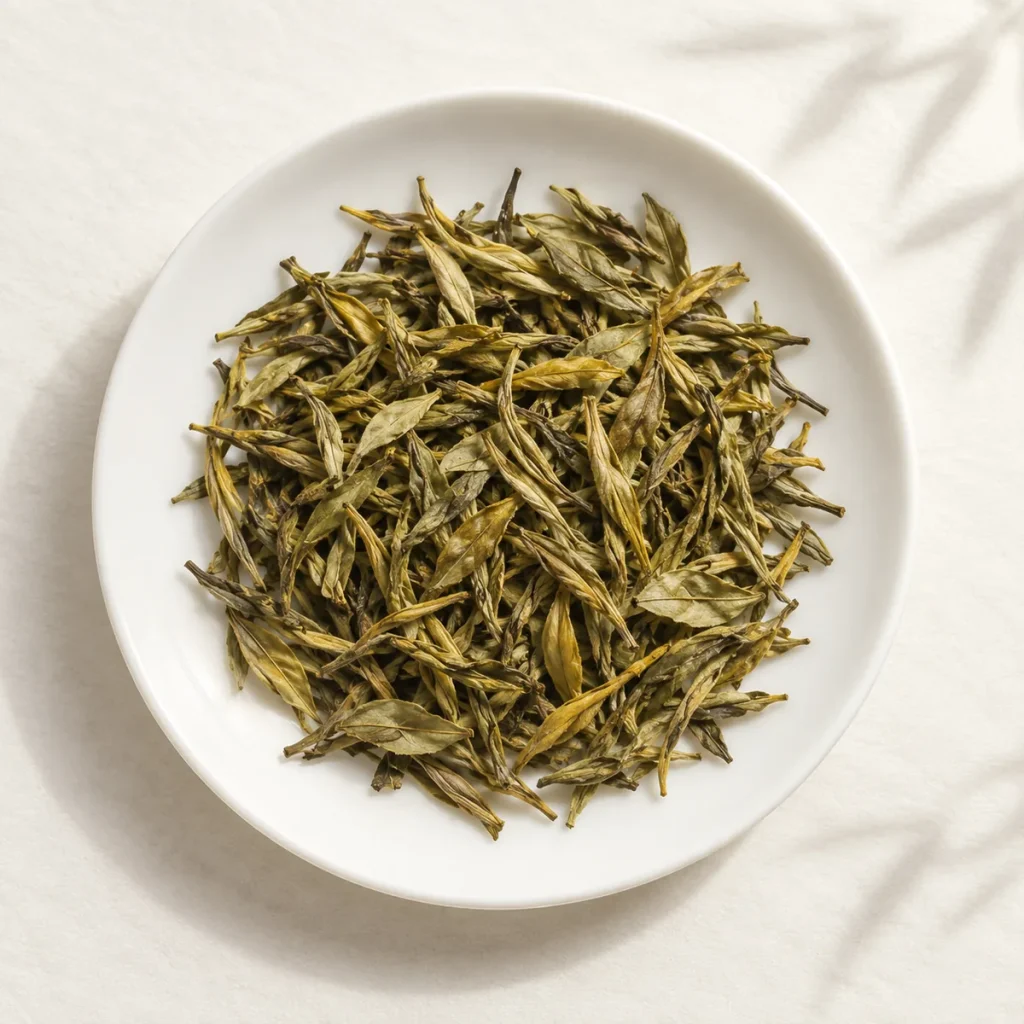
Beigang Maojian is a historic yellow tea from Yueyang, Hunan, traditionally associated with the Beigang River basin and the Nanhu area, and closely connected with the old Yueyang tea lineage known as Yonghu tea. Current Yueyang yellow-tea processing standards place it under “Yueyang Yellow Leaf,” using spring shoots of one bud with one to two leaves. The finished tea has plump buds and leaves, a moist yellow appearance with visible hairs, apricot- to orange-yellow liquor, a clean high aroma and a mellow, sweet-brisk taste.

Origin
Yueyang, Hunan · Beigang River basin and Nanhu area
Harvest
Spring tea · one bud with one to two leaves
Craft
Heat-fixing · rolling · menhuang · re-firing/drying
Aroma
Tender, clean and high · Persistent fragrance
Taste
Mellow and sweet-brisk · Clear returning sweetness
Liquor
Bright apricot-yellow · Clear and warm
Dry Leaf
Plump buds and leavesMoist yellow with visible hairs
Liquor Color
Bright apricot-yellowClear and warm
Aroma
Tender, clean and highPersistent fragrance
Taste
Mellow and sweet-briskClear returning sweetness
Finish
Sweetness builds graduallyClean gentle aftertaste
Infused Leaf
Tender yellow and softRelatively even buds and leaves

Tea Overview

Tea Category
Yellow tea · traditional small-leaf yellow tea · Yueyang yellow-tea system
Cultivar
Yueyang medium- and small-leaf tea · no single required cultivar
Grade
Yueyang Yellow Leaf system: Special / Grade 1 / Grade 2
Harvest Period
Spring tea · traditionally around Qingming
Plucking Standard
Spring tea, one bud with one to two leaves · visual baseline one bud with two leaves
Processing
Heat-fixing · rolling · menhuang/paihan · re-firing · drying
Also Known As
Beigang Tea (related historic name); Yonghu Tea (historic lineage term, not a modern synonym)

Origin & Terroir

The historical core of Beigang Maojian lies in the Beigang River basin and around Nanhu in Yueyang. If produced within the “Yueyang Yellow Tea” geographical-indication system, the protected area is the current administrative territory of Yueyang City. No independent GI identity for Beigang Maojian itself was verified, so the historical origin and the broader Yueyang Yellow Tea GI range must be described separately.

Origin
Yueyang, Hunan · Beigang River basin and Nanhu area
Altitude
No independent Beigang legal value · Yueyang Yellow Tea GI 60–800 m
Climate
Dongting Lake region · humid and moisture-rich
Soil
GI: red/yellow-brown soils · pH 4.0–6.0
Landform
Lakeside river network · low hills

Brewing

Glass cup / gaiwanWater first, then tea, then top up
Leaf Method
Glass cup / gaiwan
Teaware
Clear glass cup or white porcelain gaiwan
Leaf Amount
3 g
Water Temperature
80–85°C
Tea-to-Water Ratio
About 1:50 (3 g / 150 mL)
Time
Glass 2–3 min · gaiwan start around 30–45 s
Infusions
About 3–4 infusions
Water
Clean soft or low-mineral water
Brewing Steps · 4
  1. Warm the vessel: Warm the glass or gaiwan with hot water and discard the warming water.
  2. Add the tea: Use about 3 g of Beigang Maojian per 150 mL, leaving enough room for the buds and leaves to open.
  3. Brew with moderately hot water: Pour water at about 80–85°C gently and observe the yellow-green one-bud-two-leaf shoots opening as the apricot liquor develops.
  4. Drink promptly: In a glass, begin drinking after about 2–3 minutes; in a gaiwan, decant the first infusion around 30–45 seconds and adjust later steeps to taste rather than holding the tea at high temperature for too long.

Composition & the Body

Beigang Maojian has substantial historical, origin, processing and sensory documentation, but this batch did not obtain enough complete, auditable tea-specific peer-reviewed composition research to build field-level composition records.

Available evidence is insufficient to build a tea-specific composition profile. Only verified basics and drinking notes are retained; unsupported values or effects are not added.

Composition Profile

Verified · 2026-09-26
Data in progress

No tea-specific featured composition data can be displayed safely at present.

This batch does not convert Hunan government product introductions, traditional process descriptions or generic yellow-tea chemistry into Beigang Maojian composition research.

If future work obtains direct Beigang Maojian aroma, taste-chemistry or metabolomics papers, this record can be upgraded from insufficient to tea_specific.

Tea Culture

Landscapes, people and history within a single leaf.

01

Beigang Maojian: Traditionally a Small-Leaf Yellow Tea, Now Classified as “Yueyang Yellow Leaf”

The easiest mistake with Beigang Maojian is to treat traditional tea-class terminology and today's Yueyang regional standard as if they were exactly the same system. Traditionally, Beigang Maojian has long been regarded as a representative small-leaf yellow tea. Current T/YYSCX 002—2021, Yueyang Yellow Tea Processing Technical Specification, places it directly under “Yueyang Yellow Leaf” and specifies spring shoots of one bud with one to two leaves. T/YYSCX 001—2022 later defines Yueyang Yellow Leaf as tea made from one bud with two leaves to one bud with multiple leaves or mature paired leaves, and divides it into Special Grade, Grade 1 and Grade 2. This page therefore preserves “traditional small-leaf yellow tea” as its historical identity while using “Yueyang Yellow Leaf” for its current regional-standard position, rather than forcing one term to erase the other.

02

From Yonghu Tea to Beigang Tea

Yueyang official local materials place Beigang tea within the historical lineage of ancient Yonghu tea. The Beigang River and Nanhu area are treated as the traditional origin of Beigang tea, while compiled local histories cite works such as Yueyang Fengtu Ji, Wenxian Tongkao and Baling County Gazetteers to show a regional tea-history relationship among names such as Yonghu tea, Baihe tea, Huanglingmao and later Junshan tea and Beigang tea. The more cautious modern wording is to understand “Yonghu tea” as a historical lineage and regional cultural term rather than simply declaring that a specific ancient tribute tea was identical to modern Beigang Maojian. From the 1970s onward, Beigang Maojian was restored and reproduced and became one of Yueyang's most historically distinctive yellow teas alongside Junshan Yinzhen.

03

A Lakeside Yellow Tea Shaped by Dongting Moisture

Beigang Maojian's regional character does not depend on one high-mountain elevation number. Its traditional core lies around the Beigang River basin and Nanhu, in a lakeside, river-network and low-hill environment strongly influenced by the Dongting Lake water system. Yueyang industry materials emphasize abundant moisture and sufficient light and heat. The broader “Yueyang Yellow Tea” geographical indication extends across Yueyang's current administrative territory and sets tea-garden conditions such as 60–800 m elevation, red or yellow-brown soils and pH 4.0–6.0. This page therefore separates the traditional Beigang lakeside terroir from the broader GI's legal environmental parameters, avoiding the mistake of treating all Yueyang as one small Beigang production site.

04

Paihan and Menhuang: Different Process Languages for the Same Yellowing Logic

The core of yellow tea is warm-humid yellowing after heat-fixing. Beigang Maojian is especially interesting because different transmission sources use different names for this process. Yueyang local materials list heat-fixing, pan rolling, menhuang, re-firing, re-rolling and drying; a publicly documented 1976 revival process uses pan-firing, pan-rolling, paihan, re-firing and drying and explains that pan-rolling, paihan and drying jointly produce the yellowing effect; old-brand heritage lines also describe staged first and second menhuang. Rather than inventing one “unique ancient method,” it is more accurate to explain the shared logic: heat-fix first, then use rolling, piling or wrapping to create warm humid conditions so greenness subsides and taste becomes mellower, before re-firing and drying fix the yellow, clean and sweet-brisk Beigang style.
05

Neither Green-Tea Emerald nor Pure-Bud Junshan Yinzhen

The tasting identity of Beigang Maojian is that of a bud-and-leaf yellow tea. Historical Yueyang descriptions commonly emphasize stout buds and full leaves, slight curvature, visible tips, and golden or moist yellow dry tea. The liquor should range from apricot-yellow to orange-yellow and remain clear, while aroma is described as high and clean or tender and persistent, and the taste as mellow, sweet-brisk and returning sweet. The current Yueyang Yellow Leaf standard for higher grades emphasizes relatively tight fine strips, a bright green-yellow appearance, a comparatively high lasting clean aroma and a mellow, substantial, brisk taste. These two vocabularies reflect the difference between a specific historic tea style and a broader regional standard. The images therefore should not turn Beigang Maojian into pure needle-like buds or vivid green tea; they should emphasize one bud with two leaves, yellow-green to golden color, visible hairs and plump tender shoots.

06

Another Historical Line within Yueyang Yellow Tea

Today, when people hear Yueyang yellow tea, Junshan Yinzhen is usually the first tea they remember, but Beigang Maojian preserves another historical line closer to a lakeside small-leaf yellow-tea tradition. In 2014, “Yueyang Yellow Tea” received national geographical-indication protection, providing Beigang Maojian with a broader regional brand and technical-quality framework. At the same time, the Yueyang yellow-tea craft that entered China's national intangible-cultural-heritage list and became part of UNESCO's 2022 “Traditional tea processing techniques and associated social practices in China” is Yellow Tea Making Craft (Junshan Yinzhen Tea Making Craft), not Beigang Maojian making craft. The two belong to the same Yueyang yellow-tea cultural sphere, but Junshan Yinzhen's national and UNESCO heritage identities must remain related heritage rather than being transferred to Beigang Maojian itself.

Frequently Asked Questions

What type of tea is Beigang Maojian?
Beigang Maojian is a historic yellow tea from Yueyang, Hunan. Traditional tea classification usually places it among small-leaf yellow teas, while current T/YYSCX 002—2021 Yueyang Yellow Tea Processing Technical Specification explicitly places traditional Beigang Maojian under the “Yueyang Yellow Leaf” system.
Why is Beigang Maojian called both a small-leaf yellow tea and Yueyang Yellow Leaf?
The terms belong to different classification levels. “Small-leaf yellow tea” is a traditional yellow-tea category based largely on raw-material tenderness; “Yueyang Yellow Leaf” is a current Yueyang regional product classification. Beigang Maojian historically belongs to the former and is placed under the latter by the current Yueyang processing standard, so both descriptions can coexist.
Should Beigang Maojian use one bud with one leaf or one bud with two leaves?
T/YYSCX 002—2021 specifies spring shoots of one bud with one to two leaves for Beigang Maojian. T/YYSCX 001—2022 later sets one bud with two leaves as the lower tenderness limit for “Yueyang Yellow Leaf,” and the 2014 Yueyang Yellow Tea GI requirement for “yellow-tea maojian” is also one bud with at least two leaves. This page preserves the full one-bud-one- to two-leaf Beigang definition but uses one bud with two leaves as the main visual baseline.
Does Beigang Maojian have its own national geographical indication?
As of September 2026, this review did not verify Beigang Maojian as an independent geographical-indication product. The nationally protected name is the broader “Yueyang Yellow Tea,” whose legal production area is Yueyang's current administrative territory. Use of the GI special mark by a specific product still requires compliance and authorization.
Is the core process of Beigang Maojian called paihan or menhuang?
Both terms appear in different heritage sources. The shared technical logic is warm-humid menhuang. In some Beigang process lines, paihan performs or contributes to that yellowing; some use a distinct menhuang step, while others distribute yellowing across pan rolling, paihan and drying. It is therefore inaccurate to present only one name as the sole process used by every Beigang Maojian tradition.
Is Beigang Maojian a national or UNESCO intangible cultural heritage tea?
It should not be described that way. The verified national Yueyang yellow-tea heritage project is Yellow Tea Making Craft (Junshan Yinzhen Tea Making Craft), which also became part of UNESCO's 2022 “Traditional tea processing techniques and associated social practices in China.” Beigang Maojian belongs to the same Yueyang yellow-tea cultural sphere, but this page does not transfer Junshan Yinzhen's heritage status to Beigang Maojian.
What is the main difference between Beigang Maojian and Junshan Yinzhen?
Junshan Yinzhen is a needle-shaped yellow tea centered on single buds, with its own current group standard and direct national intangible-cultural-heritage identity. Beigang Maojian is a bud-and-leaf yellow tea traditionally made from one bud with one to two leaves and is currently placed under Yueyang Yellow Leaf. Their raw material, appearance, process details and cultural identities are different.

Tea Conversations

Tea lovers from around the world meet over a cup of tea.

Sign in or register to join the conversation. Your comment account is created automatically the first time you use a connected account.