Skip to content
Tea & Realm
English

Baimudan

White tea · bud-and-leaf style

Silvery buds embraced by green leaves, with a clean, sweet floral impression in the cup.

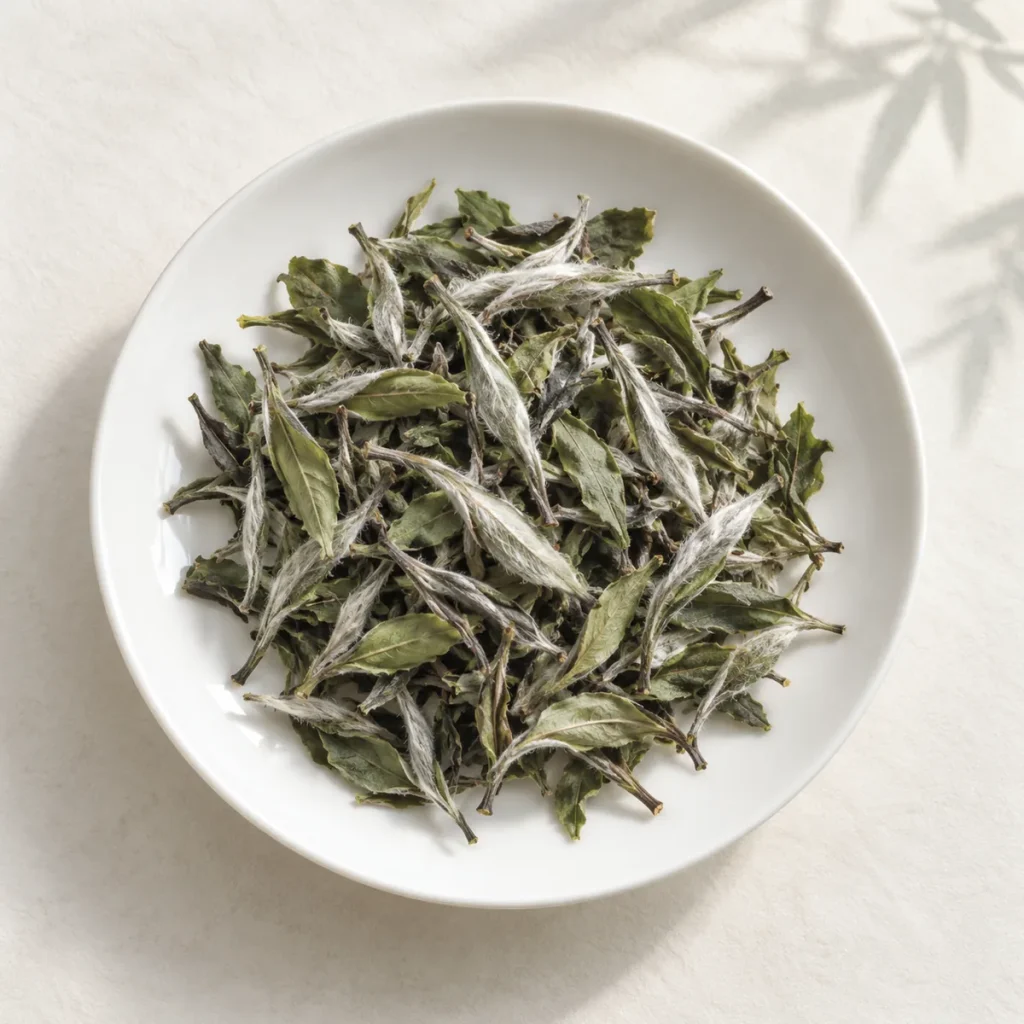
Baimudan is the classic bud-and-leaf white tea made from one bud with one or two leaves. Under the current national standard, it uses tender shoots of Dabai tea or Shuixian tea cultivars. Higher-grade tea shows plump hairy buds attached to tender gray-green leaves, the silver-white trichomes giving the dry leaf a blossom-like appearance. After brewing, the liquor is bright yellow and clear, with fresh tender-bud and pekoe aromas alongside a naturally sweet floral impression. The taste is clean, sweet, mellow and brisk, with pronounced fine-bud character. Its no-firing, no-rolling process preserves the bud, leaf, white hairs and natural branching form.

Origin
Traditional areas include Jianyang, Zhenghe and Fuding in Fujian
Harvest
One bud with one to two leaves · mainly tender spring shoots
Craft
Withering · drying · sorting · homogenizing · re-drying
Aroma
Fresh and tender · Distinct pekoe aroma
Taste
Clean, sweet, mellow and brisk · Pronounced fine-bud character
Liquor
Bright clear yellow · Soft and translucent
Dry Leaf
Bud and leaves remain attachedPlump hairy buds
Liquor Color
Bright clear yellowSoft and translucent
Aroma
Fresh and tenderDistinct pekoe aroma
Taste
Clean, sweet, mellow and briskPronounced fine-bud character
Finish
Clean returning sweetnessLong fresh finish
Infused Leaf
Plump tender buds and leavesBright yellow-green

Tea Overview

Tea Category
White tea · bud-and-leaf style
Cultivar
Dabai tea or Shuixian tea cultivars
Grade
Special Grade · Grade 1 · Grade 2 · Grade 3
Harvest Period
Mainly tender spring shoots · harvested by bud-and-leaf maturity
Plucking Standard
One bud with one to two leaves · intact shoot
Processing
Withering → drying → sorting → homogenizing → re-drying
Also Known As
Peony White Tea · “Peony King” is a market nickname for very high grade, not a separate national grade
Aging
Baimudan can be stored long-term under controlled conditions and its aroma and liquor texture can change with time. NY/T 4859—2025 White Tea Storage Technical Specification took effect on 2026-05-01. Storage age is not a quality grade under GB/T 22291; a high-grade fresh tea and a properly stored aged tea belong to different evaluation dimensions.

Origin & Terroir

Baimudan is a nationally defined white-tea product rather than the exclusive product of one county. Its modern creation and spread are linked mainly to traditional white-tea areas such as Shuiji in Jianyang, Zhenghe and Fuding, spanning inland northern Fujian mountains and the coastal hills of northeastern Fujian. This page therefore describes their shared Fujian white-tea background rather than applying one GI area's altitude, temperature or soil values to all Baimudan.

Origin
Shuiji in Jianyang · Zhenghe · Fuding and other traditional areas
Altitude
No single legal altitude · large hill and mountain variation
Climate
Humid subtropical · diverse local microclimates
Soil
Mostly acidic mountain soils · no unified indicator
Landform
Northern Fujian mountains and northeastern Fujian hills

Brewing

White porcelain gaiwan or glass cup · 90–95°CWater first, then tea, then top up
Leaf Method
White porcelain gaiwan or glass cup · 90–95°C
Teaware
White porcelain gaiwan or clear glass cup
Leaf Amount
About 4–5 g / 150 mL
Water Temperature
90–95°C
Tea-to-Water Ratio
About 1:30–1:38
Time
Gaiwan: start around 20–30 s · extend gradually
Infusions
About 5–7 infusions, adjusted to tenderness and leaf dose
Water
Clean low- to medium-mineral drinking water
Brewing Steps · 4
  1. Warm the vessel and admire the leaves: Warm a white porcelain gaiwan or glass cup and empty it. Add Baimudan and observe the silvery buds set against the tender gray-green leaves.
  2. Cool the water slightly: Let freshly boiled water cool to about 90–95°C and pour gently so the buds and leaves hydrate evenly without suppressing delicate pekoe aroma.
  3. Decant the clear liquor: For a gaiwan, begin around 20–30 seconds; in a glass, start drinking after about 2 minutes. Observe the clear yellow liquor and gradual opening of the bud-and-leaf shoots.
  4. Follow the sweetness infusion by infusion: Extend later steeps according to strength and follow how pekoe aroma, tender fragrance, clean sweetness and returning sweetness gradually soften.

Composition & the Body

Baimudan has direct research on aroma composition, terpene enantiomers, anthocyanin glycosides and long-term aroma change in stored Zhenghe Baimudan.

Composition Profile

Verified · 2026-09-26
  1. 01
    Aroma composition of BaimudanAlcohols accounted for 60.13% of the aroma extract. Major compounds included β-linalool and its oxides, geraniol, methyl salicylate, phenethyl alcohol and benzyl alcohol, with relative proportions of about 35.40%, 11.94%, 10.72%, 6.80% and 2.71% respectively.
    Dry-leaf sample
  2. 02
    Aroma changes during storage of Zhenghe BaimudanAcross samples stored for 0, 5, 10 and 15 years, 66 volatile compounds were detected. Total volatiles declined significantly with storage; pekoe, fresh, sweet and floral aromas weakened while aged and woody notes strengthened. Six key differential volatiles met both rOAV>1 and VIP>1.
    Dry-leaf sample
  3. 03
    Total anthocyanin glycosidesSpecial Grade Baimudan: 90.59±9.59 μg/g; Grade 1: 70.67±4.88 μg/g.
    Dry-leaf sample

Alcohols and linalool-related compounds are important parts of the aroma profile. In stored Zhenghe samples, pekoe, fresh, sweet and floral aromas weakened over time while aged and woody notes became stronger.

Fuding and Zhenghe studies belong to different origin contexts and should not be merged into one universal numerical profile. Anthocyanin values are retained exactly by grade.

View Research Sources

顶空固相微萃取-气质联用法分析白茶的香气成分

王力, 蔡良绥, 林智, 钟秋生, 吕海鹏, 谭俊峰, 郭丽 · 茶叶科学 · 2010

Finished Baimudan samples in the study.

Baimudan volatile composition differed from Baihao Yinzhen and from green and black teas made from the same source material.

DOI: 10.13305/j.cnki.jts.2010.02.007View Source

白茶花青素苷的结构鉴定与分析

胡金祥, 叶钰珊, 蔡梅生, 张青碧, 李博, 吴媛媛, 屠幼英, 何普明 · 浙江大学学报(农业与生命科学版) · 2022

Special Grade and Grade 1 Baimudan.

Total amount and composition of anthocyanin glycosides differed among Baimudan grades.

DOI: 10.3785/j.issn.1008-9209.2021.03.181View Source

不同贮藏年份政和白茶的香气特征与挥发性成分分析

黄维, 张灵枝, 张嘉琳, 林馥茗, 荣杰峰, 肖春燕, 岳鹏航, 余华珠, 孙威江, 黄艳 · 茶叶科学 · 2023

Zhenghe Baimudan stored for 0, 5, 10 and 15 years.

Storage significantly changed volatile composition and perceived aroma in Zhenghe Baimudan.

DOI: 10.13305/j.cnki.jts.2023.05.006View Source

Tea Culture

Landscapes, people and history within a single leaf.

01

Green Leaves Around a Silver Heart

The most immediate difference between Baimudan and Baihao Yinzhen is the leaf. GB/T 22291—2017 requires Baimudan to use one bud with one or two leaves from Dabai tea or Shuixian cultivars. It therefore combines a silvery hairy bud with tender gray-green leaves. In higher grades, the bud and leaves remain connected, the leaf margins curl naturally, and white trichomes extend from the bud onto the leaf underside, creating the impression of green leaves holding a pale flower center.

This is also the most common explanation for the name “Baimudan,” or White Peony. As the tea opens in water, the tender leaves spread around the silvery central bud like a flower beginning to bloom. It is less minimal than Silver Needle and less leaf-dominant than Gongmei or Shoumei, maintaining a particularly balanced relationship between bud and leaf.

Special Grade Baimudan is not defined by “the stronger the floral aroma, the better.” The current national standard first emphasizes freshness, purity and pekoe aroma, while the taste should be clean, sweet, mellow and brisk with clear fine-bud character. Its charm lies in the coexistence of pekoe aroma, tender fragrance, sweetness and the fuller texture contributed by the leaves.

02

Peony Blossoms in Shuiji

The modern history of Baimudan is closely connected with Shuiji in Jianyang. Zhang Tianfu's Investigation and Research on Fujian White Tea records that Baimudan originated in Shuiji, though the exact starting year remains uncertain, roughly after modern white-tea making began in Fuding and before Zhenghe developed its own production. Jianyang tea-history materials also identify Shuiji and Dahu as important early sources.

By around 1922, Baimudan had reached Zhenghe. Materials from the Zhenghe County Museum record that the tea was already being produced there and exported to Annam and other overseas markets. Zhenghe later became an important production area, and after 1949 higher-grade Baimudan was long used for premium export and gift tea. Fuding, Songxi and other areas also developed production traditions.

Baimudan history is therefore not the exclusive story of one county. The tea spread across northern and northeastern Fujian white-tea regions, where different Dabai and Shuixian cultivars, climates and withering environments together shaped the nationally standardized product known today.

03

Northern and Eastern Fujian

The traditional geography of Baimudan demonstrates the cross-regional nature of Fujian white tea. Shuiji in Jianyang lies among mountains and river valleys of northern Fujian; Zhenghe has extensive middle- and high-mountain ecology; Fuding lies closer to the coastal hills of northeastern Fujian. Their elevations, humidity, sunlight and wind conditions are not identical.

For white tea, these differences affect not only fresh-leaf growth but processing itself. Sunny or cloudy weather, humidity and airflow all change the pace of withering. The same one-bud-two-leaf material can become aromatically thin if it loses water too quickly, or develop undesirable reddening or stale notes if moisture loss is too slow. In Baimudan, terroir therefore extends beyond the roots into the air of the withering space.

This is why the page does not provide one universal altitude, temperature or soil value. Only when a specific Baimudan also carries a geographical indication such as Fuding White Tea or Zhenghe White Tea should the legal environmental parameters of that origin be applied.

04

A Flower Formed Naturally

Baimudan appears to require only withering and drying, yet the process demands careful protection of the tender shoots. Fresh material contains one bud with one or two leaves; the bud is densely hairy and the leaves are delicate. During spreading, the shoots must not be crushed or piled too thickly, while water from bud, leaf and stem needs to dissipate slowly and relatively evenly.

GB/T 32743—2016 permits natural, heated and combined withering. Natural withering depends strongly on weather and airflow; heated withering improves environmental stability; combined withering switches between the two. The process uses no oolong-style shaking, no green-tea heat-fixing and no strong enzymatic oxidation following rolling as in black tea.

Once withering reaches the desired point, the tea is dried, then sorted, blended, homogenized and re-dried. Because there is no rolling, the natural shape of the connected bud and leaves is preserved as much as possible, producing Baimudan's characteristic appearance of “green leaves holding a silver heart.”

05

Pekoe Aroma and Clean Sweetness

Tasting Baimudan begins with the ratio of buds to leaves. Special Grade requires many plump hairy buds and heavily pubescent leaf undersides. Grade 1 still shows clear buds and tender leaves, while Grade 2 and Grade 3 gradually contain fewer buds and more mature material. Visual differences among the four grades are therefore substantial.

Higher-grade aroma centers on freshness, purity and pekoe character. Drinkers may perceive floral impressions, but the national standard does not define one specific flower as the sole marker of quality. It is more accurate to describe a combination of tender fragrance, pekoe aroma and natural sweetness that can suggest a light floral quality.

In the mouth, Baimudan usually has more leaf-derived texture than Baihao Yinzhen. Special Grade should be clean, sweet, mellow and brisk with pronounced fine-bud character; lower grades gradually move toward greater body. Good Baimudan should not be all bud-like freshness without depth, nor should the additional leaf material turn coarse or harsh.

06

One Peony, Three Tea Regions

Baimudan is a useful example of how a tea name and a local cultural identity do not always map one-to-one. Today it is a nationally standardized white-tea product name, but its modern history connects Jianyang Shuiji, Zhenghe, Fuding and other Fujian white-tea regions. Each place preserves its own memories of making, trading and drinking the tea.

Heritage identity must be separated in the same way. Baimudan itself has no standalone national intangible-cultural-heritage project spanning all origins. Fuding's White Tea Making Craft (Fuding White Tea Making Craft) entered China's third national list in 2011 and in 2022 became part of “Traditional tea processing techniques and associated social practices in China” on UNESCO's Representative List. Zhenghe white-tea making craft is a Fujian provincial-level heritage project.

A specific Fuding Baimudan can therefore be discussed naturally within Fuding white-tea culture, while a Zhenghe Baimudan connects to Zhenghe's local heritage tradition. For a generic Baimudan encyclopedia page, the accurate approach is to present these identities as related heritage rather than let any one of them stand for every Baimudan.

Frequently Asked Questions

What type of tea is Baimudan?
Baimudan is a white tea and one of the four white-tea products defined by GB/T 22291—2017. It is made from one bud with one or two leaves of Dabai tea or Shuixian tea cultivars through withering, drying and sorting.
What is the main difference between Baimudan and Baihao Yinzhen?
The key difference is raw-material form. Baihao Yinzhen uses only single buds; Baimudan uses one bud with one or two leaves. Baimudan therefore combines silvery buds with tender leaves and usually has more leaf-derived body in the liquor.
How many grades does Baimudan have?
Current GB/T 22291—2017 recognizes four grades: Special Grade, Grade 1, Grade 2 and Grade 3. Higher grades generally show fuller buds, more tender leaves, greater evenness and stronger fresh pekoe and clean-sweet qualities.
Is “Peony King” an official national grade?
No. “Peony King” is a market and folk nickname often used for very high-grade Baimudan with prominent buds. Official national grades remain Special Grade, Grade 1, Grade 2 and Grade 3.
Where did Baimudan originate?
Traditional white-tea research and Jianyang local sources commonly connect its creation with Shuiji and Dahu in Jianyang. Zhang Tianfu recorded that Baimudan originated in Shuiji, though the exact year remains uncertain. Zhenghe began making it around 1922 and later became an important production area, while Fuding and Songxi also developed traditions.
What water temperature should I use for Baimudan?
For higher-grade Baimudan, about 90–95°C works well. In a gaiwan, use about 4–5 g per 150 mL and begin around 20–30 seconds, extending later infusions. In a glass cup, begin drinking after about 2 minutes.

Tea Conversations

Tea lovers from around the world meet over a cup of tea.

Sign in or register to join the conversation. Your comment account is created automatically the first time you use a connected account.