Skip to content
Tea & Realm
English

Wuyi Rougui

Oolong tea · Wuyi rock tea

Pungent cassia-like fragrance enters the rock structure, over golden liquor, mellow body and returning sweetness.

Wuyi Rougui is produced in Wuyishan, Fujian, and is one of the most representative Wuyi rock teas known for a distinctive cultivar aroma. It is made from fresh leaves of the Rougui tea cultivar, harvested at the open-face stage and processed through withering, repeated zuoqing, double pan-firing and double rolling, followed by re-baking and chi-huo finishing. Special Grade tea is plump, tightly twisted, weighty and glossy, with clear bright golden liquor. Its cassia-bark-like spice and floral-fruity aroma are penetrating and persistent, while the taste is rich, mellow and brisk with clear yanyun and quick returning sweetness. It is one of the Wuyi cultivars most strongly associated with the saying “for fragrance, nothing surpasses Rougui.”

Origin
Wuyishan, Fujian · geographical-indication area
Harvest
Resting-bud open-face plucking · 2–4 tender leaves
Craft
Withering · zuoqing · double firing and rolling · re-baking and chi-huo
Aroma
Cassia-bark-like spice · Rich and persistent
Taste
Rich, mellow and brisk · Clear yanyun
Liquor
Clear golden yellow · Bright and translucent
Dry Leaf
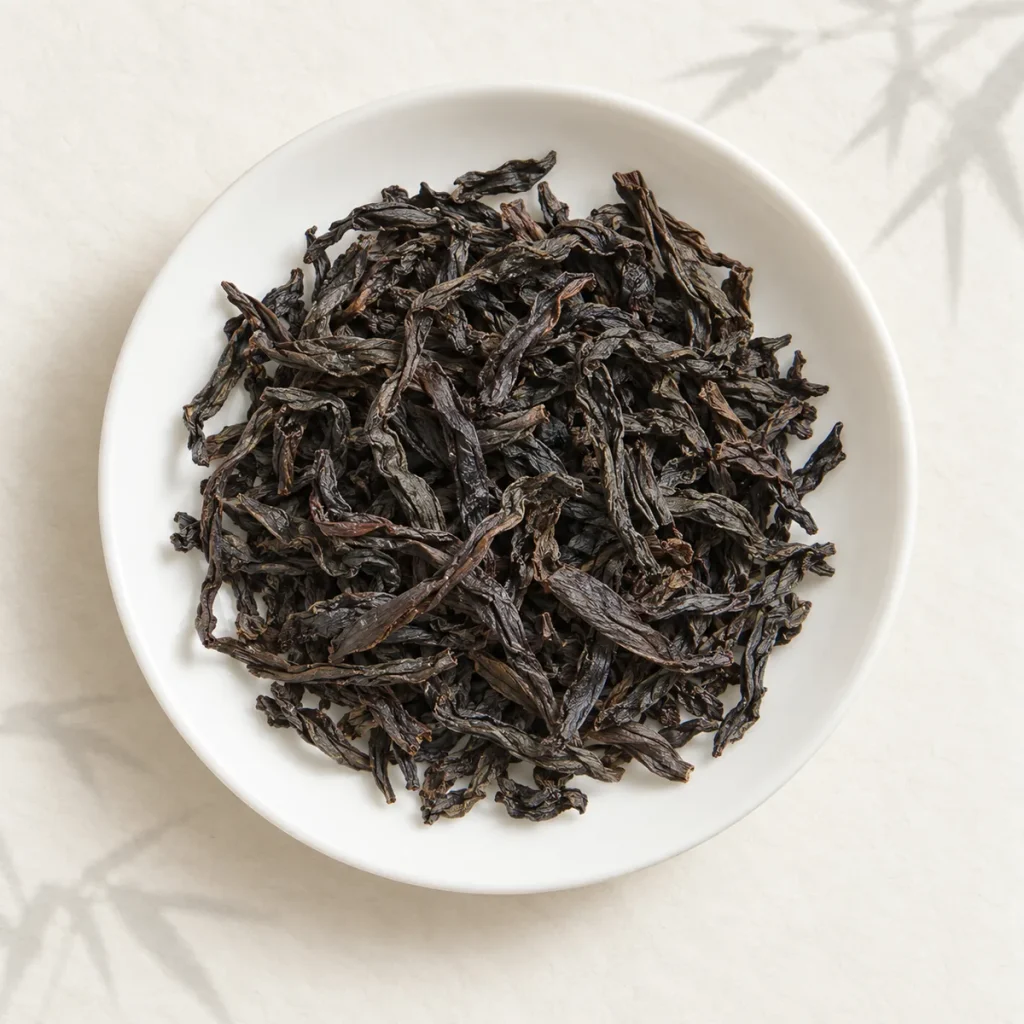
Plump and tightly twistedGlossy sandy green-brown
Liquor Color
Clear golden yellowBright and translucent
Aroma
Cassia-bark-like spiceRich and persistent
Taste
Rich, mellow and briskClear yanyun
Finish
Pungent then sweet-returningLingering fragrance in the mouth
Infused Leaf
Thick, soft and glossyClear red edges

Tea Overview

Tea Category
Oolong tea · Wuyi rock tea
Cultivar
Rougui cultivar · clonal propagation
Grade
Special Grade · Grade 1 · Grade 2
Harvest Period
Spring around Grain Rain · seasonal production allowed
Plucking Standard
Resting-bud open-face plucking · 2–4 tender leaves
Processing
Withering → zuoqing → double firing and rolling → re-baking and chi-huo
Also Known As
Rougui · Yugui
Oxidation / Fermentation
Wuyi Rougui is a partially oxidized oolong tea. Repeated resting, shaking and mechanical contact during zuoqing first damage leaf-edge cells and promote selective enzymatic oxidation, gradually forming red edges, floral-fruity aroma and cultivar spice. High-temperature pan-firing then stops oxidation. National standards do not define one fixed oxidation percentage.
Roasting
Late-stage baking strongly affects Rougui aroma and liquor texture. Traditional Wuyi processing includes first baking, re-baking, chi-huo and final fire, emphasizing long low-temperature heating. Products may be described as light, medium, medium-full or full fire, but these are processing and market descriptions rather than legal grades in GB/T 18745—2006. Good fire stabilizes cassia-bark and floral-fruity aroma and yanyun without leaving burnt notes.

Origin & Terroir

Wuyi Rougui belongs to the Wuyi rock-tea geographical-indication system, whose legal production range covers designated areas within Wuyishan, Fujian. Danxia peaks, ravines and streams, moist mist and acidic rocky soils create numerous micro-sites. The same Rougui cultivar can show marked differences in aroma and liquor texture across Niulankeng, Matouyan, Huiyuan and other sites.

Origin
Wuyishan, Fujian · citywide GI range
Altitude
Danxia hills and mountains · substantial elevation differences
Climate
18–18.5°C · humid and misty
Soil
Acidic rocky soils · pH 4–6
Landform
Danxia cliffs · ravines and stream valleys

Brewing

White porcelain gaiwan · freshly boiled waterWater first, then tea, then top up
Leaf Method
White porcelain gaiwan · freshly boiled water
Teaware
White porcelain gaiwan or clay pot · 100–150 mL
Leaf Amount
About 8 g / 110 mL
Water Temperature
About 100°C · brew with freshly boiled water
Tea-to-Water Ratio
Standard range about 1:7–1:22 · default around 1:14
Time
8 g: 20s → 30s → 45s
Infusions
Extend after the fourth infusion · high-quality Rougui is highly infusible
Water
Clean, odor-free drinking water
Brewing Steps · 4
  1. Warm the vessel and add tea: Warm a roughly 110 mL white porcelain gaiwan and tasting cups thoroughly with boiling water, empty them, then add about 8 g of Wuyi Rougui.
  2. Use boiling water to lift the aroma: Pour freshly boiled water quickly and from some height so the tight strips hydrate fully, then first distinguish cassia-bark spice, floral-fruity aroma and roast aroma.
  3. Decant in stages: For medium strength, use about 20 seconds, 30 seconds and 45 seconds for the first three infusions and drain completely each time to avoid prolonged steeping that amplifies bitterness.
  4. Follow the resonance: After the fourth infusion, extend gradually and compare pungency, aroma in the liquor, body, speed of returning sweetness and empty-cup fragrance.

Composition & the Body

Wuyi Rougui has direct research on aroma formation through processing and roasting, covering the full zuoqing process, phenolic changes, aroma precursors, and key odorants before and after medium firing.

Composition Profile

Verified · 2026-09-26
  1. 01
    Key aroma profile through processingAcross 11 processing stages, 276 aroma compounds were detected and 35 characteristic aroma substances identified. Floral-fruity compounds including linalool, benzyl alcohol, benzaldehyde, eugenol and β-ocimene increased during processing.
    Other sample

    Dehydrolinalool, α-ionone and related compounds are associated with Rougui's pungent cassia-like aromatic direction.

  2. 02
    Phenolic and volatile changes through processingDuring the oxidation/fermentation stage, about 78% of fresh-leaf flavan-3-ols were oxidized and converted into complex products including theaflavins, while flavonols, phenolic acids and xanthine alkaloids remained relatively stable.
    Other sample
  3. 03
    Key aroma compounds created by roastingAcross rough tea and medium-fire Rougui, 80 aroma-active compounds were identified, 42 high-FD compounds quantified, and 26 key odorants ultimately confirmed through aroma recombination and omission experiments.
    Dry-leaf sample

    Roasting reconstructs the balance among floral-fruity, woody, nutty and baked aromas.

Cassia-like spice, floral-fruity fragrance and roasted aroma arise from joint changes in volatiles, glycosidically bound aroma precursors and phenolic oxidation throughout processing.

The approximately 78% flavan-3-ol oxidation reported in one study applies only to that research system and must not be treated as a fixed result for all Rougui. No tea-specific human evidence was included.

View Research Sources

武夷肉桂加工中挥发性成分糖苷结合物和香气品质形成研究

吴宗杰, 欧晓西, 林宏政, 余欣茹, 程守悦, 吴晴阳, 李鑫磊, 孙云 · 茶叶科学 · 2024

Wuyi Rougui samples from fresh leaf through finished rough tea across successive processing stages.

Processing continuously reshaped floral-fruity aroma, green notes, spicy character and aroma precursors.

DOI: 10.13305/j.cnki.jts.2024.01.005View Source

Dynamic changes of volatile and phenolic components during the whole manufacturing process of Wuyi Rock tea (Rougui)

Zhibin Liu, Fuchen Chen, Jinyuan Sun, Li Ni · Food Chemistry · 2022

The complete Wuyi Rougui manufacturing process.

Roasting mainly formed aldehydes, ketones and heterocyclic compounds associated with woody, floral, nutty and baked aromas.

DOI: 10.1016/j.foodchem.2021.130624View Source

Characterization of Key Aroma-Active Compounds in Rough and Moderate Fire Rougui Wuyi Rock Tea (Camellia sinensis) by Sensory-Directed Flavor Analysis and Elucidation of the Influences of Roasting on Aroma

Ping Yang, Mingguang Yu, Huanlu Song et al. · Journal of Agricultural and Food Chemistry · 2022

Wuyi Rougui rough tea and medium-fire samples.

Medium firing does not merely add charred aroma; it reorganizes the combination of key odorants.

DOI: 10.1021/acs.jafc.1c06066View Source

Tea Culture

Landscapes, people and history within a single leaf.

01

For Fragrance, Nothing Surpasses Rougui

What makes Wuyi Rougui easiest to remember is fragrance. Under current GB/T 18745—2006, Special Grade Rougui is described as having a rich, persistent aroma that may suggest creamy, peach-like or cassia-bark notes. The revised national standard scheduled for 2027 narrows this identity further to “rich and persistent, with cassia-bark aroma.” Cassia-bark fragrance is therefore not merely a merchant's marketing term but language actually used in the national standard to identify the cultivar.

Rougui is not only about aroma. Special Grade also requires plump, tightly twisted, weighty leaves, clear bright golden liquor, and a rich, mellow, brisk taste with obvious yanyun. Truly fine Rougui does not leave fragrance floating above the water; the pungent cultivar aroma enters the liquor and links with body, returning sweetness and yanyun.

The saying “for fragrance, nothing surpasses Rougui” should therefore be understood as a statement about cultivar distinctiveness, not as a contest to make the aroma as aggressive as possible. Only when cassia-bark spice, floral-fruity fragrance, fire and rock-structured liquor are in balance does Wuyi Rougui show its complete identity.

02

A Wuyi Cassia Cultivar

Rougui is one of Wuyishan's traditional tea cultivars and is also locally called Yugui. Its name does not come from adding cinnamon or cassia spice during processing; rather, the finished tea's natural aroma can evoke the pungent character of cassia bark. As Wuyi tea cultivars were organized, clonally propagated and standardized, Rougui gradually became one of the most important modern plantings among the many local Wuyi tea resources.

Its large-scale modern market presence is closely tied to the 20th-century development of cultivar-based and commercial Wuyi rock tea. Short-cutting propagation helped preserve desirable traits more consistently, and tea gardens that had once contained complex mixtures of qizhong and named clumps increasingly included clearer single-cultivar plantings. As consumers repeatedly encountered a more stable cassia-bark-like fragrance, Rougui moved from being a cultivar name in the mountains to a nationally recognizable rock-tea identity.

Today Rougui has entered a further “site-specific” phase. Names such as Niulankeng Rougui and Matouyan Rougui place differences among micro-terroirs at the center of tasting the same cultivar. That makes Rougui especially useful for understanding the three-way relationship among cultivar, site and craft in Wuyi rock tea.

03

Cassia Fragrance in the Rock Ravines

Why can the same Rougui cultivar taste so different from one site to another? Wuyishan's answer lies in its fragmented Danxia landscape. Rock walls, ravines, streams, slope aspect and forest cover divide gardens into many small ecological units, so nearby sites can differ in sunlight duration, humidity, soil depth and day-night temperature change.

The current national standard describes the broader Wuyi rock-tea environment as having annual mean temperature around 18–18.5°C, annual rainfall near 2,000 mm and average relative humidity around 80%. Much of the soil derives from weathered volcanic gravel, red sandstone and shale, with pH around 4–6 and relatively rich surface humus. These shared conditions give Rougui a common ecological background while each ravine and cliff creates smaller differences.

Niulankeng is famous not because the national standard designates it the “highest grade,” but because long production and tasting history have created a strong site reputation. Nicknames such as “Niurou” and “Marou” belong to the market culture of site-specific Rougui, not to official grading. An encyclopedia page should explain the terroir distinction rather than treating the nickname itself as certification.

04

Pungent Fragrance Meets Fire

Rougui's cassia-bark aroma begins with the cultivar, but turning it into Wuyi rock tea requires the full zuoqing and roasting system. Fresh leaves are picked at the resting-bud open-face stage and first lose moisture through sun or indoor withering. Resting and shaking then repeat, leaf edges continually bruise and enzymatic oxidation develops outward from the edge, while floral-fruity and pungent cultivar aromas are reorganized through water loss.

Once the leaf reaches the appropriate degree, pan-firing rapidly inactivates enzymes. Traditional Wuyi processing then uses “double firing and double rolling”: first firing and first rolling, followed by second firing and second rolling, fixing aroma and tightening the mature leaves into strips. First baking, cooling, sorting and re-baking then lead into Rougui's crucial fire stage.

Roasting is not a shortcut for manufacturing cassia-bark aroma. If the fire is too light, green odor and sharpness may remain raw; if too heavy, caramelized or charred notes can bury the cultivar itself. Appropriate re-baking and chi-huo make the pungency rounder and deeper, press aroma into the liquor and improve body and infusion endurance.

05

Cassia Spice and Yanyun

The first tasting keyword for Rougui is “pungent.” Special Grade aroma should be rich and persistent, and classic standards allow cassia-bark, peach-like or creamy expressions. Cassia-bark aroma does not mean the tea literally smells like powdered kitchen spice; it is a cultivar impression combining spice, warmth, woodiness and penetration, often accompanied by floral and ripe-fruit notes.

The second keyword is “in the liquor.” If lid fragrance is intense but the tea tastes thin, the Rougui is still incomplete. The standard requires Special Grade taste to be rich, mellow and brisk with obvious yanyun. Fine Rougui gives some stimulation and thickness on the tongue, then quickly turns into returning sweetness and lingering mouth aroma.

The third keyword is “fire without suppressing fragrance.” Different roast levels change liquor color and aromatic expression, but the tea should remain clean, clear and bright. Thick, soft glossy infused leaves with clear red edges show good coordination among mature raw material, zuoqing and roast.

06

One Rougui, One Tea Site

The modern popularity of Rougui has almost reshaped how consumers understand Wuyi rock tea. Drinkers no longer ask only for Da Hong Pao; they ask about Niulankeng, Matouyan and Huiyuan, shifting attention from the tea name itself to how the same cultivar changes across sites. Rougui has therefore become one of the strongest carriers of Wuyi shanchang culture.

It also inherits the national intangible-cultural-heritage identity of Wuyi rock tea. In 2006, Wuyi Rock Tea (Da Hong Pao) Making Craft entered China's first national list of representative intangible cultural heritage projects as VIII-63, No. 413. The project protects the traditional knowledge system used for Wuyi rock teas including Rougui, especially compound withering, adaptive zuoqing, double firing and rolling, and long low-temperature roasting.

In 2022, the craft became part of “Traditional tea processing techniques and associated social practices in China” on UNESCO's Representative List. Rougui itself is therefore not a separate national heritage project; it is an extremely important cultivar-type product within the larger Wuyi rock-tea tradition.

Frequently Asked Questions

What type of tea is Wuyi Rougui?
Wuyi Rougui is an oolong tea in the Wuyi rock-tea system. Under current GB/T 18745—2006, Wuyi rock tea is divided into Da Hong Pao, Mingcong, Rougui, Shuixian and Qizhong, with Rougui as an independent cultivar-type category.
Does Rougui tea actually contain cinnamon or cassia spice?
No. Rougui is the name of the tea cultivar. The cassia-bark-like aroma is a natural cultivar expression shaped by terroir, zuoqing and roasting. The national standard itself uses “cassia-bark aroma” to describe high-grade Rougui.
How many grades does Wuyi Rougui have?
As of 2026-09, current GB/T 18745—2006 divides Rougui into three grades: Special Grade, Grade 1 and Grade 2. GB/T 18745—2026 keeps the same three-grade structure but does not take effect until 2027-04-01.
Is Niulankeng Rougui the highest official grade?
No. Niulankeng is a famous Wuyi rock-tea site, and “Niurou” is a market nickname for Niulankeng Rougui. Official grading remains Special Grade, Grade 1 and Grade 2. A site name expresses provenance and terroir, not an official grade.
Is stronger cassia-bark aroma always better in Rougui?
Not necessarily. Fine Rougui needs a clear cultivar aroma together with purity, persistence, rich brisk liquor, obvious yanyun and good returning sweetness. If the tea has only aggressive high aroma while the liquor is thin or the roast is harsh, overall quality is incomplete.
What water temperature should I use for Wuyi Rougui?
Wuyi rock tea works well with freshly boiled water, close to 100°C. A practical starting point is about 8 g in a 110 mL gaiwan, using roughly 20, 30 and 45 seconds for the first three infusions, then extending later steeps. Adjust to leaf dose and roast level.

Tea Conversations

Tea lovers from around the world meet over a cup of tea.

Sign in or register to join the conversation. Your comment account is created automatically the first time you use a connected account.