Skip to content
Tea & Realm
English

Wuyi Da Hong Pao

Oolong tea · Wuyi rock tea

Floral fragrance from red cliffs and ravines, deep orange liquor, and the mineral structure of rock tea.

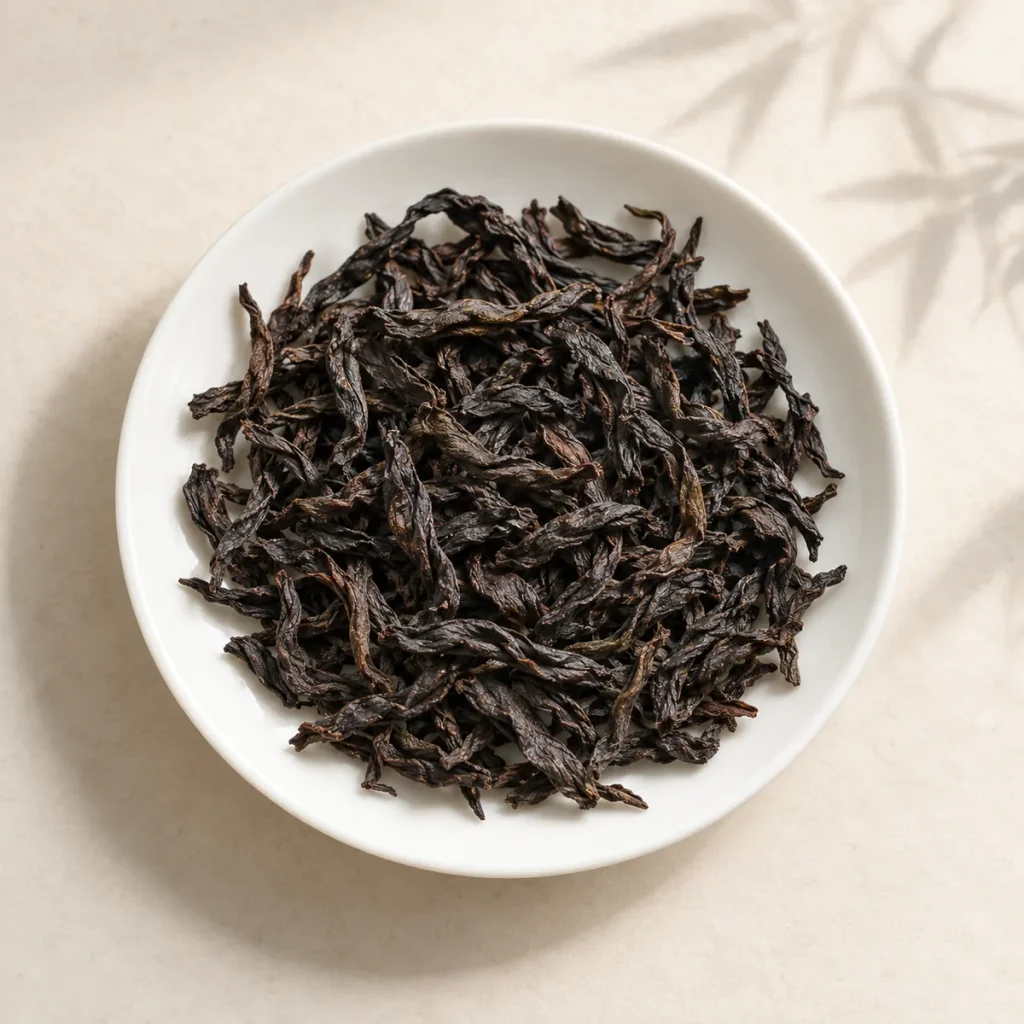
Wuyi Da Hong Pao is produced in Wuyishan, Fujian, and is one of the most representative products within the Wuyi rock-tea system. Classic Da Hong Pao uses suitable rock-tea material harvested at the open-face stage and processed through withering, repeated zuoqing, double pan-firing and double rolling, baking and refining. Finished tea is robust, tightly twisted and slightly curved, with a glossy treasured hue. The liquor is bright deep orange-yellow, the aroma can be rich and long or quiet and distant, and the taste is mellow, sweet-brisk and clearly marked by yanyun, with persistent fragrance left in the empty cup. Modern commercial Da Hong Pao includes both single-cultivar products and products blended from multiple high-quality Wuyi rock teas.

Origin
Wuyishan, Fujian · geographical-indication area
Harvest
Open-face plucking · mature tender shoots with 2–4 leaves
Craft
Withering · zuoqing · double firing and rolling · baking
Aroma
Sharp, rich and long · Quiet and far-reaching
Taste
Clear yanyun · Mellow, full and sweet-brisk
Liquor
Deep vivid orange · Clear and bright
Dry Leaf
Robust and tightly twistedGlossy with a treasured hue
Liquor Color
Deep vivid orangeClear and bright
Aroma
Sharp, rich and longQuiet and far-reaching
Taste
Clear yanyunMellow, full and sweet-brisk
Finish
Lively returning sweetnessFragrance in the empty cup
Infused Leaf
Soft, bright and evenRed edges with cinnabar tones

Tea Overview

Tea Category
Oolong tea · Wuyi rock tea
Cultivar
Single-cultivar Da Hong Pao or suitable Wuyi rock-tea blends
Grade
Special Grade · Grade 1 · Grade 2
Harvest Period
Spring around Grain Rain · seasonal production allowed
Plucking Standard
Resting-bud open-face plucking · 2–4 tender leaves
Processing
Withering → zuoqing → double firing and rolling → baking/chi-huo
Also Known As
Da Hong Pao · Wuyi Da Hong Pao
Oxidation / Fermentation
Da Hong Pao is a partially oxidized oolong tea. Repeated resting, shaking and leaf-edge friction during zuoqing create selective enzymatic oxidation, traditionally producing “green leaves with red borders” and the “three red, seven green” appearance. High-temperature pan-firing then stops further oxidation. Current standards do not set a fixed oxidation percentage.
Roasting
Baking is a crucial late stage in Wuyi rock tea. Traditional production includes first baking, re-baking, chi-huo and final fire, with heritage materials emphasizing sufficient firing and long low-temperature baking. Market terms such as light, medium, medium-full and full fire describe processing style rather than legal grades in GB/T 18745—2006. Good fire should support floral-fruity aroma, body and yanyun rather than mask defects with char.

Origin & Terroir

The legal geographical-indication range of Wuyi rock tea covers the administrative area of Wuyishan, while the most symbolic cultural core of Da Hong Pao is Jiulongke in the Wuyishan scenic area. Danxia cliffs, ravines, streams, humid mist and acidic rocky soils create complex micro-ecologies. Tea gardens are embedded among rock walls, gullies, slopes and forests, forming the most important regional quality of Wuyi rock tea: yanyun.

Origin
Wuyishan, Fujian · citywide GI range
Altitude
Danxia hills and mountains · substantial elevation differences
Climate
18–18.5°C · humid and misty
Soil
Acidic rocky mountain soils · pH 4–6
Landform
Danxia cliffs · ravines and stream valleys

Brewing

White porcelain gaiwan · freshly boiled waterWater first, then tea, then top up
Leaf Method
White porcelain gaiwan · freshly boiled water
Teaware
White porcelain gaiwan or clay pot · 100–150 mL
Leaf Amount
About 8 g / 110 mL
Water Temperature
About 100°C · brew with freshly boiled water
Tea-to-Water Ratio
Standard range about 1:7–1:22 · default around 1:14
Time
8 g: 20s → 30s → 45s
Infusions
Extend after the fourth infusion · high-quality tea can be brewed many times
Water
Clean, odor-free drinking water
Brewing Steps · 4
  1. Warm the vessel and add tea: Thoroughly warm a roughly 110 mL white porcelain gaiwan and tasting cups with boiling water, empty them, then add about 8 g of Da Hong Pao.
  2. Pour freshly boiled water: Use just-boiled water and pour briskly so the tight leaves hydrate quickly. In the first infusion, observe floral-fruity aroma, roast aroma and lid fragrance.
  3. Decant in stages: For medium strength, use about 20 seconds, 30 seconds and 45 seconds for the first three infusions, draining fully each time to separate tea from water.
  4. Follow the yanyun: From the fourth infusion onward, extend gradually and compare aroma in the liquor, body, returning sweetness, yanyun and the persistence of empty-cup fragrance.

Composition & the Body

Da Hong Pao has direct sensomics research on the brewed liquor and volatile-component research across standard grades, providing tea-specific evidence for roasted aroma, caramel-like notes and grade differences.

Composition Profile

Verified · 2026-09-26
  1. 01
    Key odorants of the roasty aroma in tea liquorSixty-five odor-active regions were obtained and 54 compounds quantified, of which 32 exceeded their odor thresholds. OAV values for 2-methylbutanal and γ-hexalactone reached 248 and 154 respectively.
    Infusion / tea liquor

    Multiple pyrazines, lactones, aldehydes and phenols jointly shape roasty, caramel-like and baked aromatic impressions.

  2. 02
    Volatile profiles across gradesA total of 210 volatile compounds were analyzed across Special Grade, Grade 1 and Grade 2 samples. The grades differed in the proportions of terpenes, esters, aldehydes/ketones and pyrazine/furan compounds.
    Dry-leaf sample

Roasty aroma arises from the combined action of multiple aldehydes, lactones, pyrazines, phenols and related odorants, while different grades also show systematic differences in volatile composition.

OAV values measured in tea liquor belong specifically to the infusion context and must not be treated as fixed dry-leaf concentrations. No tea-specific human evidence was included.

View Research Sources

Decoding the Specific Roasty Aroma Wuyi Rock Tea (Camellia sinensis: Dahongpao) by the Sensomics Approach

Jing Wang, Mengru Li, Hui Wang, Wenjing Huang, Fang Li, Lili Wang, Chi-Tang Ho, Yanyan Zhang, Liang Zhang, Xiaoting Zhai, Xiaochun Wan · Journal of Agricultural and Food Chemistry · 2022

Freshly brewed Da Hong Pao tea liquor.

Aroma recombination and omission experiments showed that Da Hong Pao's roasty aroma is jointly formed by multiple key odorants.

DOI: 10.1021/acs.jafc.2c02249View Source

Research on Taste and Aroma Characteristics of Dahongpao Tea with Different Grades

Xiaomin Pang, Jishuang Zou, Pengyao Miao, Weiting Cheng, Zewei Zhou · Chemosensors · 2025

Standard samples of Special Grade, Grade 1 and Grade 2 Da Hong Pao.

Grade differences were reflected in both taste and aroma profiles and cannot be represented by a single volatile compound.

DOI: 10.3390/chemosensors13040134View Source

Tea Culture

Landscapes, people and history within a single leaf.

01

Red Robe on the Rock

The three characters “Da Hong Pao” appear simple, but in practice they point to cultivar, product and brand at the same time. Under current GB/T 18745—2006, Da Hong Pao is first of all one of five Wuyi rock-tea product categories, alongside Mingcong, Rougui, Shuixian and Qizhong, and is graded as Special Grade, Grade 1 and Grade 2. This is a product-quality concept, not a claim that every commercial Da Hong Pao comes from the few mother trees at Jiulongke.

Modern Da Hong Pao products generally follow either single-cultivar or blending approaches. In 2012, “Da Hong Pao” passed Fujian tea-cultivar approval, making it possible to produce single-cultivar Da Hong Pao from approved planting material. At the same time, modern commercial Da Hong Pao is also commonly blended from multiple high-quality Wuyi rock teas so that different cultivars contribute complementary aroma, liquor texture and yanyun while the final product remains stable and meets the national standard.

Whatever the raw-material route, the national standard judges the finished tea. Special Grade should be robust, tightly twisted and slightly curved, with a treasured or glossy hue. Aroma may be sharp and long or quiet and distant. The liquor should be deep orange-yellow, clear and vivid, with obvious yanyun, mellow body, a sweet-brisk finish and lingering fragrance in the empty cup.

02

The Tea King of Jiulongke

The most legendary source of Da Hong Pao lies at Jiulongke in Wuyishan. The mother trees beneath the cliff inscription “Da Hong Pao” have long been regarded as tea kings of Wuyi rock tea. Folk stories explain the name through tales of a scholar's red robe, imperial robes or monks protecting the tea, but recent local historical research also notes that many such details lack contemporary documentary support. They are best preserved as cultural legends rather than treated as settled fact.

What can be traced more reliably is the modern history of protection and research. In the 20th century, tea researchers observed, processed and recorded the mother trees and later used cuttings and clonal propagation to preserve valuable material. From the 1980s, Wuyishan tea researchers also explored commercial blending methods, allowing a tea name once attached to extremely scarce legendary material to become a stable commercial product.

In 2006, the Wuyishan government permanently stopped harvesting the mother-tree Da Hong Pao for protective conservation. The last especially commemorative batch later entered the collection of the National Museum of China. Therefore any normal commercial Da Hong Pao today should not be marketed as freshly picked from the Jiulongke mother trees. The mother trees have shifted from raw-material source to historical and cultural symbol.

03

Red Cliffs and Ravines

The idea of yanyun begins with Wuyishan's highly distinctive landform. Danxia peaks are cut by streams and ravines, and tea plants grow below cliffs, beside gullies, on slopes and in small basins. Differences in rock shade, sunlight duration, slope aspect, stream distance and soil depth create different microclimates even between nearby gardens.

GB/T 18745—2006 records a typical Wuyi rock-tea environment with annual mean temperature around 18–18.5°C, annual rainfall about 2,000 mm, relative humidity around 80%, and moist misty air. Much of the tea-area soil forms from weathered volcanic gravel, red sandstone and shale, with pH about 4–6 and relatively rich surface humus. Rock and soil do not literally give the tea a “stone flavor”; they influence root environment, water, mineral conditions and microclimate, which in turn affect tea growth.

Tea people also use terms such as zhengyan and banyan to distinguish ecological tiers, with the three pits and two streams, Jiulongke and other sites regarded as core rock-tea areas. These are core quality and cultural zones, not the complete legal geographical-indication boundary. The protected Wuyi rock-tea range covers designated areas across Wuyishan and is much broader than a few famous ravines.

04

Double Firing, Double Rolling

One reason Wuyi Rock Tea (Da Hong Pao) Making Craft entered China's first national intangible-cultural-heritage list in 2006 is that the process is not a simple mechanical line but a continuous sequence of judgments. Fujian's DB35/T 2157—2023 later organized the traditional craft into sixteen steps.

Fresh leaves first undergo sun or heated withering, traditionally sometimes through a compound “two sun-withers, two coolings” process. Then comes the crucial zuoqing, with resting and shaking repeated according to the principles of adjusting to the leaf and weather. When the leaf edges gradually turn cinnabar red while the center remains green—forming the traditional “three red, seven green”—and floral-fruity aroma becomes clear, the tea enters pan-firing.

Wuyi rock tea traditionally uses double firing and double rolling. First firing rapidly stops enzymatic oxidation, hot rolling forms the strips, and a second firing and rolling further tighten them. This is followed by first baking, winnowing, cooling, sorting, re-baking, chi-huo and final fire through long, low-temperature heating. Good fire does not turn the tea into burnt sugar or charred wood; it integrates moisture, aroma and taste so floral-fruity fragrance settles into the liquor and the cup becomes mellow, lively and enduring.

05

Rock Structure, Floral Fragrance

The most important tasting term for Da Hong Pao is yanyun. The current national standard directly defines Wuyi rock tea as oolong with the characteristic yanyun, explained as “rock structure and floral fragrance.” For Special Grade Da Hong Pao, aroma can be sharp and rich or quiet and far-reaching; what matters is that it integrates with the liquor rather than appearing only as a burst of lid fragrance.

The “rock structure” is more evident in the architecture of taste. The liquor should be mellow and substantial without stopping at coarse bitterness or dryness. A little stimulation should transform quickly into returning sweetness, liveliness and persistent mouthfeel. Deep orange-yellow liquor should remain clear, and a clean lingering aroma should stay in the empty cup after drinking.

The infused leaf helps show whether zuoqing and roasting are in balance. Light- to medium-fired tea more readily shows soft glossy leaves with clear red edges; full-fired tea opens less and may show the traditional “toad-back” texture. Whatever the fire level, fine Da Hong Pao should not be reduced to charcoal aroma. Floral-fruity fragrance, roast integration, body and yanyun ultimately need to resolve into one coherent “rock structure and floral fragrance.”

06

A Robe Becomes a Name

Da Hong Pao may be one of the Chinese tea names most easily transformed from a beverage into a cultural symbol. The Jiulongke mother trees, cliff inscription, auction records and “tea king” stories created extraordinary fame, while modern commercial blending brought the once extremely scarce name onto ordinary tea tables. The two roles are not contradictory: one preserves symbolic heritage and the other solves the practical needs of scale and quality stability.

In 2006, Wuyi Rock Tea (Da Hong Pao) Making Craft entered China's first national list of representative intangible cultural heritage projects as VIII-63, No. 413. It was among the earliest nationally recognized tea crafts. The heritage focus is not one tree, but the full knowledge system of compound withering, adaptive zuoqing, double firing and rolling, and long low-temperature roasting. In 2022, the craft also became part of “Traditional tea processing techniques and associated social practices in China” on UNESCO's Representative List.

Da Hong Pao is now facing another kind of modernization: a national-standard update. GB/T 18745—2026 has been issued and will formally replace the current 2006 version in 2027. Wuyi rock tea therefore continues to reorganize site knowledge, traditional craft, product classification and modern quality management into evolving standards. From the six mother trees at Jiulongke to a stable commercial blend, what the name truly preserves is Wuyishan's ability to keep nature, craft and flavor connected.

Frequently Asked Questions

What type of tea is Wuyi Da Hong Pao?
Wuyi Da Hong Pao is an oolong tea in the Wuyi rock-tea system. Under current GB/T 18745—2006, Wuyi rock tea is divided into Da Hong Pao, Mingcong, Rougui, Shuixian and Qizhong, with Da Hong Pao as one independent product category.
Is the Da Hong Pao sold today picked from the Jiulongke mother trees?
No. In 2006 the Wuyishan government permanently stopped harvesting the Jiulongke mother trees for protective conservation. Commercial products today are mainly single-cultivar Da Hong Pao or standard-compliant blended commercial Da Hong Pao.
Is Da Hong Pao always a blended tea?
Not always. The market includes single-cultivar products made from the approved Da Hong Pao cultivar as well as commercial Da Hong Pao rationally blended from multiple high-quality Wuyi rock teas. Blending itself is a normal refining and quality-design technique; the key is whether the finished tea meets the Da Hong Pao quality standard.
How many grades does Wuyi Da Hong Pao have?
As of 2026-09, current GB/T 18745—2006 divides Da Hong Pao into three grades: Special Grade, Grade 1 and Grade 2. GB/T 18745—2026 has been issued but does not take effect until 2027-04-01.
What is Da Hong Pao's yanyun?
The national standard explains Wuyi rock-tea yanyun as “rock structure and floral fragrance.” It is not one aroma note, but the integrated quality formed by Wuyishan terroir, tea cultivar, zuoqing and roasting: floral-fruity aroma, body, returning sweetness, liveliness and persistent finish.
What water temperature should I use for Da Hong Pao?
Wuyi rock tea is best brewed with freshly boiled water, close to 100°C. DB35/T 1545—2015 allows a broad tea-to-water ratio; this page defaults to about 8 g in a 110 mL gaiwan, with the first three infusions around 20, 30 and 45 seconds, then gradually longer.

Tea Conversations

Tea lovers from around the world meet over a cup of tea.

Sign in or register to join the conversation. Your comment account is created automatically the first time you use a connected account.