Skip to content
Tea & Realm
English

Fenghuang Dancong · Milanxiang

Oolong tea · Fenghuang Dancong · Milanxiang aroma type

Honeyed orchid fragrance rises in the Fenghuang Mountains, over golden liquor, clean sweetness and a long dancong resonance.

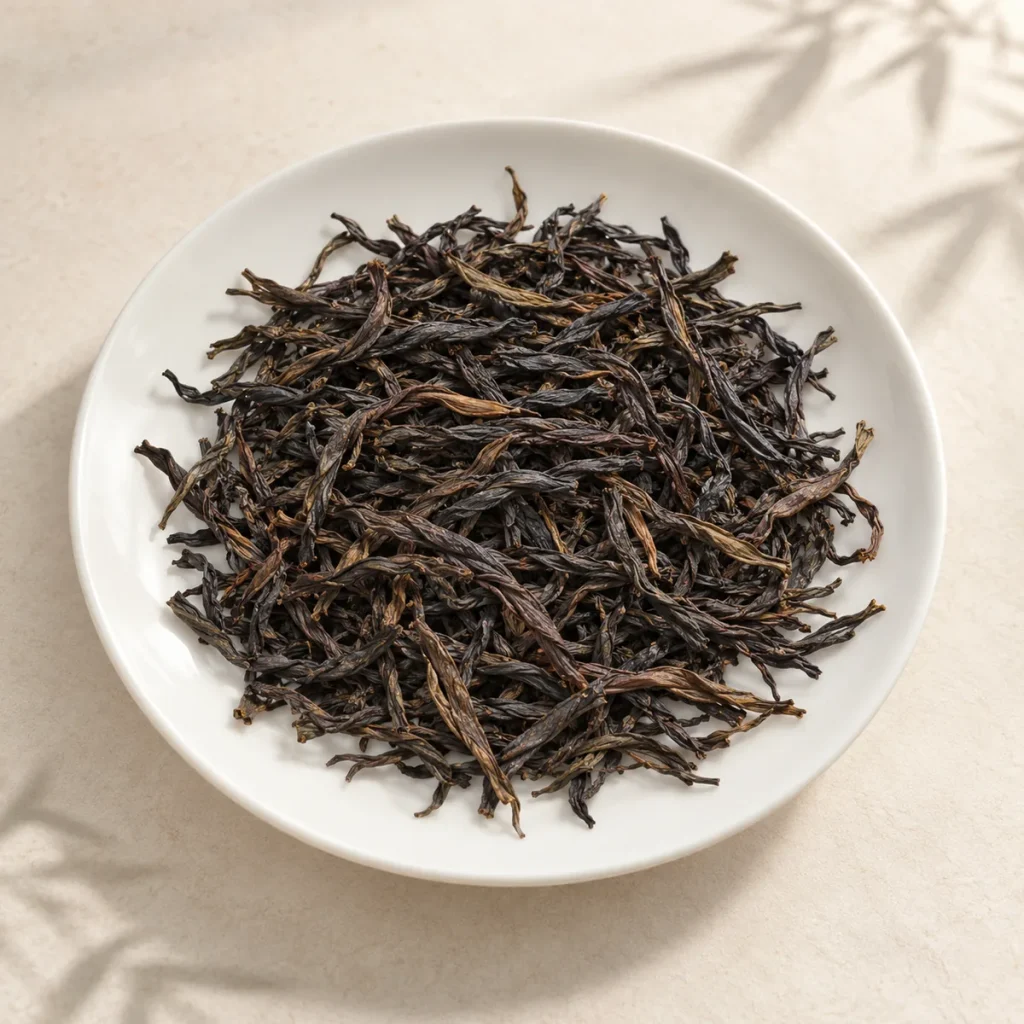
Fenghuang Dancong · Milanxiang comes from the Fenghuang mountain system of Chaozhou, Guangdong, and is one of the most representative Milanxiang aroma types among the ten classic Fenghuang Dancong aroma families. It uses suitable lines and individual selections developed from the Fenghuang Shuixian population, harvested at the resting-bud, small- to medium-open-face stage with 2–4 tender leaves. Processing includes sun withering, cooling, repeated langcai zuoqing, heat-fixing, rolling and repeated baking. Finished tea is tight and slightly curved, glossy yellow-brown, with clear golden liquor, naturally high and persistent honey-orchid fragrance, a rich yet brisk taste, clear honeyed resonance, strong returning sweetness and the characteristic dancong and mountain resonance of Fenghuang tea.

Origin
Chaozhou, Guangdong · Fenghuang Mountains as the core
Harvest
Resting-bud open-face plucking · 2–4 tender leaves
Craft
Sun withering · langcai · heat-fixing · rolling · repeated baking
Aroma
Honey-orchid fragrance · High and persistent
Taste
Rich, mellow and brisk · Clear honeyed resonance
Liquor
Clear golden yellow · Bright and transparent
Dry Leaf
Tight and slightly curvedGlossy yellow-brown
Liquor Color
Clear golden yellowBright and transparent
Aroma
Honey-orchid fragranceHigh and persistent
Taste
Rich, mellow and briskClear honeyed resonance
Finish
Strong returning sweetnessLong dancong resonance
Infused Leaf
Yellow centers with red edgesSoft, bright and lively

Tea Overview

Tea Category
Oolong tea · Fenghuang Dancong · Milanxiang aroma type
Cultivar
Selected from Fenghuang Shuixian population · Milanxiang family
Grade
Boutique · Special Grade · Grade 1 · Grade 2 · Grade 3
Harvest Period
Spring through mid-May · autumn/winter after mid-September
Plucking Standard
Resting bud, small-to-medium open face · 2–4 leaves
Processing
Sun withering → langcai → heat-fixing → rolling → repeated baking
Also Known As
Milanxiang Dancong · Milanxiang-type Fenghuang Dancong
Oxidation / Fermentation
Fenghuang Dancong is partially oxidized oolong tea. After sun withering and cooling, repeated bruising, shaking and resting damage the leaf edges and induce selective enzymatic oxidation, gradually creating natural floral-honey aroma, red edges and a fuller liquor. Heat-fixing then stops further oxidation. The standard does not define one fixed oxidation percentage.
Roasting
The current GI standard requires at least two baking rounds during primary drying and at least two more during refining to set aroma, until finished moisture reaches about 4–5%. Traditional Chaozhou dancong often uses repeated low, steady charcoal baking. Baking should stabilize the Milanxiang fragrance, liquor and congyun rather than create char, bitterness or high-fire aroma that masks the tea.

Origin & Terroir

The legal geographical-indication range of Fenghuang Dancong spans multiple traditional tea areas of Chaozhou, while the Fenghuang mountain system around Fenghuang Township remains the most representative origin core. Mountain and hill terrain, relatively high humidity, abundant rainfall and deep acidic soils form the broad ecological background, while Wudong, Fengxi, Fengxi-area villages and Funan develop finer site differences through elevation, slope aspect and old tea-tree resources.

Origin
Chaozhou, Guangdong · Fenghuang Mountains as the core
Altitude
≥100 m · core areas often higher mountain tea
Climate
16–22°C · humid and rainy
Soil
Deep acidic soils · pH 4.0–6.5
Landform
Fenghuang mountains · stream valleys and terraces

Brewing

Chaozhou gongfu style · boiling water, quick decantWater first, then tea, then top up
Leaf Method
Chaozhou gongfu style · boiling water, quick decant
Teaware
White porcelain gaiwan or Chaozhou zhuni clay pot
Leaf Amount
About 8 g / 110 mL
Water Temperature
About 100°C · freshly boiled
Tea-to-Water Ratio
About 1:14
Time
First infusion about 5–10 seconds · extend later
Infusions
Fine dancong is highly infusible · extend after the fourth infusion
Water
Clean low- to medium-mineral drinking water
Brewing Steps · 4
  1. Warm the vessels and add tea: Thoroughly warm a white porcelain gaiwan or zhuni pot and tasting cups with boiling water, empty them, then add about 8 g of Fenghuang Dancong Milanxiang.
  2. Use boiling water to lift the aroma: Pour freshly boiled water quickly along the vessel wall or at one point so the tight strips hydrate rapidly and the natural honey-orchid fragrance rises first.
  3. Decant the golden liquor quickly: For the first infusion, decant after about 5–10 seconds and drain fully. Observe the clear golden liquor and whether the honeyed aroma has entered the cup.
  4. Follow the resonance infusion by infusion: Lengthen later steeps gradually, focusing on honeyed resonance, dancong resonance, returning sweetness and the persistence of fragrance in the throat.

Composition & the Body

Milanxiang has direct GC-MS/GC-O research on the Fenghuang Dancong aroma type and has also been identified as a distinct category in broader studies classifying multiple Fenghuang Dancong lines by aroma.

Composition Profile

Verified · 2026-09-26
  1. 01
    Milanxiang volatile profileFifty-three volatile compounds were identified in the Milanxiang sample. Compounds with relatively high abundance included dihydroactinidiolide 4.77%, nerolidol 3.41%, linalool oxide I 2.59%, epoxylinalool 2.29% and methyl heptenone 2.18%.
    Dry-leaf sample

    Floral, honeyed, sweet and fruity qualities arise from multiple aroma-active volatiles acting together.

  2. 02
    Milanxiang aroma-classification featuresSeventeen finished Fenghuang Dancong teas could be grouped into multiple aroma families by volatile composition. Terpineol, β-ionone, caryophyllene and related compounds were proposed as possible characteristic contributors to the Milanxiang type.
    Dry-leaf sample

A 2018 study identified 53 volatile compounds in Milanxiang, with dihydroactinidiolide, nerolidol and linalool oxides among the more prominent components. Aroma-classification research further shows that Milanxiang is a composite volatile profile rather than one aroma molecule.

Only Milanxiang-specific data are used for this tea profile. Yulanxiang and Guihuaxiang appear only as comparison groups in the same studies. Relative-abundance values represent study samples rather than fixed composition of all Milanxiang. No tea-specific human evidence was included.

View Research Sources

3种香型凤凰单丛茶挥发性成分分析

肖凌, 毛世红, 童华荣 · 食品科学 · 2018

Spring 2016 Milanxiang Fenghuang Dancong finished tea from the Fenghuang Mountains in Chao'an, Guangdong.

Milanxiang shared many volatiles with Yulanxiang and Guihuaxiang but differed in the relative proportions of characteristic compounds.

DOI: 10.7506/spkx1002-6630-201820034View Source

不同品种(系)凤凰单丛成品茶的香型分类与鉴定

周春娟, 庄东红, 郭守军, 朱慧, 马瑞君, 吴清韩 · 茶叶科学 · 2014

Seventeen finished Fenghuang Dancong teas with Fenghuang Shuixian population tea and Shiguping Oolong as controls.

Milanxiang is not defined by one aromatic substance but by a volatile combination formed jointly by tea-tree line and processing.

DOI: 10.13305/j.cnki.jts.2014.06.023View Source

Tea Culture

Landscapes, people and history within a single leaf.

01

Honeyed Orchid in the Liquor

The fascination of Fenghuang Dancong lies in how the tea plant itself can create aromas reminiscent of flowers, fruit and honey without any flowers or flavoring being added. DB4451/T 1—2021 directly defines Fenghuang Dancong as an oolong tea with natural floral-fruity aroma, dancong resonance and honeyed resonance, while T/CZTTBZ 002—2021 lists Milanxiang among the ten major aroma families.

The name Milanxiang can sound as if it were one fixed tea cultivar, but Chaozhou's dancong naming system is more complex. Aroma families were formed as growers selected different lines and individual plants from the Fenghuang Shuixian population over long periods and grouped them by natural aroma, honeyed resonance and dancong character. Within the Milanxiang family are historic resources such as Milanxiang, Xiangfanshu, Da'an Mixiang and Shitou Mixiang.

So on this page, “Fenghuang Dancong · Milanxiang” first means a Milanxiang-family product within the Fenghuang Dancong geographical-indication system. Its classic cup profile is glossy yellow-brown strips, clear golden liquor, naturally lifted honey-orchid fragrance and a rich brisk taste in which honeyed resonance, returning sweetness and dancong character keep resurfacing.

02

One Clump, One Fragrance

The tea-tree resources of the Fenghuang Mountains are extraordinarily diverse, and the idea of “dancong” itself comes from valuing differences among individual plants. Growers discovered trees within the Fenghuang Shuixian population whose aroma or taste was especially distinctive, then maintained traditions of picking, processing, storing and propagating notable trees separately. Different named clumps gradually developed their own names and flavor identities.

This naming system is not based on botany alone. A tree might be named for leaf shape, tree form, place, owner, story or the aroma of the finished tea. In modern times, the industry organized the huge number of local names into families such as Huangzhi, Zhilan, Yulan, Milan, Xingren, Jianghua, Rougui, Guihua, Yelai and Moli, making highly local knowledge easier for consumers to understand.

The 2021 Fenghuang Dancong naming rules formally standardized this folk knowledge. The standard appendix records one historic resource explicitly named Milanxiang in Kexi Village, Funan, while also listing Xiangfanshu, Da'an Mixiang and Shitou Mixiang within the same family. Today “Milanxiang” may therefore refer either to a specific historic resource or more broadly to the Milanxiang aroma family in commerce; an encyclopedia page needs to keep those levels distinct.

03

Cloud Mountains of Fenghuang

The legal production area of Fenghuang Dancong is much broader than the phrase “Wudong high-mountain tea.” Current standards place the GI area roughly between 116°22′–117°11′ E and 23°26′–24°14′ N, at elevations no lower than 100 m in the hilly mountains of Chaozhou. Fenghuang Township is the most important origin core, but the protected range also covers multiple traditional areas in Chao'an, Raoping and Xiangqiao.

The climate has a clear southern maritime-monsoon character. Annual mean temperature is about 16–22°C, annual rainfall 1,400–2,200 mm and relative humidity around 80%. Higher parts of the Fenghuang Mountains experience more mist, stronger day-night temperature differences and greater slope-aspect effects, so areas such as Wudong develop growth rates and aroma expression different from lower hills.

Soil parent materials include granite, sandy shale, gneiss and sandstone. The profiles are deep, organic matter is at least 2%, and pH is about 4.0–6.5. On top of these shared conditions, every ridge, hollow and village forms a micro-site. That is why Milanxiang carries not only “honey” and “orchid” but also a regional quality that tea drinkers describe as shanyun and congyun.

04

Langcai Builds the Fragrance

The fragrance of Fenghuang Dancong does not suddenly appear during baking. The direction of Milanxiang is determined through the long langcai process that begins with sun withering. Fresh leaves are first spread thinly in sunlight, with the current standard recommending a weight loss of about 10–15%, then moved into shade to cool so leaf temperature drops and internal moisture redistributes.

Next comes zuoqing. In Chaozhou this is commonly called bruising, shaking or langcai. Leaves repeatedly collide and rest, gradually losing moisture while edge cells are damaged and undergo enzymatic oxidation. DB4451/T 1—2021 requires at least four cycles; heritage descriptions often record five or six rounds over roughly 10–12 hours. Tea makers judge progress from leaf color, hand feel and aroma rather than from a timer alone.

High-temperature heat-fixing then stops oxidation, the leaves are rolled into strips, and at least two baking stages complete primary manufacture. Rough tea is further piled, sorted, screened and graded, then baked at least twice more to set aroma. Good Milanxiang is not “the more baking, the more fragrant”; the fire must preserve lifted orchid notes while making honeyed sweetness and the liquor deeper and more stable.

05

Honeyed Resonance, Dancong Fragrance

Milanxiang should not be judged only by smelling the lid. In high-quality dancong, the real value is that the fragrance enters the liquor. Dry tea is glossy yellow-brown, tight and slightly curved. When boiling water is poured, a lifted orchid-like impression appears first, followed by honeyed sweetness and mature aromatic notes.

The liquor should be clear and golden. It should have obvious concentration while still remaining brisk rather than simply bitter. Standard dancong tasting language places strong emphasis on “honeyed resonance,” “dancong resonance” and “returning sweetness”: after swallowing, sweetness and fragrance should continue returning from the mouth and throat.

The infused leaf is important evidence of zuoqing quality. Higher-grade honey-aroma dancong commonly shows “yellow centers with vermilion edges”: the central leaf remains bright yellow-green to yellow-brown while the edges turn red through zuoqing oxidation, and the leaf remains soft and resilient. If the entire leaf turns dark red, or if the aroma is high but the liquor thin, the tea does not fully express high-quality Milanxiang.

06

A Chaozhou Furnace of Fragrance

Fenghuang Dancong is almost never culturally separated from the way it is drunk. It is closely tied to the thin cups, zhuni pots, rolling boil and rapid pouring of Chaozhou gongfu tea, together forming one of the most recognizable drinking practices in everyday Chaozhou life. The cultural value of a Milanxiang therefore lies not only in the garden but also in how it is brewed, shared and discussed.

The making craft of Chaozhou Dancong Tea is currently a provincial-level intangible cultural heritage project of Guangdong, recognized in 2013. A crucial distinction is that the Chaozhou element included in UNESCO's 2022 “Traditional tea processing techniques and associated social practices in China” is the national-level intangible heritage project Tea Art (Chaozhou Gongfu Tea Art), not the Chaozhou Dancong Tea Making Craft itself. The two are closely related, but their heritage levels and UNESCO status must not be borrowed from one another.

Fenghuang Dancong also has an agricultural-cultural identity. In 2014, the “Guangdong Chao'an Fenghuang Dancong Tea Culture System” entered China's second list of Important Agricultural Heritage Systems. It protects old tea trees, terraced gardens, genetic diversity, traditional knowledge and mountain communities. As of 2026 it is not on FAO's formally recognized China GIAHS list, so the correct description is “China Important Agricultural Heritage System,” not “Globally Important Agricultural Heritage System.”

Frequently Asked Questions

What type of tea is Fenghuang Dancong · Milanxiang?
It is an oolong tea in the Fenghuang Dancong family and a representative product of the Milanxiang aroma type, one of the ten classic Fenghuang Dancong aroma families. Its honey-orchid fragrance comes naturally from tea-plant lines, mountain ecology and oolong processing rather than scented flowers or honey.
Is Milanxiang a single tea cultivar?
Not quite. In Fenghuang Dancong, Milanxiang is first of all a standardized aroma-family name. The family can include multiple historic named clumps, lines or individual selections developed over time from Fenghuang Shuixian population resources.
How is Fenghuang Dancong Milanxiang graded?
T/CZTTBZ 001—2021 divides Fenghuang Dancong into five sensory grades: Boutique, Special Grade, Grade 1, Grade 2 and Grade 3. Guangdong also implemented a provincial quality standard for strip-style dancong tea in 2026, but the two standards have different scopes and should not be merged mechanically.
Is honey or orchid added to Milanxiang?
No. Fenghuang Dancong standards prohibit added flavoring substances. Honey-orchid fragrance, honeyed sweetness and resonance arise naturally from tea-tree material, local ecology, zuoqing and baking.
Why does Milanxiang show “yellow centers with red edges” after brewing?
During langcai zuoqing, the leaf edges are repeatedly bruised and undergo more visible enzymatic oxidation, while the central leaf oxidizes less. Higher-grade infused leaves therefore often show bright yellow centers edged with vermilion red.
What water temperature should I use for Fenghuang Dancong Milanxiang?
For everyday gongfu brewing, freshly boiled water works well. A practical starting point is about 8 g of tea in a 110 mL gaiwan, with a quick first infusion of roughly 5–10 seconds and later steeps extended according to strength. These are household brewing suggestions rather than mandatory product-standard parameters.

Tea Conversations

Tea lovers from around the world meet over a cup of tea.

Sign in or register to join the conversation. Your comment account is created automatically the first time you use a connected account.