Skip to content
Tea & Realm
English

Jianyang Small White Tea

White tea · Jianyang white tea · population-cultivar small white tea

Caicha population cultivars · one grove, many flavors · pekoe and floral fragrance.

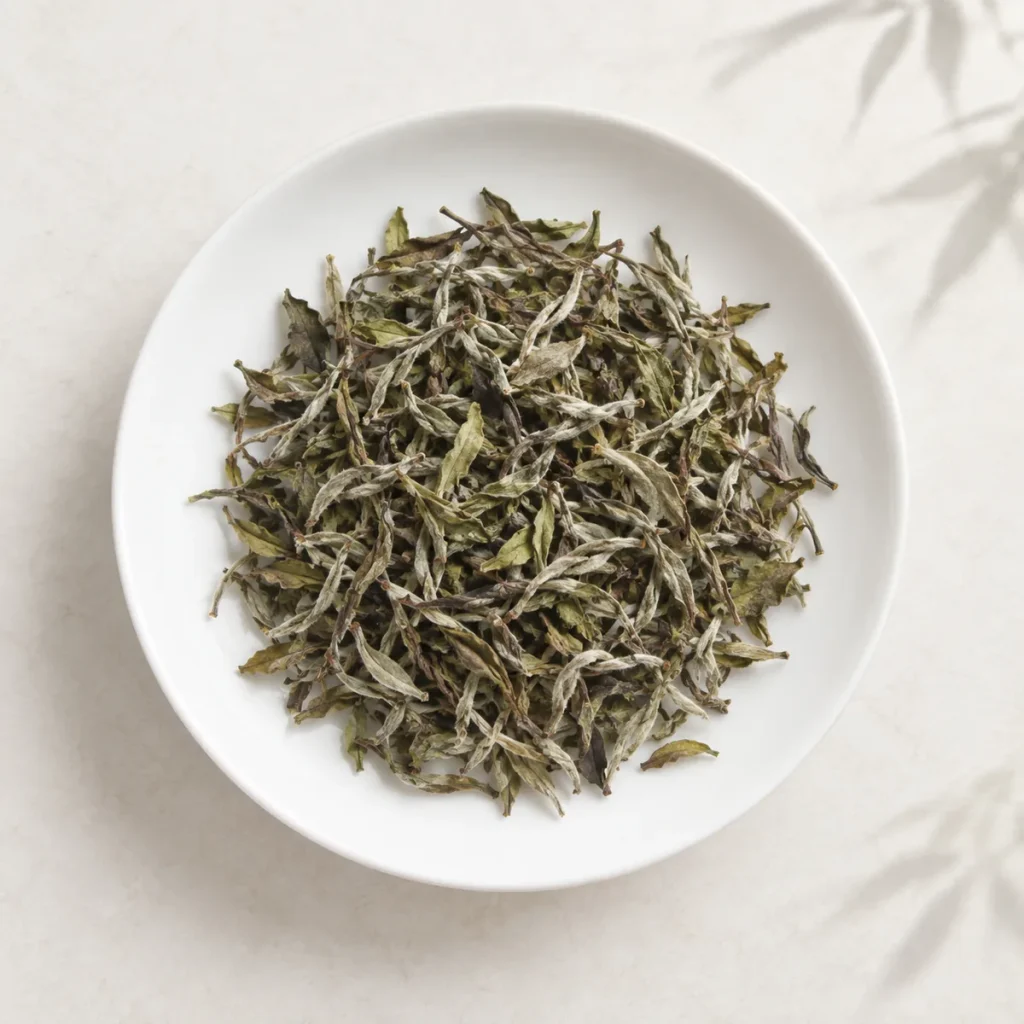
Jianyang Small White Tea is a highly distinctive traditional white-tea system from Jianyang, Fujian, made from local sexually propagated population-cultivar Caicha leaves using white-tea processing. Current T/CSTEA 00014.2—2020 divides it into Small White Silver Needle, Small White Gongmei and Small White Shoumei. The population-cultivar material preserves rich plant-to-plant variation. Higher-grade Small White Gongmei commonly shows curled gray-green leaves, visible hairy buds, fresh pekoe and floral aroma, pale apricot-yellow liquor and a fresh, mellow, sweet-brisk taste.

Origin
Jianyang, Nanping, Fujian · Zhangdun as the core area
Harvest
Local Jianyang population cultivar (Caicha) · varies by the three product forms
Craft
Natural withering · drying · sorting
Aroma
Fresh tender pekoe aroma · Elegant floral fragrance
Taste
Fresh, mellow and sweet-brisk · Sweet, moist and lively
Liquor
Bright pale apricot-yellow · Light and translucent
Dry Leaf
Curled gray-green leavesHairy buds with natural variation
Liquor Color
Bright pale apricot-yellowLight and translucent
Aroma
Fresh tender pekoe aromaElegant floral fragrance
Taste
Fresh, mellow and sweet-briskSweet, moist and lively
Finish
Clean returning sweetnessFloral resonance emerges gradually
Infused Leaf
Tender bright yellow-greenBud and leaves remain attached

Tea Overview

Tea Category
White tea · Jianyang white tea · population-cultivar small white tea
Cultivar
Local Jianyang population cultivar (Caicha)
Grade
Evaluated by product form · Small White Gongmei has 4 grades
Harvest Period
Depends on tenderness of Silver Needle / Gongmei / Shoumei
Plucking Standard
Plucked separately according to the three product forms
Processing
Natural withering · drying · sorting
Also Known As
Small White Tea · Jianyang Caicha White Tea
Aging
The current group standard cites DB35/T 1896—2020 White Tea Storage Technical Specification and allows long-term storage. Whether desirable aged character develops still depends on raw material, moisture, packaging and storage conditions.

Origin & Terroir

Jianyang Small White Tea has a clear regional identity, but “Jianyang Small White Tea” itself is not a standalone national geographical-indication product name. Its broader place identity can connect to the geographical-indication certification trademark “Jianyang White Tea,” while Zhangdun also has the more specific GI certification trademark “Zhangdun Gongmei White Tea.” T/CSTEA 00014.2—2020 separately defines the product by requiring local Jianyang population-cultivar (Caicha) raw material.

Origin
Jianyang, Fujian · Zhangdun as the core
Altitude
No single legal value
Climate
Humid northern Fujian mountains · under-forest ecological trials
Soil
Depends on the specific garden · no unverified hard values
Landform
Northern Fujian hills and mountains · stream-valley gardens

Brewing

Gaiwan / white porcelain cup / glass cupWater first, then tea, then top up
Leaf Method
Gaiwan / white porcelain cup / glass cup
Teaware
White porcelain gaiwan, tasting cup or heat-resistant glass cup
Leaf Amount
About 5 g
Water Temperature
About 90–95°C
Tea-to-Water Ratio
About 1:20–1:30 (editorial recommendation)
Time
Representative first infusion about 15–25 s
Infusions
About 5–7 infusions, adjusted to product form and age
Water
Clean drinking water
Brewing Steps · 4
  1. Identify the product form: First determine whether the tea is Small White Silver Needle, Small White Gongmei or Small White Shoumei, then adjust water temperature and steeping time.
  2. Warm the vessel: Warm the gaiwan or glass cup with hot water and discard the warming water.
  3. Pour the water: For representative Small White Gongmei, use about 90–95°C water and pour steadily along the vessel wall to avoid violently breaking the shoots.
  4. Decant: Begin the first infusion around 15–25 seconds, then adjust later steeps according to how the population-cultivar leaves open, their tenderness and preferred strength.

Composition & the Body

Jianyang Small White Tea has a clear product definition, group standard and publicly announced quality-chemistry work, but the currently verifiable public evidence is not sufficient to build peer-reviewed composition research records that meet the V3.5 evidence requirements field by field.

Available evidence is insufficient to build a tea-specific composition profile. Only verified basics and drinking notes are retained; unsupported values or effects are not added.

Composition Profile

Verified · 2026-09-26
Data in progress

No tea-specific featured composition data can be displayed safely at present.

The evidence slot remains intentionally open. This page does not borrow composition data from Jianyang White Tea generally, Gongmei, Shoumei or generic white tea. It will be expanded only when the full technical white paper or peer-reviewed research becomes publicly available.

Jianyang Small White Tea has been verified as using fresh leaves from local Jianyang population cultivars (Caicha) and has the standard Jianyang White Tea Part 2: Jianyang Small White Tea. Quality indicators such as moisture, ash or water extract in standards are not equivalent to a research-style composition profile and are therefore not forced into composition.research in this batch.

Tea Culture

Landscapes, people and history within a single leaf.

01

“Small White Tea” Is Not Low-Grade White Tea, but an Independent Jianyang Caicha Population System

In Jianyang Small White Tea, the word “small” first refers to the relatively small buds and leaves of the traditional local Caicha population, not to low quality. T/CSTEA 00014.2—2020 directly defines it as white tea made from fresh leaves of local Jianyang population cultivars (Caicha) and divides it into Small White Silver Needle, Small White Gongmei and Small White Shoumei.

Unlike clonal Dabai tea cultivars, Caicha is sexually propagated and preserves more complex genetic variation. Even within one population-cultivar garden, different tea plants may show subtle differences in bud form and aroma. This “one tree, one flavor” character is not a flaw in standardization but one of the most valuable regional traits of Jianyang Small White Tea.

02

Jianyang Had Tribute-Tea Traditions in the Song, but Modern Small White Tea Craft Should Not Simply Be Pushed Back to the Song Dynasty

Jianyang has a deep Song-dynasty tea culture shaped by the wider influence of Beiyuan tribute tea and Jian ware, and some local promotional narratives extend Small White Tea back into the Song tribute-tea tradition. For today's no-firing, no-rolling, withering-and-drying white-tea process, however, a safer chronological anchor comes from modern tea-history research.

A 2025 Fujian government feature citing local research traces the creation of modern Small White Tea to around 1772, when the Xiao family of Nankeng in Zhangdun used tender local Caicha shoots and a half-sun, half-shade method. In the 20th century, Jianyang white tea developed a substantial overseas-Chinese market, later declined, and in recent years has been revived through population-cultivar conservation, standardization and brand building.

The page therefore preserves two different historical levels at the same time: the broader Song-dynasty tea-cultural background of Jianyang, and the formation of modern Small White Tea craft in the 18th century, without conflating the two.
03

What Is Truly Rare in Zhangdun Is Not Just the Tea Site, but a Whole Sexually Propagated Population Gene Pool

The core of Jianyang Small White Tea remains in Zhangdun today. Unlike many clonally propagated tea gardens where plant traits are relatively uniform, local Caicha is propagated from seed, so natural differences remain among individual tea plants. Recent Fujian government reporting describes this ecology as “one tree, one flavor” and notes local work to establish mother-tree and germplasm conservation bases and promote under-forest ecological cultivation.

This means the terroir of Jianyang Small White Tea is not only altitude, soil or mist. It also includes the diversity of a population cultivar that has been preserved over a long period.

04

No Firing and No Rolling Looks Simple; the Hard Part Is Bringing Uneven Population-Cultivar Shoots to the Right Withering State Together

Jianyang Small White Tea follows the white-tea technical line of no firing and no rolling, and the group standard requires compliance with GB/T 32743. Traditional processing centers on natural withering, followed by drying and refining to stabilize quality.

The challenge is that population-cultivar buds and leaves naturally differ in size, moisture and maturity, so withering is not simply waiting for the leaf to dry. Tea makers adjust spreading, combining/screening, drying and re-baking according to weather, shoot condition and batch variation, trying to preserve pekoe aroma, floral fragrance and fresh mellowness while avoiding green odor, undesirable reddening or coarse mixed notes.

05

Jianyang Small White Tea Has No Single Fixed Appearance: Silver Needle, Gongmei and Shoumei Are Three Different Faces

The current group standard gives the three product forms clearly different sensory anchors. Small White Silver Needle has slender gray-green buds, tender pekoe aroma, a clean mellow sweet-brisk taste and pale apricot liquor. Special Grade Small White Gongmei has abundant hairy buds, curled leaf edges and connected buds and leaves, with fresh pekoe and floral fragrance and a fresh mellow sweet-brisk taste. Small White Shoumei has more open leaves, some tender stems, deeper liquor and a stronger taste.

For that reason the four representative images on this page use higher-grade Small White Gongmei as the visual anchor, while the database retains all three product forms. One appearance must never be presented as if it represented all Jianyang Small White Tea.

06

It Already Has Provincial Intangible Heritage and GI Certification Marks, but Its Agricultural-Heritage Application Is Still in Progress

In 2019, White Tea Making Craft (Jianyang) was added as an extension project to Fujian's provincial representative intangible cultural heritage list, with the Jianyang District White Tea Association as the safeguarding unit. In 2020, Zhangdun Gongmei White Tea obtained a geographical-indication certification trademark, while Jianyang White Tea itself had already obtained a broader GI certification trademark.

In 2026, Jianyang formally began the application process for Small White Tea to enter China's Important Agricultural Heritage Systems. As of this verification, however, it has not yet been recognized as a China Important Agricultural Heritage System, has not entered China's GIAHS tentative list, and is not an FAO-designated GIAHS. The page may therefore say “application underway,” but must not describe it as already recognized.

Frequently Asked Questions

Why is it called Jianyang “Small White Tea”?
The word “small” mainly refers to the relatively small buds and leaves of Jianyang's local sexually propagated Caicha population and does not mean low grade. The current group standard explicitly requires fresh leaves from local Jianyang population cultivars.
What types of Jianyang Small White Tea are there?
T/CSTEA 00014.2—2020 divides it into Small White Silver Needle, Small White Gongmei and Small White Shoumei according to fresh-leaf plucking standards.
Does Jianyang Small White Tea have one unified grading system?
No. One grading system does not cover all three forms. Small White Gongmei has Special Grade, Grade 1, Grade 2 and Grade 3, while Small White Silver Needle and Small White Shoumei are each evaluated according to their own sensory requirements.
What is the relationship between Jianyang Small White Tea and ordinary Gongmei?
Gongmei is a nationwide white-tea product type under GB/T 22291—2017. Jianyang Small White Tea is a regional Caicha white-tea system, and Small White Gongmei is only one of its three product forms. They are related but exist at different classification levels.
Is Jianyang Small White Tea the same as Zhangdun Gongmei White Tea?
No. Zhangdun Gongmei White Tea is a more specific regional product with a geographical-indication certification trademark. Jianyang Small White Tea also includes Small White Silver Needle and Small White Shoumei and therefore has a broader scope.
Does Jianyang Small White Tea have a geographical indication?
The broader “Jianyang White Tea” has a geographical-indication certification trademark, while Zhangdun Gongmei White Tea has a separate GI certification trademark. Jianyang Small White Tea itself should not be given an invented standalone national GI product identity.
Is White Tea Making Craft (Jianyang) a national intangible cultural heritage project?
No. Its accurate status is a Fujian provincial representative intangible cultural heritage extension project announced in 2019, safeguarded by the Jianyang District White Tea Association. It should not be upgraded to national-level or UNESCO status.
Is Jianyang Small White Tea already a China Important Agricultural Heritage System or FAO GIAHS?
No, not as of 2026-09-24. Jianyang launched an application for national important agricultural heritage recognition in 2026, but applying is not the same as being recognized.

Tea Conversations

Tea lovers from around the world meet over a cup of tea.

Sign in or register to join the conversation. Your comment account is created automatically the first time you use a connected account.