Skip to content
Tea & Realm
English

Mengding Huangya

Yellow tea · yellow-bud tea · distinctive Mengding Mountain tea

Golden buds with subtle hairs · three fryings and three menhuang stages · sweet aroma and honeyed resonance.

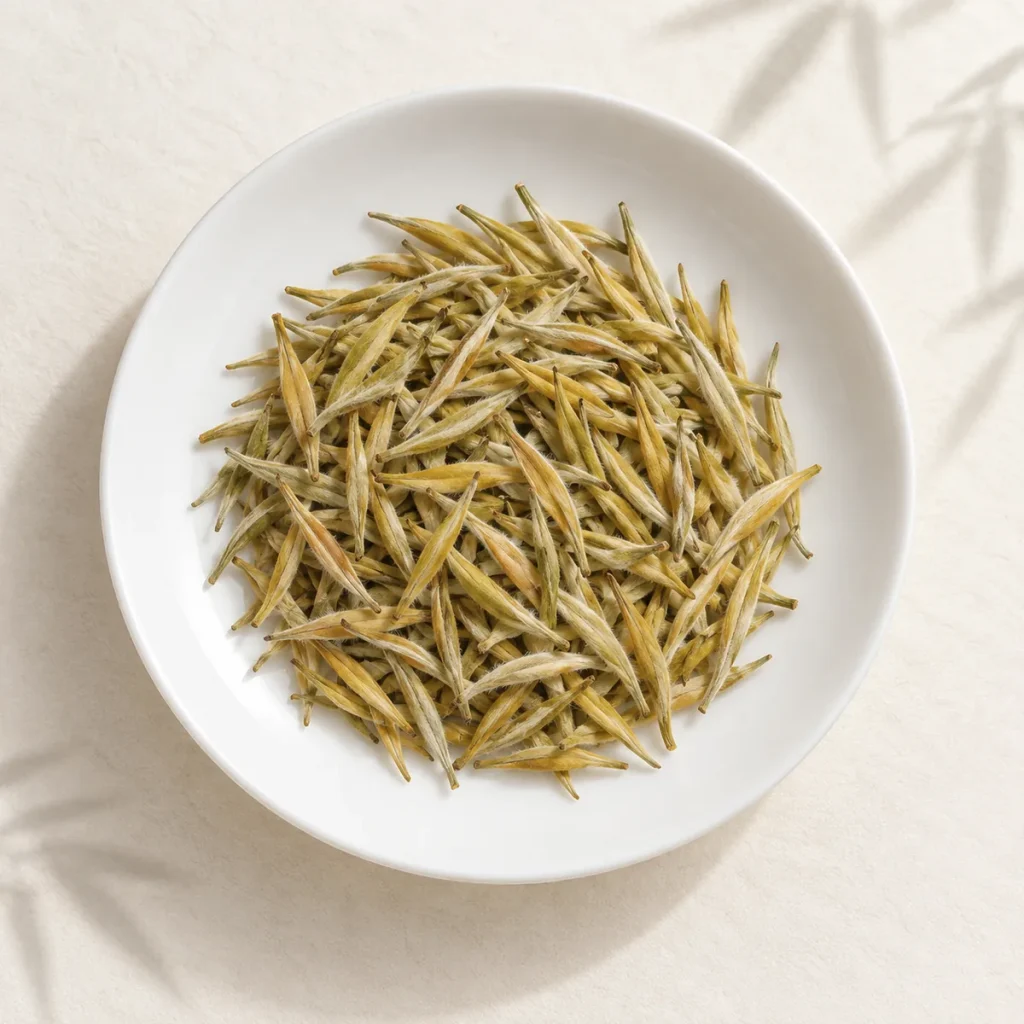
Mengding Huangya is a traditional yellow-bud tea from Mount Mengding in Ya'an, Sichuan, and a distinctive famous tea within the Mengshan Tea geographical-indication system. Its independent group standard, effective from 2025, divides loose tea into Treasure Grade, Special Grade and Grade 1 and also recognizes compressed tea. Traditional higher-grade tea commonly uses full tender buds picked before Qingming and develops through multiple yellowing stages including pan-firing, wrapping-yellowing and piling-yellowing. Finished tea is glossy yellow, with subtle golden hairs, bright tender-yellow liquor, sweet fragrance and honeyed resonance, and a fresh, mellow, sweet-brisk taste.

Origin
Ya'an, Sichuan · Mengshan Tea GI protection area
Harvest
Traditional higher grades · plump tender buds before Qingming
Craft
Pan-firing · wrapping-yellowing · re-firing · piling-yellowing · shaping · drying
Aroma
Rich sweet fragrance · Distinct honeyed resonance
Taste
Sweet, mellow and fresh · Moist sweetness with returning sweetness
Liquor
Bright tender yellow · Clear and soft
Dry Leaf
Plump, even budsGlossy yellow with subtle golden hairs
Liquor Color
Bright tender yellowClear and soft
Aroma
Rich sweet fragranceDistinct honeyed resonance
Taste
Sweet, mellow and freshMoist sweetness with returning sweetness
Finish
Long gentle sweetnessHoneyed resonance lingers
Infused Leaf
Bright yellow budsPlump, tender and even

Tea Overview

Tea Category
Yellow tea · yellow-bud tea · distinctive Mengding Mountain tea
Cultivar
Suitable cultivars of the Mengding Mountain tea area
Grade
Loose tea: Treasure / Special / Grade 1
Harvest Period
Traditional higher grades · tender buds before Qingming
Plucking Standard
Traditional higher grades: plump single buds
Processing
Pan-firing · wrapping-yellowing · re-firing · piling-yellowing · shaping · drying

Origin & Terroir

The legal geographical-indication object above Mengding Huangya is “Mengshan Tea,” while modern industry and branding more often use “Mengding Mountain Tea.” The historical and cultural core is Mount Mengding in Mingshan District, Ya'an. The GI protection area also includes relevant villages in the parts of Yucheng District that lie on Mengshan. This page therefore separates the legal term “Mengshan Tea” from the modern brand term “Mengding Mountain Tea.”

Origin
Ya'an, Sichuan · Mengshan Tea GI protection area
Altitude
No unified published legal value · mountain and hill tea region
Climate
Humid subtropical · rainy and misty
Soil
Acidic to slightly acidic · loose and deep soils
Landform
Western basin edge · highlands and hills

Brewing

Glass cup / white porcelain gaiwanWater first, then tea, then top up
Leaf Method
Glass cup / white porcelain gaiwan
Teaware
Clear glass cup or white porcelain gaiwan
Leaf Amount
3 g
Water Temperature
80–85°C
Tea-to-Water Ratio
About 1:50 (3 g / 150 mL)
Time
Glass 2–3 min · gaiwan start around 25–40 s
Infusions
About 3–4 infusions
Water
Clean soft or low-mineral water
Brewing Steps · 4
  1. Warm the cup: Warm the glass or gaiwan with hot water, then discard the warming water.
  2. Add the tea: Use about 3 g of Mengding Huangya per 150 mL, leaving enough room for the plump buds to open.
  3. Brew with moderately hot water: Pour water at about 80–85°C gently to avoid striking the tender buds with excessive heat.
  4. Observe color and aroma: After about 2–3 minutes, observe the bright tender-yellow liquor and opening buds, then follow the sweet fragrance, honeyed resonance and fresh mellow returning sweetness.

Composition & the Body

Mengding Huangya has direct systematic composition measurements and processing research on menhuang, making it one of the best-supported yellow-bud teas in this batch.

Composition Profile

Verified · 2026-09-26
  1. 01
    Caffeine4.98 %
    Dry-leaf sample
  2. 02
    Volatile aroma compositionSixty-nine aroma components were detected. Alcohols had the greatest number and abundance, with 22 alcohol compounds accounting for 31.69% of total volatiles.
    Dry-leaf sample
  3. 03
    Physicochemical and aroma changes driven by menhuang durationWhen total menhuang time increased from 140 to 220 min, tea polyphenols decreased from 23.41% to 20.28%, catechins from 17.03% to 15.64% and caffeine from 4.68% to 3.84%; soluble sugars increased from 2.97% to 3.27% and water extract from 33.42% to 38.33%, while the aroma direction shifted from clean/fresh toward sweeter notes.
    Other sample

Direct quantitative data cover caffeine, catechins, free amino acids, tea pigments and aroma composition. Menhuang duration also significantly changes major taste compounds and the aromatic direction.

The 2014 values represent specific research samples, and the paper explicitly reports substantial differences among products from different enterprises. The 140→220 minute values from 2021 describe process-driven change and must not be rewritten as fixed product ranges.

View Research Sources

蒙顶黄芽主要成分含量及组分分析

速晓娟, 郑晓娟, 杜晓, 边金霖, 李明月, 李丹 · 食品科学 · 2014

Research samples of Mengding Huangya famous tea.

Caffeine content was 4.98±0.34%, with clear differences among samples from different producers.

DOI: 10.7506/spkx1002-6630-201412021View Source

闷黄新工艺对蒙顶黄芽品质及香气的影响

张厅, 刘晓, 王小萍, 龚雪蛟, 唐晓波, 王云, 李春华 · 食品工业科技 · 2021

Mengding Huangya processing trials with different first- and second-wrapping menhuang time combinations.

Menhuang duration significantly changed taste compounds, tea-pigment transformation and volatile aroma composition.

DOI: 10.13386/j.issn1002-0306.2021030026View Source

Tea Culture

Landscapes, people and history within a single leaf.

01

After 2025, Mengding Huangya Finally Has Its Own Single-Product Standard

For a long time, Mengding Huangya existed mainly under the broader umbrellas of “Mengshan Tea,” “Mengding Mountain Tea” and yellow-tea industry standards. That changed in 2025: T/YACX 006—2024 Mengding Huangya took effect on January 1, 2025, filling the gap in a dedicated single-product standard. The new standard divides the product into loose tea and compressed tea; loose tea is graded Treasure Grade, Special Grade and Grade 1, while compressed tea is not graded.

At the same time, GH/T 1351—2021 Mengding Mountain Tea Part 3: Yellow Tea continues to provide the broader industry framework, while GB/T 18665—2008 Geographical Indication Product—Mengshan Tea carries the GI identity. The page therefore no longer treats Mengding Huangya as an old famous tea with historical prestige but no modern standardization.

02

Tribute-Tea Memory and Modern Huangya Need to Be Told Separately

Ya'an official and heritage materials have long placed Mengding Huangya within Mount Mengding's tribute-tea history, using the local cultural narrative that tribute began in the first year of the Tianbao era of the Tang and continued through the end of the Qing. This historical memory is an important part of Mengding Huangya's cultural identity, but today's yellow-tea category definition, standardized menhuang craft and Treasure/Special/Grade 1 grading system are product languages that became institutionalized much later.

The safest website approach is therefore to acknowledge the long continuity of Mount Mengding tribute-tea tradition and the Huangya name while avoiding the claim that Tang-dynasty tribute tea was identical in process, grading and sensory specification to Mengding Huangya under today's T/YACX 006—2024.

03

Mengshan and Mengding Mountain: One Tea Region, Two Naming Contexts

The region behind Mengding Huangya has a typical naming difference. National geographical-indication protection and the national standard use “Mengshan Tea,” while industry standards, regional branding and contemporary cultural communication more often use “Mengding Mountain Tea.” Both point toward Mount Mengding in Mingshan, Ya'an as the core tea area, but legal and standard names should not be rewritten casually.

China's official heritage materials describe this area on the southwestern edge of the Sichuan Basin, in the transition from the Chengdu Plain to the western Sichuan plateau, as a humid subtropical monsoon environment with highlands and hills, abundant rain and mist, and mostly acidic or slightly acidic, loose, deep soils. This humid, cloudy ecology forms part of the regional background for Mengding Huangya's tender bud material and sweet honeyed character.

04

The Standard Says “Wrapping-Yellowing and Piling-Yellowing”; Tea Makers Say “Three Fryings and Three Menhuang Stages”

Mengding Huangya is best understood by preserving two kinds of process language at once. Current GH/T 1309—2020 describes a standardized sequence of fresh-leaf spreading, pan-firing, cooling, first frying, wrapping-yellowing, re-frying, piling-yellowing, strip arranging and pressing, shaping, drying, sorting, blending and aroma-finishing bake.

Local intangible heritage and traditional craft, however, more often summarize its soul as “three fryings and three menhuang stages.” Frying and resting alternate repeatedly, allowing the heat-fixed buds to lose green odor slowly under warm, humid conditions, shift from green toward yellow and develop sweet fragrance, honeyed resonance and mellow sweetness. The two descriptions do not conflict: one emphasizes modern production nodes, while the other preserves the experience-based language of tea makers. The formal process field follows the current standard; the cultural chapter explains the traditional phrase.

05

Its Yellow Is Warmer than Junshan Yinzhen, Yet Far More Delicate than Large-Leaf Yellow Tea

The official national-level Mengshan Tea heritage page gives Mengding Huangya a highly recognizable sensory description: full, even buds; bright yellow glossy appearance with subtle golden hairs; sweet fragrance and honeyed resonance. Ya'an provincial heritage materials further emphasize bright tender-yellow liquor, rich sweet aroma, fully yellow buds and a mellow returning-sweet taste.

The representative images therefore use plump single buds, tender to golden yellow tones, a glossy surface and subtle fine hairs as the higher-grade visual anchor, without copying Junshan Yinzhen's long needle form or its large-scale upright display in the cup. Mengding Huangya's appeal is more like a rounded, warm golden bud: sweet but not cloying, with honeyed resonance, fresh mellowness and a clear sweet return.

06

How a Provincial Huangya Heritage Project Enters the National and UNESCO Systems

Mengding Huangya has an unusually complete heritage chain. In 2011, Mengding Huangya Traditional Making Craft entered the second batch of Sichuan provincial intangible-cultural-heritage extension projects, giving the tea its most direct single-product heritage identity.

In 2021, the national project Green Tea Making Craft (Mengshan Tea Traditional Making Craft) entered China's fifth national intangible-cultural-heritage list. Although the official project name says “green tea making craft,” China's official heritage project page explicitly states that the system also includes “the yellow-tea making craft of Mengding Huangya.” In 2022, Mengshan Tea Traditional Making Craft then became a Sichuan constituent element of UNESCO's “Traditional tea processing techniques and associated social practices in China.” The page can therefore record a direct relationship with national heritage and UNESCO, but must explain that the connection comes through the broader Mengshan Tea Traditional Making Craft rather than inventing a separate UNESCO project named “Mengding Huangya.”

Frequently Asked Questions

Does Mengding Huangya now have its own dedicated product standard?
Yes. T/YACX 006—2024 Mengding Huangya took effect on 2025-01-01, and official reporting described it as filling the previous gap in a dedicated single-product standard.
How many grades does Mengding Huangya have?
Current T/YACX 006—2024 divides Mengding Huangya into loose tea and compressed tea. Loose tea has Treasure Grade, Special Grade and Grade 1; compressed tea is not divided into grades.
Must Mengding Huangya always be single-bud tea?
Traditional higher-grade production and provincial heritage materials clearly use plump single buds picked before Qingming, and the representative images on this page use that form. However, public news materials for T/YACX 006—2024 did not disclose the complete fresh-leaf tenderness clauses for all three loose-tea grades, so “single bud” should not be expanded into a universal legal picking rule for every grade under the new group standard.
Is “three fryings and three menhuang stages” the core Mengding Huangya process?
It is a very important traditional and heritage summary. Current GH/T 1309—2020 uses standardized terms such as pan-firing, wrapping-yellowing, re-firing, piling-yellowing, shaping and drying. Both describe the same broad logic of repeated frying and warm-humid yellowing, but the traditional phrase should not replace the formal standard wording as if it were the only clause.
Does Mengding Huangya have an independent geographical indication?
The current legal upper-level GI object is “Mengshan Tea.” GB/T 18665—2008 Geographical Indication Product—Mengshan Tea remains in force and received Amendment No. 1 in 2025. Mengding Huangya is a distinctive famous tea within this Mengshan Tea/Mengding Mountain Tea system and should not be given an unverified separate Mengding Huangya GI identity.
Why does the national heritage project say “Green Tea Making Craft” if Mengding Huangya is yellow tea?
Because the official national project name is Green Tea Making Craft (Mengshan Tea Traditional Making Craft), but China's official heritage project page explicitly states that the same craft system includes the yellow-tea making craft of Mengding Huangya. The product remains yellow tea, while the official heritage-project name must be preserved exactly.
Has Mengding Huangya entered UNESCO?
More precisely, the national-level Green Tea Making Craft (Mengshan Tea Traditional Making Craft), which explicitly includes the yellow-tea making craft of Mengding Huangya, became a Sichuan constituent element of UNESCO's 2022 “Traditional tea processing techniques and associated social practices in China.” It is not a separate UNESCO project named Mengding Huangya.
Does the Mengding Huangya tea region have agricultural-heritage status?
Yes. The Sichuan Mingshan Mount Mengding Tea Culture System is a China Important Agricultural Heritage System, with the core area around Mengdingshan Town and Mengyang Town in Mingshan District. As of this review, it is not presented here as a formally designated FAO Globally Important Agricultural Heritage System.

Tea Conversations

Tea lovers from around the world meet over a cup of tea.

Sign in or register to join the conversation. Your comment account is created automatically the first time you use a connected account.