Skip to content
Tea & Realm
English

Mogan Huangya

Yellow tea · fine bud-and-leaf yellow tea · geographical-indication product

Fine lotus-heart curls · yellowing while drying · clean sweetness and mellow freshness.

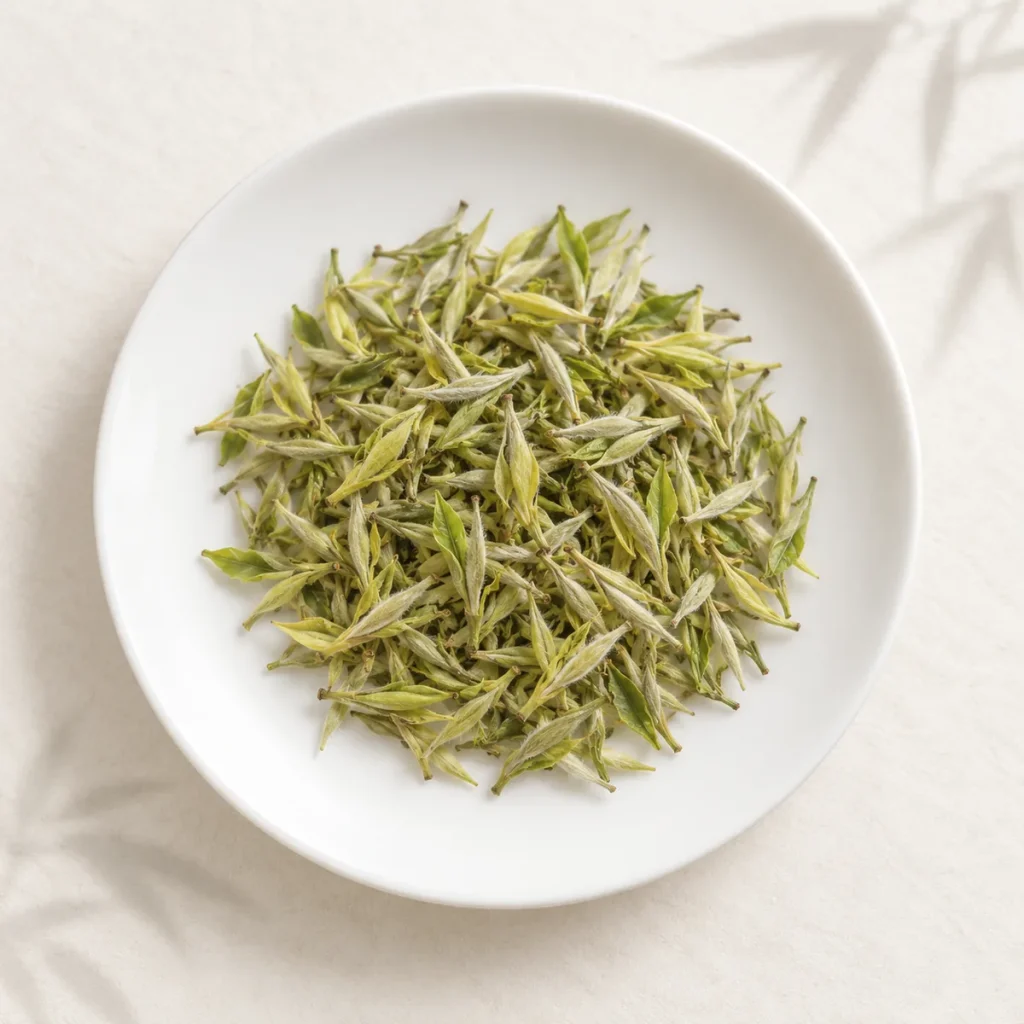
Mogan Huangya is a representative yellow tea from Mount Mogan in Deqing, Zhejiang, and was re-recognized in 2025 as an independently protected geographical-indication product. The current industry standard divides the yellow-tea version into Special Grade, Grade 1 and Grade 2. Higher-grade tea is represented by tender material such as one bud with one just-opening leaf and is made through spreading, heat-fixing, rolling, heated menhuang, first drying, shaping and final drying. The finished tea is fine, tight and slightly curved, tender yellow with visible hairs; the liquor is bright tender yellow, with a clean sweet aroma and a fresh, mellow, sweet taste.

Origin
Deqing, Huzhou, Zhejiang · GI area around Mount Mogan
Harvest
Tender spring shoots · visual baseline one bud with one just-opening leaf
Craft
Spreading · heat-fixing · rolling · heated menhuang · shaping · final drying
Aroma
Clean and sweet · Elegant tender-bud fragrance
Taste
Sweet, mellow and fresh · Moist sweetness and returning sweetness
Liquor
Bright tender yellow · Clear and soft
Dry Leaf
Fine, tight and slightly curvedTender yellow with visible hairs
Liquor Color
Bright tender yellowClear and soft
Aroma
Clean and sweetElegant tender-bud fragrance
Taste
Sweet, mellow and freshMoist sweetness and returning sweetness
Finish
Sweetness continuesLong clean aftertaste
Infused Leaf
Tender yellow and brightTender, even and flower-like

Tea Overview

Tea Category
Yellow tea · fine bud-and-leaf yellow tea · geographical-indication product
Cultivar
Local population cultivars · Longjing 43, Yingshuang, Hengling and others
Grade
Special Grade / Grade 1 / Grade 2
Harvest Period
Spring production · mainly around pre-Qingming through Guyu
Plucking Standard
Tender buds and leaves · visual baseline one bud with one just-opening leaf
Processing
Spreading · heat-fixing · rolling · heated menhuang · shaping · final drying

Origin & Terroir

Mogan Huangya now has an independent geographical-indication product identity. After CNIPA Announcement No. 640 of 2025 re-recognized it, the latest protected area was defined precisely as 26 administrative villages in four township or subdistrict units—Moganshan Town, Wukang Subdistrict, Wuyang Subdistrict and Fuxi Subdistrict in Deqing County—with explicit soil requirements.

Origin
Deqing, Huzhou, Zhejiang · GI area around Mount Mogan
Altitude
No unified legal altitude
Climate
Humid mountains of northern Zhejiang · misty with dense bamboo
Soil
Yellow sandy loam · pH 5.5–6.3
Landform
Mountains and hills · interwoven bamboo and tea

Brewing

Glass cup / white porcelain gaiwanWater first, then tea, then top up
Leaf Method
Glass cup / white porcelain gaiwan
Teaware
Clear glass cup or white porcelain gaiwan
Leaf Amount
3 g
Water Temperature
80–85°C
Tea-to-Water Ratio
About 1:50 (3 g / 150 mL)
Time
Glass 2–3 min · gaiwan start around 25–40 s
Infusions
About 3–4 infusions
Water
Clean soft or low-mineral water
Brewing Steps · 4
  1. Warm the cup: Warm the glass or gaiwan with hot water and discard all warming water.
  2. Add the tea: Use about 3 g of Mogan Huangya yellow tea per 150 mL, leaving room for the tender shoots to open.
  3. Brew with moderately hot water: Pour water at about 80–85°C gently and avoid prolonged direct steeping with boiling water.
  4. Drink promptly: After about 2–3 minutes, observe the bright tender-yellow liquor and flower-like opening shoots, then follow the clean sweetness, mellow freshness and returning sweetness.

Composition & the Body

Mogan Huangya has direct peer-reviewed research on the relationship between different degrees of menhuang and aroma composition.

Composition Profile

Verified · 2026-09-26
  1. 01
    Aroma composition under different menhuang degreesThe study compared aroma components in Mogan Huangya samples with different sensory degrees of menhuang and used those profiles to help calibrate yellow-tea menhuang degree. This batch does not transcribe individual numerical compound values that could not be stably re-verified.
    Other sample

The most robust tea-specific evidence currently available is the relationship between menhuang degree and aroma profile. Without stable access to the full quantitative table, this batch does not fill individual compound values from secondary sources.

Amino-acid or water-extract requirements in GI or industry standards are quality specifications rather than composition measurements from research samples.

View Research Sources

黄茶感官闷黄程度标定及不同闷黄程度莫干黄芽香气组分研究

龚淑英, 周森杰, 谢雨欣, 等 · 茶叶 · 2021

Mogan Huangya processing-trial samples with different menhuang degrees.

The study directly links Mogan Huangya aroma composition with menhuang degree.

DOI: 10.3969/j.issn.0577-8921.2021.03.002View Source

Tea Culture

Landscapes, people and history within a single leaf.

01

Why Can the Same “Mogan Huangya” Be Both Yellow Tea and Green Tea?

Mogan Huangya is an unusual case among famous Chinese teas because the same GI name currently covers two tea categories. The latest 2025 geographical-indication protection requirements define both a yellow-tea version and a green-tea version. The yellow tea undergoes heated menhuang and is characterized by fine, tight, slightly curved leaves, tender-yellow hairs, bright tender-yellow liquor and clean, sweet, mellow taste. The green-tea version does not use menhuang and instead shows a fine, green-moist appearance, tender-green liquor and fresh tender aroma.

The standards likewise separate the two: GH/T 1235—2018 specifically regulates Mogan Huangya yellow tea, while T/DQCY 003—2019 regulates Mogan Huangya green tea. This page belongs to Cha Yu Jing's yellow-tea directory, so all sensory descriptions, representative images and process fields are locked to the yellow-tea version and must not import the vivid green appearance of the same-named market green tea.

02

Ancient Mount Mogan Tea History and the Modern Huangya Restored in 1979

Tea cultivation on Mount Mogan predates the modern standardized Mogan Huangya product by many centuries. Local literature and heritage materials trace mountain tea activity back to the Jin and Song periods and preserve cultural memories of monks growing tea and Mount Mogan tea gradually becoming known.

The modern restoration and definition of Mogan Huangya as a fine yellow tea, however, is closely connected with the late 1970s. Deqing local materials record that production was restored around 1979 with participation from tea specialists; the tea subsequently entered Zhejiang famous-tea evaluations and by the 1980s had become one of the province's early recognized famous teas. This page therefore keeps “ancient Mount Mogan tea history” separate from the modern restoration of standardized Mogan Huangya yellow tea rather than equating old mountain tea directly with the product defined today by GH/T 1235.

03

Bamboo Forest, Yellow Sandy Loam and 26 Villages Around Mount Mogan

The 2025 GI re-recognition made the geographic boundary of Mogan Huangya very clear. It is not all of Deqing County and not only the Mount Mogan scenic area, but 26 administrative villages within Moganshan Town, Wukang Subdistrict, Wuyang Subdistrict and Fuxi Subdistrict.

What stands out most is not one legal altitude line, but the humid mountain environment, bamboo forest and yellow sandy loam around the Mount Mogan range. The latest GI requires soil pH 5.5–6.3 and organic matter of at least 2.5%, while emphasizing deep, permeable, fertile and loose soil. Together with tender raw material, clean sweet aroma and fresh mellow liquor, this ecological background forms the regional character of Mogan Huangya.

04

“Yellowing While Drying” Is the Key to This Yellow Tea

The step that truly separates Mogan Huangya yellow tea from the same-named green tea is menhuang. The 2025 GI writes the yellow-tea process as fresh-leaf spreading, heat-fixing, rolling, heated menhuang, first drying, shaping, final drying and finishing, and summarizes the technical character as “yellowing while drying, fixing substance and releasing aroma.”

Traditional heritage materials likewise treat menhuang as the defining yellow-tea process, though different handcraft lines may organize menhuang, first drying and strip shaping somewhat differently. The formal process field prioritizes the latest GI chain, while the cultural explanation clarifies that “yellowing while drying” means controlling the shift from green toward yellow through alternating heat and humidity, reducing green odor while avoiding dull, smothered aroma.

05

Not the More Yellow the Better: Tender Yellow, Clean Sweetness and Mellow Freshness

The sensory grading of GH/T 1235—2018 is reproduced again in Appendix B of the 2024 Mogan Yellow Tea standard. Special Grade is fine, tight and curled, even and clean, with a moist tender-yellow appearance, clean sweet aroma, bright tender-yellow liquor, a mellow sweet taste and relatively tender, bright yellow infused leaves. Grade 1 and Grade 2 gradually move from tight to relatively tight leaf form and from more moist yellow toward a slightly less vivid yellow as tenderness decreases.

The 2025 GI summarizes the representative yellow-tea style as fine, tight and slightly curved, tender yellow with visible hairs, bright tender-yellow liquor, clean sweetness and mellow taste. The representative images should therefore avoid both deep golden yellow and vivid green. Its most typical color is a soft, delicate tender yellow with a slight yellow-green transition.

06

From Municipal Heritage to Zhejiang Provincial Heritage in 2023

Mogan Huangya Making Craft had already been recognized as a Huzhou municipal intangible-cultural-heritage project before 2023. When the Zhejiang Provincial Government announced the sixth batch of provincial representative intangible cultural heritage projects in 2023, “Mogan Huangya Making Craft” formally entered the provincial list as a Deqing County project. China's official heritage feature pages also list it among Zhejiang tea heritage and emphasize the distinctive menhuang tradition.

In 2024, the “Zhejiang Deqing Mogan Huangya Tea Culture System” entered Zhejiang Province's Important Agricultural Heritage resource repository. This is a provincial agricultural-heritage resource identity and is not the same as the Ministry of Agriculture and Rural Affairs' China Important Agricultural Heritage System, nor is it an FAO Globally Important Agricultural Heritage System. Mogan Huangya Making Craft is also not one of the 44 constituent elements of UNESCO's 2022 “Traditional tea processing techniques and associated social practices in China.”

Frequently Asked Questions

Is Mogan Huangya yellow tea or green tea?
The name currently exists in both a yellow-tea and a green-tea version. The latest 2025 geographical-indication protection requirements regulate both: the yellow tea uses heated menhuang, while the green tea does not. This Cha Yu Jing page belongs to the yellow-tea directory and therefore follows the Mogan Huangya yellow-tea system under GH/T 1235—2018.
How many grades does Mogan Huangya yellow tea have?
Current GH/T 1235—2018 recognizes three grades: Special Grade, Grade 1 and Grade 2. Appendix B of T/CTSS 89—2024 Mogan Yellow Tea directly reproduces the same sensory grading system.
What is the core processing step of Mogan Huangya?
The latest 2025 GI yellow-tea process is spreading, heat-fixing, rolling, heated menhuang, first drying, shaping, final drying and finishing, summarized as “yellowing while drying, fixing substance and releasing aroma.” Menhuang is the key step distinguishing it from the same-named green-tea version.
Should Mogan Huangya be picked as one bud with one leaf or one bud with two leaves?
GI fresh-leaf quality materials cover one bud with one just-opening leaf, one bud with one leaf, and later one bud with two leaves. Public GH/T 1235 sensory materials do not lock each grade to one unique bud-leaf formula. This page uses one bud with one just-opening leaf as the higher-grade visual baseline without presenting it as the sole legal Special Grade plucking rule.
Is Mogan Huangya currently a geographical-indication product?
Yes. It obtained an agricultural geographical-indication registration in 2017, and CNIPA Announcement No. 640 of 2025 formally re-recognized Mogan Huangya as a geographical-indication product. The protected area includes 26 administrative villages in four township or subdistrict units around Mount Mogan in Deqing.
What level of intangible cultural heritage is Mogan Huangya Making Craft?
In 2023, Mogan Huangya Making Craft entered Zhejiang's sixth batch of provincial representative intangible cultural heritage projects, with Deqing County as the application area. It had previously been recognized at the Huzhou municipal level.
Has Mogan Huangya entered UNESCO intangible heritage?
No, not as of September 2026. Several Zhejiang tea crafts are constituent elements of UNESCO's 2022 “Traditional tea processing techniques and associated social practices in China,” but Mogan Huangya Making Craft is not among the 44 listed elements.
Is the Mogan Huangya Tea Culture System a China Important Agricultural Heritage System?
Its current verified identity is the “Zhejiang Deqing Mogan Huangya Tea Culture System” in Zhejiang Province's Important Agricultural Heritage resource repository. It is not presented here as a Ministry of Agriculture and Rural Affairs China Important Agricultural Heritage System or as a formally designated FAO GIAHS.

Tea Conversations

Tea lovers from around the world meet over a cup of tea.

Sign in or register to join the conversation. Your comment account is created automatically the first time you use a connected account.