Skip to content
Tea & Realm
English

Huoshan Huangdacha

Yellow tea · large-leaf yellow tea · geographical-indication product

Bronze hook-shaped leaves · prolonged menhuang and high fire · intense caramel aroma.

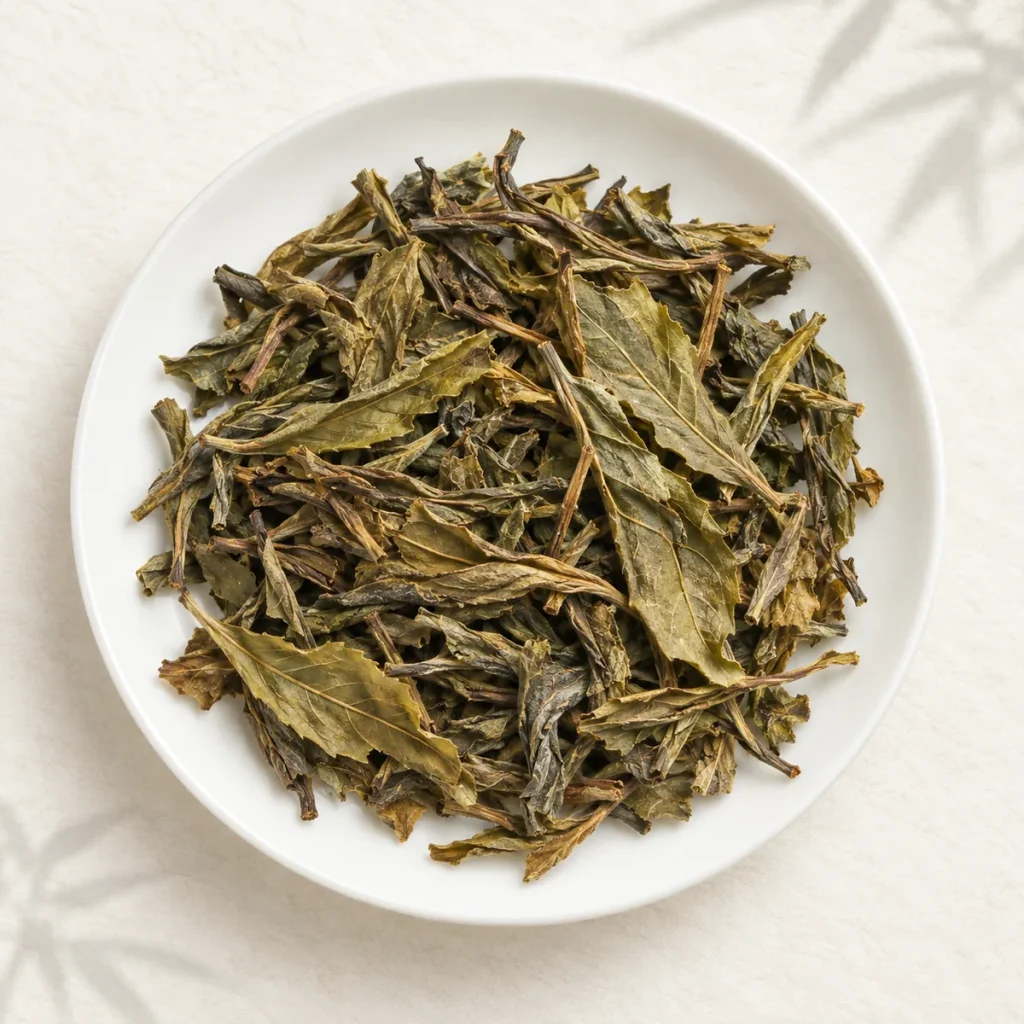
Huoshan Huangdacha is a representative large-leaf yellow tea from Huoshan, Anhui, and an independently protected geographical-indication product. Under the current 2025 GI requirements, it uses one bud with three to four leaves from local population cultivars and is made through heat-fixing, rolling, first drying, menhuang and final high-temperature drying. The finished tea has thick stems and broad leaves attached in hook-like sprays, a bronze appearance, deep yellow liquor and a rich, durable taste. Its most distinctive feature is a lifted, intense caramel-like aroma.

Origin
Huoshan County, Lu'an, Anhui · GI covers the whole county
Harvest
Mid-to-late April through early June · one bud with three to four leaves
Craft
Heat-fixing · rolling · first drying · menhuang · final drying
Aroma
Rich caramel aroma · Lifted, brisk and persistent
Taste
Rich and mellow · Sweet, smooth and durable
Liquor
Bright deep yellow · Slight golden-brown cast
Dry Leaf
Strong stems and broad leavesGlossy bronze tone
Liquor Color
Bright deep yellowSlight golden-brown cast
Aroma
Rich caramel aromaLifted, brisk and persistent
Taste
Rich and mellowSweet, smooth and durable
Finish
Substantial returning sweetnessLingering fire aroma
Infused Leaf
Yellow infused leavesStems and leaves fully open

Tea Overview

Tea Category
Yellow tea · large-leaf yellow tea · geographical-indication product
Cultivar
Latest GI: local population cultivars
Grade
No grades in the current GI
Harvest Period
Mid-to-late April through early June
Plucking Standard
One bud with three to four leaves
Processing
Heat-fixing · rolling · first drying · menhuang · final drying
Also Known As
West Anhui Huangdacha (a broader regional category, not identical to Huoshan Huangdacha)

Origin & Terroir

Huoshan Huangdacha has an independent geographical-indication product identity. CNIPA Announcement No. 632 of 2025 re-recognized the product and updated its protection requirements, defining the production area as the current administrative territory of Huoshan County, Anhui. The latest GI rules provide clear hard requirements for cultivar, altitude, soil and harvest.

Origin
Lu'an, Anhui · current administrative territory of Huoshan County
Altitude
GI: elevation ≥400 m
Climate
Humid Dabie Mountain climate · abundant rainfall
Soil
Yellow-brown/brown soils · pH 5.0–6.5
Landform
Dabie Mountain hills and mountains

Brewing

Gaiwan / large cup / teapotWater first, then tea, then top up
Leaf Method
Gaiwan / large cup / teapot
Teaware
White porcelain gaiwan, glass cup or ceramic teapot
Leaf Amount
5 g
Water Temperature
90–95°C
Tea-to-Water Ratio
About 1:30 (5 g / 150 mL)
Time
First infusion 30–45 s · glass 3–4 min
Infusions
About 4–6 infusions
Water
Clean soft or low- to medium-mineral water
Brewing Steps · 4
  1. Warm the vessel: Warm the gaiwan or teapot with hot water so the high-fire caramel aroma opens more readily.
  2. Add the tea: Use about 5 g per 150 mL, keeping the broad leaves and long stems intact rather than deliberately breaking them.
  3. Brew hot: Use 90–95°C water and decant the first infusion after about 30–45 seconds, observing the bright deep-yellow liquor.
  4. Extend gradually: Huoshan Huangdacha is rich and relatively durable; simply lengthen later steeps according to strength.

Composition & the Body

Huoshan Huangdacha has direct aroma-analysis research, roasting-flavor research using material from Huoshan, and sensomics/flavoromics studies of traditionally processed samples from Huoshan County.

Composition Profile

Verified · 2026-09-26
  1. 01
    Volatile aroma profile of Huoshan HuangdachaSDE detected 74 volatile compounds and HS-SPME detected 76, with 44 shared between the two methods. Furfural, 5-methylfurfural, 3-ethyl-2,5-dimethylpyrazine and methyl salicylate each exceeded 2% relative abundance in both methods.
    Dry-leaf sample

    Furans, pyrazines and related compounds jointly contribute to the distinctive roasted and toasted-rice-like aroma.

  2. 02
    Flavor chemistry under different roasting intensitiesLarge-leaf yellow tea made from material collected in the Huoshan area was compared under light, medium and old-fire roasting. Old fire was critical to the characteristic toasted-rice-like aroma; trans-β-ionone contributed floral aroma and 2,3-diethyl-5-methylpyrazine contributed roasted aroma.
    Dry-leaf sample
  3. 03
    Flavoromics of whole tea, stems and leavesIn traditionally processed large-leaf yellow tea from Huoshan County, stems showed stronger roasted/nutty aroma and sweetness, mainly associated with higher theanine and soluble monosaccharides; leaves were richer in catechins and caffeine and contributed more to body and astringency.
    Dry-leaf sample

Its characteristic roasted-rice-like aroma arises from the combined action of furans, pyrazines, aldehydes, ketones and other volatiles. Roast intensity and the proportion of stems to leaves both significantly reshape aroma and taste chemistry.

Relative abundances from SDE and HS-SPME cannot be directly compared. Different roasting temperatures, tea stems and leaves belong to different treatment or tissue contexts.

View Research Sources

SDE和HS-SPME结合GC-MS分析霍山黄大茶香气成分的比较

朱晓凤, 刘政权, 宛晓春, 陶勐, 肖志鹏, 程淑华 · 食品科学 · 2020

Finished Huoshan Huangdacha samples.

The volatile composition and relative abundance differed substantially between extraction methods.

DOI: 10.7506/spkx1002-6630-20190110-136View Source

Effect of the roasting degree on flavor quality of large-leaf yellow tea

Xiangyang Guo, Chi-Tang Ho, Wilfried Schwab, Xiaochun Wan · Food Chemistry · 2021

Large-leaf yellow tea made from raw material harvested in the Huoshan area of Lu'an, Anhui, under different roasting treatments.

Roasting intensity significantly reshaped both volatile and non-volatile flavor chemistry.

DOI: 10.1016/j.foodchem.2021.129016View Source

Effect of tea stems on the quality formation of large-leaf yellow tea: Sensomics and flavoromics approaches

Wenjing Huang, Qiuyan Liu, Jingming Ning · Food Chemistry: X · 2024

Traditionally processed large-leaf yellow tea purchased from a local tea factory in Huoshan County, Anhui, separated into whole tea, stems and leaves.

Stems and leaves differed systematically in amino acids, sugars, catechins, caffeine and aroma-active compounds.

DOI: 10.1016/j.fochx.2024.101794View Source

Tea Culture

Landscapes, people and history within a single leaf.

01

The “Large” in Large-Leaf Yellow Tea Does Not Mean Low Grade

In Huoshan Huangdacha, “large” refers first to raw-material maturity and shoot form rather than quality grade. Yellow-bud teas pursue single buds or one bud with one leaf, while small-leaf yellow teas often use one bud with one to two leaves. The latest 2025 GI requirements for Huoshan Huangdacha explicitly specify one bud with three to four leaves. These mature shoots create thick stems, broad leaves and connected branches and leaves, while also tolerating stronger fire and supporting a fuller taste. GB/T 21726—2018 recognizes yellow tea as an independent tea category, and DB34/T 2891—2017 further distinguishes yellow-bud, small-leaf yellow and large-leaf yellow tea within West Anhui yellow tea. Broad leaves and long stems therefore should not be misread as “coarse, low-grade tea.”

02

A Large-Leaf Yellow Tea Grown from the Tea History of Lu'an

The history of Huoshan Huangdacha needs to be understood within the broader tea history of Lu'an in western Anhui. Ming-dynasty tea literature already clearly identified Huoshan as an important core region of Lu'an tea. Xu Cishu's Chashu noted that north of the Yangtze, Lu'an tea was famous, while much of the actual production came from Huoshan. Local and agricultural materials commonly trace the mature formation of Huoshan Huangdacha to the Ming period and emphasize its historical appeal in northern markets for strong aroma and infusion durability.

The modern product identity is much clearer: it received agricultural geographical-indication registration in 2010, geographical-indication product protection under the former AQSIQ in 2015, and was re-recognized with updated protection requirements by CNIPA Announcement No. 632 in 2025 under the newer GI protection system. This page therefore separates ancient Lu'an tea history, the modern development of large-leaf yellow-tea processing, and today's legal GI identity rather than equating every historical reference to “Lu'an tea” or “Huoshan tea” with today's standardized Huoshan Huangdacha.

03

Dabie Mountain Tea Gardens Above 400 Meters

Huoshan Huangdacha is one of the relatively few yellow teas with explicit hard terroir requirements. The latest 2025 GI protection rules require tea gardens at elevations of at least 400 m, with yellow-brown or brown soils, pH 5.0–6.5, effective soil depth of at least 70 cm and organic matter of at least 2%. These conditions match the humid, mountainous tea-garden environment of Huoshan in the Dabie Mountains.

Local introductions often mention annual mean temperature, rainfall or particular “best elevation” figures. Such numbers can help describe local ecology, but they are not mandatory values in the 2025 GI protection requirements, so the front end displays only the altitude, soil and pH indicators that are actually legal requirements.

04

Five to Seven Days of Menhuang, Then the Final “Old Fire”

The distinctive craft of Huoshan Huangdacha is not simply “yellow it a little longer.” The latest GI protection requirements define the process as heat-fixing, rolling, first drying, menhuang and final drying. After first drying, the still-hot leaves are packed into tea baskets or mat enclosures so they gradually yellow in a warm humid environment. Once the leaf color turns yellow and aroma emerges, the tea moves to the final firing stage.

The West Anhui yellow-tea processing standard describes the mechanized route in more detail: Huangdacha can be piled for 5–7 days during menhuang; the later stages use light fire followed by old fire, with high-temperature final drying until the stems snap and the leaf can be rubbed into powder, accompanied by a strong high-fire aroma. Extended menhuang reduces raw green notes and astringency, while the high fire pushes sugar-like and baked aromas from mature shoots toward the characteristic caramel style. Together, these two stages distinguish Huoshan Huangdacha from delicate yellow-bud teas.

05

Bronze Leaves, Deep Yellow Liquor and Caramel Aroma

The aesthetic of Huoshan Huangdacha is almost the opposite of delicate premium bud teas. The latest GI quality description emphasizes thick stems and broad leaves, large connected shoots shaped like fishhooks, and a bronze dry-leaf color. The liquor is deep yellow, the infused leaf is yellow, the taste is rich and durable, and the aroma is a powerful yet clean caramel-like high-fire fragrance.

This caramel aroma comes from the combined effects of menhuang and high-temperature final drying; it is not added caramel or flavoring. The representative images therefore need to preserve thick stems, broad leaves and hooked shoots boldly. Refining the tea visually into tiny tender yellow buds for the sake of “premium” appearance would erase the very features that define Huoshan Huangdacha.

06

Two “Large-Leaf Yellow Tea” Heritage Projects Must Not Be Merged

Today the Lu'an region has two similarly named yellow-tea heritage projects with different administrative levels and application areas. The one directly corresponding to this product is Huoshan Huangdacha Making Craft, listed as a Lu'an municipal intangible-cultural-heritage project in 2020, with the Huoshan County Tea Industry Association as safeguarding unit; Huoshan's 2026 county-level representative-bearer list continues to use this project name.

A different project, Lu'an Huangdacha Making Craft, entered Anhui's sixth provincial intangible-cultural-heritage list in 2022, with the application area and safeguarding unit in Donghekou Town, Jin'an District, Lu'an. It is closely related to West Anhui Huangdacha culture and the old-fire process, but its higher status does not make Huoshan Huangdacha itself a provincial heritage project. Neither project is among the constituent elements of UNESCO's 2022 “Traditional tea processing techniques and associated social practices in China.”

Frequently Asked Questions

Are Huoshan Huangdacha and Huoshan Huangya the same tea?
No. Both come from Huoshan and belong to the local yellow-tea culture, but their raw-material tenderness and product standards differ. Huoshan Huangya is a delicate yellow-bud tea; the latest 2025 GI for Huoshan Huangdacha requires one bud with three to four leaves and emphasizes thick stems, broad leaves, bronze dry tea, deep yellow liquor and a high caramel aroma.
Why are the leaves and stems of Huoshan Huangdacha so large?
That is a product characteristic, not a sign of low grade. The latest GI itself requires one bud with three to four leaves. Mature shoots and visible stems are part of the standard identity, and finished tea is expected to retain connected branches and leaves in a hook-like form.
Is caramel flavor added to Huoshan Huangdacha?
No. The caramel-like aroma in the standard comes from menhuang and high-temperature final drying, especially the light-fire and old-fire stages. It should not be understood as added caramel, sugar or flavoring.
Does Huoshan Huangdacha have Grade 1, Grade 2 and Grade 3?
Current 2025 GI protection requirements and DB34/T 3020—2017 do not provide a finished-product grading table. The 2010 agricultural-GI materials used a separate four-level system of Grade 1, Grade 2, Grade 3 and stick tea. That belongs to another regulatory and historical quality-control framework and should not be presented as the current GI grading system.
Can clonal improved cultivars still be used for Huoshan Huangdacha?
There is a standards-update difference. DB34/T 3020—2017 still says “local population cultivars and clonal improved cultivars,” while CNIPA Announcement No. 632 of 2025 now specifies “local population cultivars” in the latest GI protection requirements. If Huoshan Huangdacha GI identity is claimed, the latest GI requirement should take priority.
Is Huoshan Huangdacha a provincial intangible cultural heritage tea?
Huoshan Huangdacha Making Craft is currently verified as a Lu'an municipal intangible-cultural-heritage project, listed in 2020 and safeguarded by the Huoshan County Tea Industry Association. The 2022 Anhui provincial project is a different item, Lu'an Huangdacha Making Craft, applied for from Jin'an District, and should not be rewritten as provincial status for Huoshan Huangdacha.
Has Huoshan Huangdacha entered UNESCO intangible heritage?
No verified evidence was found. Neither Huoshan Huangdacha Making Craft nor Lu'an Huangdacha Making Craft is among the 44 constituent elements of UNESCO's 2022 “Traditional tea processing techniques and associated social practices in China,” so this page does not assign UNESCO status.

Tea Conversations

Tea lovers from around the world meet over a cup of tea.

Sign in or register to join the conversation. Your comment account is created automatically the first time you use a connected account.