Skip to content
Tea & Realm
English

Anxi Tieguanyin

Oolong tea · Minnan oolong

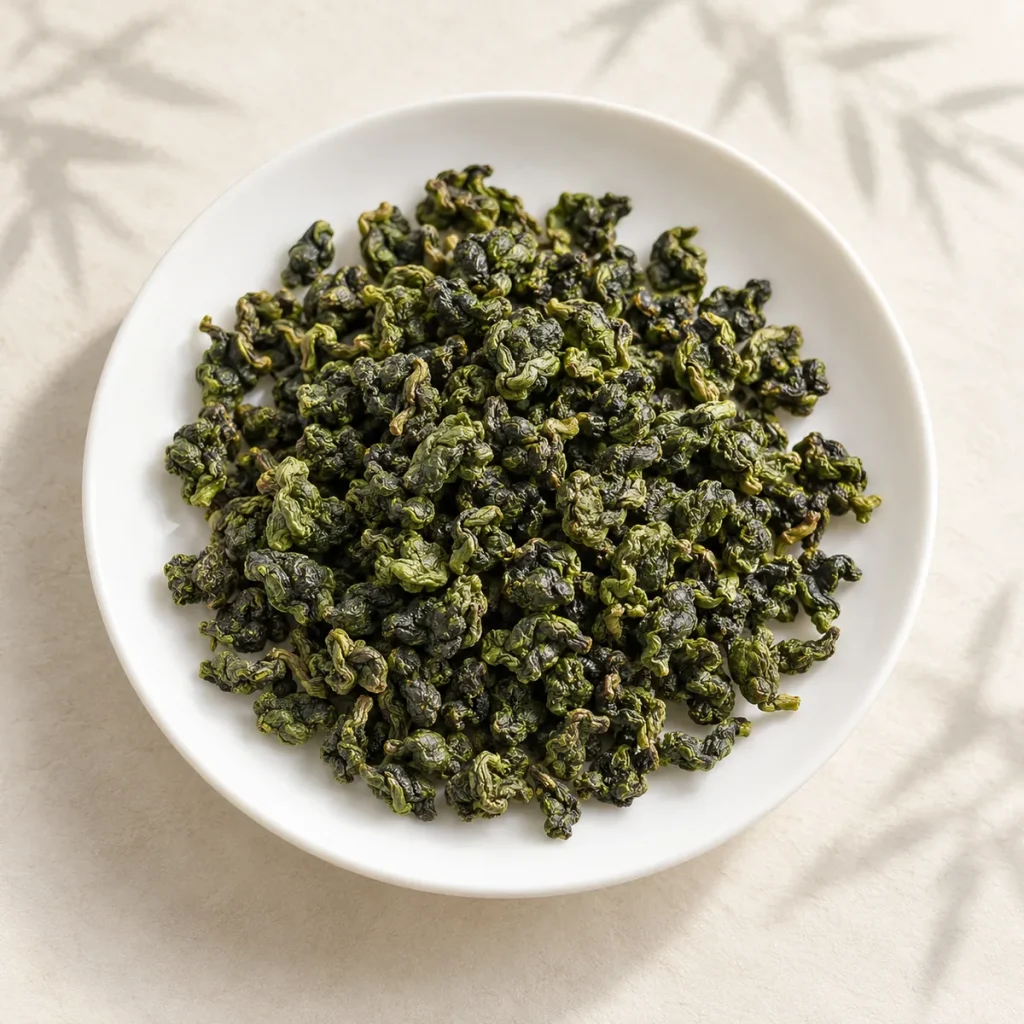
Sandy-green rolled leaves, orchid fragrance in the liquor, and a distinctive Tieguanyin resonance.

Anxi Tieguanyin is produced in Anxi County, Fujian, from fresh leaves of the nationally registered Tieguanyin tea cultivar and is one of the most representative Minnan oolong teas. Traditional manufacture uses sun withering, cooling and repeated shaking to build aroma and the classic “green leaf with red edge,” followed by heat-fixing, rolling and repeated cloth-ball rolling and baking to form the leaf. Classic fresh-aroma tea is plump, tightly rolled and glossy sandy green, with bright golden liquor, elegant lifted orchid fragrance and a fresh, mellow, sweet-brisk taste. Its most distinctive quality is not one aroma note but the unique “Yinyun” formed jointly by cultivar, terroir, processing and taste.

Origin
Anxi, Fujian · countywide geographical-indication area
Harvest
Open-face plucking at resting bud · spring and autumn most representative
Craft
Sun withering · zuoqing · heat-fixing · cloth-ball rolling · drying
Aroma
Lifted orchid fragrance · Rich and persistent
Taste
Fresh, mellow and sweet-brisk · Clear Yinyun
Liquor
Bright golden yellow · Clear and translucent
Dry Leaf
Plump and tightly rolledGlossy sandy green
Liquor Color
Bright golden yellowClear and translucent
Aroma
Lifted orchid fragranceRich and persistent
Taste
Fresh, mellow and sweet-briskClear Yinyun
Finish
Clean sweet returning finishLingering fragrance in the mouth
Infused Leaf
Thick, soft and glossyNatural red spots and edges

Tea Overview

Tea Category
Oolong tea · Minnan oolong
Cultivar
Tieguanyin cultivar · GS13007—1985
Grade
Fresh aroma 4 grades · strong aroma 5 · aged aroma 4
Harvest Period
Spring and autumn especially prized · multiple harvest seasons
Plucking Standard
Resting bud, small-to-medium open face · 2–4 leaves
Processing
Sun withering → zuoqing → heat-fixing → rolling → cloth-ball rolling → drying
Also Known As
Tieguanyin · Hongxin Guanyin (cultivar alias)
Oxidation / Fermentation
A partially oxidized oolong tea. During zuoqing, friction damages leaf-edge cells and induces selective enzymatic oxidation, creating red spots or red edges; heat-fixing then stops further oxidation. The standard does not define a fixed “oxidation percentage.”
Roasting
Fresh-aroma tea may be slowly baked at about 60–90°C; strong-aroma tea at about 90–150°C; aged-aroma tea is fully dried at roughly 70–140°C before storage.

Origin & Terroir

Anxi lies where the Daiyun Mountains extend southeastward. Elevation varies greatly from river valleys to high mountains, with low hills, high hills, low mountains, mid-mountains and valley basins interwoven across the county. A warm humid maritime monsoon climate, acidic sandy mountain soils and high forest cover together form the ecological foundation of Tieguanyin.

Origin
Anxi, Fujian · countywide geographical-indication area
Altitude
32–1,600 m · pronounced elevation range
Climate
18–22°C · humid monsoon climate
Soil
Sandy acidic soils · pH 4.5–6.0
Landform
Hilly mountain terrain · interwoven valley basins

Brewing

White porcelain gaiwan · 100°C boiling waterWater first, then tea, then top up
Leaf Method
White porcelain gaiwan · 100°C boiling water
Teaware
White porcelain gaiwan, about 115–125 mL
Leaf Amount
Fresh-aroma style: about 7 g / 110 mL effective brewing volume
Water Temperature
100°C
Tea-to-Water Ratio
Fresh aroma 1:15 · strong aroma 1:13 · aged aroma 1:18
Time
Fresh aroma: first infusion 40–60 seconds · then +10 seconds
Infusions
Multiple infusions according to style and tea quality, with progressively longer steeps
Water
Clean, odor-free drinking water
Brewing Steps · 4
  1. Warm the vessels and add tea: Warm the gaiwan and tasting cups with boiling water. For fresh-aroma Tieguanyin, use roughly a 1:15 tea-to-water ratio.
  2. Rinse and warm the cups: Add 100°C water and decant quickly, using the first liquor to warm the pitcher, filter and tasting cups.
  3. Brew with boiling water: Pour 100°C water gently and evenly. For fresh-aroma tea, a standard first infusion is about 40–60 seconds; drain the liquor completely.
  4. Extend later infusions: Add about 10 seconds to each subsequent steep and follow changes in orchid fragrance, floral aroma in the liquor, returning sweetness and Yinyun.

Composition & the Body

Tieguanyin has metabolomic and volatile-compound research covering zuoqing, cloth-ball rolling and different product styles, allowing a tea-specific composition profile centered on processing-driven change.

Composition Profile

Verified · 2026-09-26
  1. 01
    Metabolomic changes through processingAcross the full production process, 1,078 metabolites were identified and 62 changed significantly. Compared with fresh leaves, finished tea showed a 20.19% decrease in catechins and a 7.15% decrease in xanthine alkaloids.
    Other sample
  2. 02
    Metabolomic changes during cloth-ball rollingDuring cloth-ball rolling, 973 non-volatile metabolites, 468 differential metabolites and 47 volatile compounds were identified. Bitter/astringent flavonol glycosides and phenolic acids declined, while some floral-fruity volatiles increased.
    Other sample

    Cloth-ball rolling was associated with reduced bitterness/astringency and stronger floral-fruity expression.

  3. 03
    Volatile profiles of different stylesA total of 112 volatile compounds were identified across three Tieguanyin styles. Thirty-three shared dominant volatiles accounted for about 71.5% of total volatiles in fresh-aroma tea, 73.0% in strong-aroma tea and 71.8% in aged-aroma tea.
    Dry-leaf sample

Zuoqing and cloth-ball rolling continue to reshape catechins, alkaloids, flavonol glycosides, phenolic acids and floral-fruity volatiles, while fresh-aroma, strong-aroma and aged-aroma Tieguanyin also show clearly different volatile profiles.

Percentage changes during processing apply only within the corresponding studies and must not be rewritten as fixed product composition values. No tea-specific human evidence was included.

View Research Sources

An integrated metabolomic and transcriptomic analysis reveals the dynamic changes of key metabolites and flavor formation over Tieguanyin oolong tea production

Chenxue Li, Jinke Lin, Qichao Hu, Yun Sun, Liangyu Wu · Food Chemistry: X · 2023

Tieguanyin samples from multiple stages from fresh leaf to finished tea.

Processing reshaped catechins, alkaloids and the broader flavor metabolome associated with bitterness and astringency.

DOI: 10.1016/j.fochx.2023.100952View Source

基于代谢组学分析铁观音乌龙茶包揉过程中代谢物动态变化

佐明兴, 闫瑞, 封子旋, 高婷, 郑玉成, 侯炳豪, 叶乃兴, 陈倩洁, 毛宇源, 高水练 · 食品科学 · 2023

Tieguanyin rolled-leaf samples and successive cloth-ball rolling samples.

Major aroma compounds including linalool still had OAV values above 1 at the end of cloth-ball rolling.

DOI: 10.7506/spkx1002-6630-20230205-046View Source

Comparison of volatile compounds among different types of Tieguanyin oolong tea using DHI-GC-MS

D. Su, Y. Zheng, M. Huang, Z. Chen, L. Chen, M. Chen, Q. Yao · Analytical Methods · 2025

Fresh-aroma, strong-aroma and aged-aroma Tieguanyin.

E-nerolidol, ethanol, acetic acid and several C5/C6 volatiles helped distinguish the three Tieguanyin styles.

DOI: 10.1039/D4AY02042AView Source

Tea Culture

Landscapes, people and history within a single leaf.

01

Iron Bone, Orchid Heart

Anxi Tieguanyin is both a tea and the name of a tea cultivar. The 2025 national standard makes the definition explicit: only oolong tea produced within the geographical-indication area of Anxi County, using the Tieguanyin cultivar and local traditional processing, and showing the characteristic qualities of Tieguanyin, meets the protected-product definition of “Anxi Tieguanyin.”

This means that Huangjingui, Benshan, Maoxie, Meizhan and other famous Anxi cultivars cannot simply be called Anxi Tieguanyin even when made in the same county. The revised national standard also divides the product into fresh-aroma, strong-aroma and aged-aroma paths, so understanding Tieguanyin requires more than remembering “orchid fragrance”: cultivar, tea site, zuoqing, baking and storage all matter.

02

Tea Origins in Xiping

The origin of the Tieguanyin cultivar is widely associated with Xiping in Anxi, but local tradition has long preserved both the “Wei story” and the “Wang story” about its discovery and naming. The Wei story says that around 1725 Wei Yin found an unusual tea plant after a dream involving Guanyin; the Wang story says that Wang Shirang discovered the plant in 1736 and that the Qianlong Emperor later bestowed the name. Anxi County still preserves both narratives, so they are best presented side by side as local tradition rather than choosing one as uniquely proven history.

What can be stated with greater confidence is that Tieguanyin formed in Qing-dynasty Xiping and later spread through the county by vegetative propagation such as layering and cuttings. Along with the cultivar spread a body of knowledge involving open-face plucking, zuoqing, cloth-ball rolling, and the principle of adjusting the process to the leaf and weather.

03

South of the Daiyun Mountains

Anxi is a mountainous county ranging from 32 to 1,600 m in elevation, with low and high hills, low and mid-mountains, and valley basins all present. Annual mean temperature is about 18–22°C, annual rainfall around 1,600–1,800 mm, and average relative humidity about 76%. Day-night temperature differences in late spring and late autumn, together with local differences in wind, cloud, mist and slope aspect, create strong site-to-site variation.

Soils are generally acidic at about pH 4.5–6.0. Below 700 m, red soils are common; above that, yellow-red and yellow soils appear more frequently. The so-called “regional fragrance” of Tieguanyin is the expression of the same cultivar growing across these different mountain environments.

04

Shaking the Leaf into Resonance

The key to Tieguanyin is not simply rolling the leaf into pellets, but zuoqing. The 2025 standard details primary processing as withering, cooling, shaking, heat-fixing, rolling, first baking, first cloth-ball rolling, re-baking, repeated cloth-ball rolling and drying. Cooling and shaking are repeated 3–5 times, and the full zuoqing process can last 10–16 hours.

Shaking bruises cells along the leaf edge. During the resting periods, those damaged areas oxidize more deeply, creating red spots or red edges while green odors decrease and floral aroma develops. Once zuoqing reaches the desired point, the leaves are heat-fixed at roughly 260–300°C, then hot-rolled and repeatedly cloth-ball rolled and re-baked into tight, heavy pellets. Fresh-aroma tea receives lighter baking; strong-aroma tea receives stronger baking; aged-aroma tea is fully dried before at least five years of standardized storage.

05

Orchid Fragrance and Yinyun

The Tieguanyin quality most difficult to reduce to an ordinary aroma type is Yinyun. GB/T 19598—2025 defines it as the integrated expression of cultivar aroma, regional aroma, processing aroma and taste characteristic of Anxi Tieguanyin. Fujian's brewing-and-tasting standard further describes it through elegant, rich and persistent fragrance, a mellow-brisk taste, floral aroma in the liquor, clear returning sweetness and lingering fragrance in the mouth.

Special Grade fresh-aroma Tieguanyin is plump and tightly rolled, glossy sandy green, with bright golden liquor, high fragrance, a fresh, mellow and sweet-brisk taste, and clear Yinyun. Strong-aroma style is fuller and more mellow, while aged-aroma style—after at least five years of standardized storage—moves toward aged fragrance, a dark brown appearance and orange-yellow to orange-red liquor. The style should therefore be identified before the grade is discussed.

06

A Tea Homeland with Two Heritage Systems

Anxi Tieguanyin has two distinct but complementary international heritage identities. In 2008, Oolong Tea Making Craft (Tieguanyin Making Craft) entered China's second national list of representative intangible cultural heritage projects as VIII-150. In 2022, it became part of “Traditional tea processing techniques and associated social practices in China” on UNESCO's Representative List of the Intangible Cultural Heritage of Humanity.

Also in 2022, FAO recognized the “Anxi Tieguanyin Tea Culture System in Fujian” as a Globally Important Agricultural Heritage System. The latter protects not only tea-making actions but tea-plant diversity, tea-garden ecology, propagation techniques, village culture and community livelihoods. Anxi Tieguanyin is therefore both a tightly standardized geographical-indication product and a living agricultural and cultural system.

Frequently Asked Questions

What type of tea is Anxi Tieguanyin?
It is a Minnan oolong tea made from the Tieguanyin cultivar through withering, zuoqing, heat-fixing, rolling, cloth-ball rolling and drying.
What is the difference between Anxi Tieguanyin and ordinary Tieguanyin?
Anxi Tieguanyin is a geographical-indication product. It must be produced within the protected area of Anxi County, Fujian, use the Tieguanyin tea cultivar and follow local traditional processing.
What aroma styles does Tieguanyin have?
The 2025 national standard formally recognizes fresh-aroma, strong-aroma and aged-aroma styles. Aged-aroma Tieguanyin requires at least five years of standardized storage.
How many grades does Anxi Tieguanyin have?
Fresh-aroma style has four grades from Special Grade through Grade 3; strong-aroma has five through Grade 4; aged-aroma has four through Grade 3.
What is Tieguanyin's Yinyun?
The national standard defines Yinyun as the integrated expression of cultivar aroma, regional aroma, processing aroma and taste. It is often experienced as elegant persistent fragrance, floral aroma in the liquor, clear returning sweetness and lingering fragrance in the mouth.
What water temperature should I use for Anxi Tieguanyin?
DB35/T 1623—2016 recommends 100°C water. For fresh-aroma tea, a tea-to-water ratio of about 1:15 is used; around 7 g for 110 mL effective brewing volume, with a first infusion of 40–60 seconds and about 10 seconds added to each later infusion.

Tea Conversations

Tea lovers from around the world meet over a cup of tea.

Sign in or register to join the conversation. Your comment account is created automatically the first time you use a connected account.