Skip to content
Tea & Realm
English

Zhengshan Xiaozhong

Black tea · xiaozhong black tea

From the deep mountains of Tongmu: dried-longan sweetness, pine smoke, orange-red liquor and a deep mellow cup.

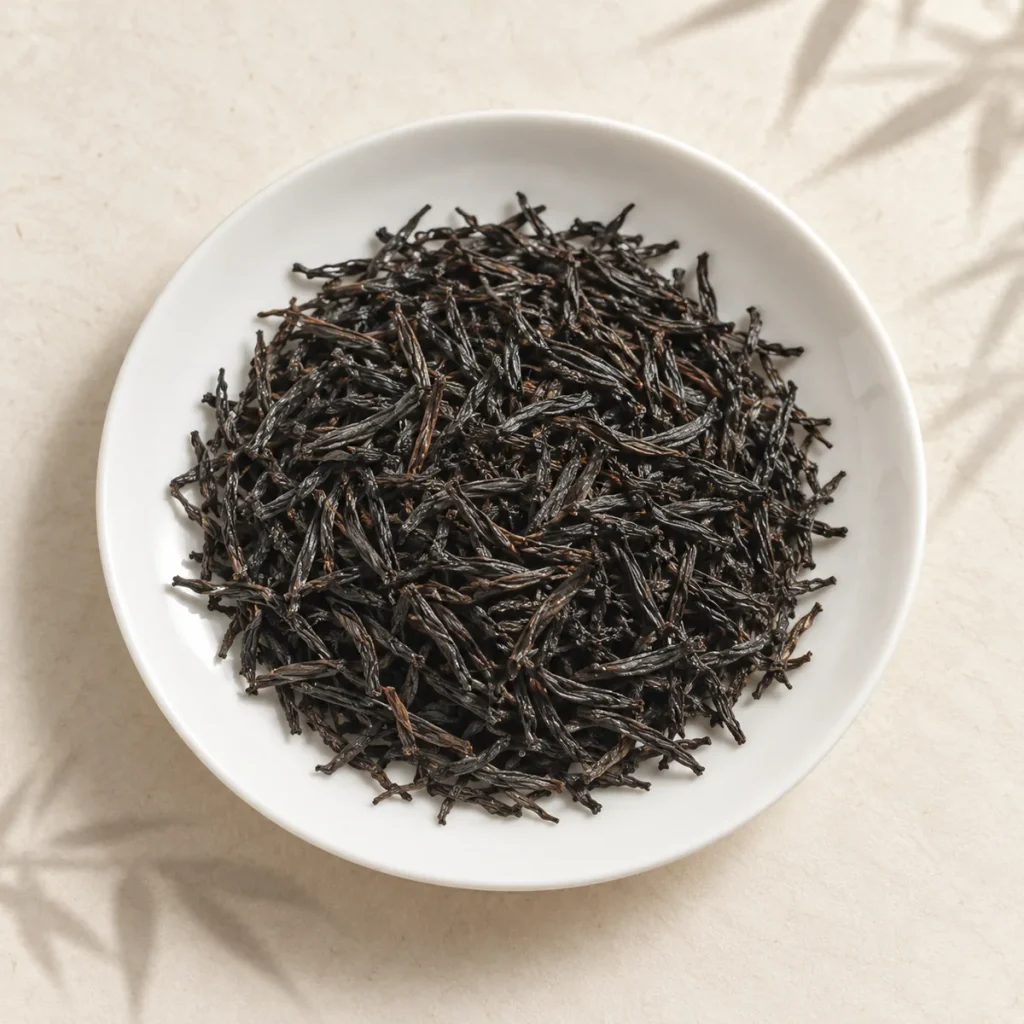
Zhengshan Xiaozhong originated around Tongmu in Wuyishan, Fujian, and official Chinese intangible-cultural-heritage materials describe it as the world's earliest black tea. The classic tea uses buds and leaves of sexually propagated Wuyi Caicha and is processed through withering, rolling, oxidation, guohongguo pan-heating, re-rolling and traditional pinewood smoking and drying. Finished tea is robust and tightly twisted, glossy black, with bright orange-red liquor. Dried-longan aroma and pine-smoke notes mingle over a rich, mellow, sweet-returning taste with clear high-mountain resonance, creating an old Wuyi style very different from modern light and sweet black teas.

Origin
Tongmu, Wuyishan · core nature-reserve area
Harvest
Wuyi Caicha · mature tender shoots
Craft
Withering · rolling · oxidation · guohongguo · pine smoking
Aroma
Dried-longan aroma · Distinct pine-smoke aroma
Taste
Rich and mellow with returning sweetness · Dried-longan-like liquor
Liquor
Bright orange-red · Clear and warm-toned
Dry Leaf
Robust and tightly twistedGlossy black
Liquor Color
Bright orange-redClear and warm-toned
Aroma
Dried-longan aromaDistinct pine-smoke aroma
Taste
Rich and mellow with returning sweetnessDried-longan-like liquor
Finish
Clear high-mountain resonanceLong smoky after-aroma
Infused Leaf
Even bright copperTender-soft with natural wrinkles

Tea Overview

Tea Category
Black tea · xiaozhong black tea
Cultivar
Wuyi Caicha · sexually propagated population
Grade
GI system: Special Grade · Grade 1 · Grade 2
Harvest Period
High-mountain spring tea · relatively late budbreak
Plucking Standard
Mature tender shoots · two to three leaves common
Processing
Withering → rolling → oxidation → guohongguo → pine smoke drying
Also Known As
Tongmuguan Xiaozhong · Lapsang Souchong
Oxidation / Fermentation
Zhengshan Xiaozhong is a fully oxidized black tea. Enzymatic oxidation follows rolling, after which traditional guohongguo uses brief high heat to rapidly inactivate enzymes, stop further oxidation and improve aroma and taste before re-rolling and smoking.

Origin & Terroir

The classic core of Zhengshan Xiaozhong lies in Tongmu Village, Xingcun Township, Wuyishan, and the surrounding Wuyishan nature-reserve area. This is a landscape of high mountains, deep valleys and dense forest, with abundant mist, rainfall and humidity. Low latitude combined with relatively high elevation creates a pronounced mountain microclimate. Traditional Wuyi Caicha grows in this environment, and together with local qinglou drying houses, pinewood and village processing knowledge forms the inseparable origin identity of Zhengshan Xiaozhong.

Origin
Tongmu Village and the Wuyishan nature-reserve area
Altitude
High-mountain reserve · substantial elevation variation
Climate
Humid and rainy · misty high-mountain climate
Soil
Acidic mountain soils · red/yellow-soil background
Landform
High mountains and deep valleys · forest streams

Brewing

Gaiwan brewing · 95–100°CWater first, then tea, then top up
Leaf Method
Gaiwan brewing · 95–100°C
Teaware
White porcelain gaiwan
Leaf Amount
About 5 g / 150 mL
Water Temperature
95–100°C
Tea-to-Water Ratio
1:30
Time
8s → 5s → 12s → 20s
Infusions
After the fourth infusion, add about 5–10 seconds each time
Water
Clean, odor-free drinking water
Brewing Steps · 4
  1. Warm the vessels and add tea: Warm a white porcelain gaiwan and tasting cups, empty them, then add Zhengshan Xiaozhong at the 1:30 ratio, for example about 5 g to a 150 mL gaiwan.
  2. Pour very hot water: Use 95–100°C water and pour quickly so the robust tight strands are evenly wetted and dried-longan and pine-smoke aromas are released.
  3. Time the first four infusions: Use about 8 seconds, 5 seconds, 12 seconds and 20 seconds for the first four steeps respectively, excluding the time needed to pour in and decant the water.
  4. Extend later infusions: After the fourth infusion, add about 5–10 seconds to each subsequent steep and follow the changes in orange-red liquor and high-mountain resonance.

Composition & the Body

The strongest tea-specific composition evidence currently available for Zhengshan Xiaozhong concerns volatile aroma chemistry, including dry-tea aroma profiles from commercial samples and the release of volatile compounds during repeated boiling-water extraction.

Composition Profile

Verified · 2026-09-25
  1. 01
    Dry-tea volatile profileAcross high-, medium- and lower-priced samples, alcohols, aldehydes, hydrocarbons, esters, phenols, ketones, acids and nitrogen- and oxygen-containing heterocycles were detected. In the higher-priced sample, phenethyl alcohol 11.05%, benzyl alcohol 7.88%, geraniol 5.75%, benzaldehyde 5.33% and methyl salicylate 3.74% were among the compounds with relatively high abundance.
    Dry-leaf sample

    Alcohols, aldehydes and phenolic compounds jointly contribute to floral-fruity, sweet and smoke-related aromatic expression.

  2. 02
    Volatile release in tea liquorAcross 12 successive boiling-water extractions, 100 volatile compounds were detected. Total volatile concentration was highest in the second extraction at 16.039 μL/L, while the third extraction contained the largest number of identified compounds, 84.
    Infusion / tea liquor

Zhengshan Xiaozhong aroma is not determined by a single “smoke molecule.” Relative proportions of alcohols, aldehydes, phenols, ketones, esters and other volatiles differ among samples and across brewing stages.

This batch does not borrow generic black-tea polyphenol or caffeine values for Zhengshan Xiaozhong. Where reliable tea-specific non-volatile quantitative data are not available, the field is left unfilled rather than inferred. No tea-specific human evidence was included.

View Research Sources

正山小种红茶挥发性成分分析

卢艳, 杜丽平, 肖冬光 · 食品工业科技 · 2015

Three commercial Zhengshan Xiaozhong samples at high, medium and lower price levels.

The samples showed broadly similar volatile-compound classes but substantial differences in the relative abundance of individual compounds and compound groups.

DOI: 10.13386/j.issn1002-0306.2015.02.003View Source

正山小种挥发性香气组成及其在多次沸水浸提下的释放规律研究

何理琴, 王彩楠, 倪莉, 陈福城, 张晨, 张雯, 刘志彬 · 福州大学学报(自然科学版) · 2018

Tea liquor from a Zhengshan Xiaozhong sample extracted successively 12 times with boiling water.

Both the number and overall abundance of aroma compounds rose and then declined across repeated extractions, with the first three extractions showing relatively similar aroma profiles.

DOI: 10.7631/issn.1000-2243.17300View Source

Tea Culture

Landscapes, people and history within a single leaf.

01

A Cup from Tongmu

Zhengshan Xiaozhong is indispensable to any account of Chinese black-tea history. China's official intangible-cultural-heritage portal states that the world's earliest black tea was invented by tea farmers in the Wuyishan region of Fujian during the Ming dynasty and was called Zhengshan Xiaozhong. The national standard now gives the product a very specific identity: it comes from Tongmu Village in Xingcun Township, Wuyishan, and the Wuyishan nature-reserve area, is made through local traditional methods, and shows dried-longan-like and pine-smoke aromas.

The tea does not seek the visual luxury of extremely tender buds. Special Grade emphasizes robust, tightly twisted, glossy black leaves. The liquor is bright orange-red rather than dark red, and the infused leaf is copper-toned, soft and naturally wrinkled. What truly separates Zhengshan Xiaozhong from other black teas is the dried-longan-like sweetness, rich returning sweetness and high-mountain resonance in the cup, together with the layered smoke left by traditional pinewood processing.

One common misunderstanding should be avoided: Zhengshan Xiaozhong is not the same as every “smoked black tea.” The Wuyi black-tea standard defines Zhengshan Xiaozhong, Xiaozhong, Yan Xiaozhong and Qihong separately. Yan Xiaozhong is a distinct type produced by pine-smoking rough black tea from other small-leaf cultivars; smoke aroma alone does not make a tea Tongmu Zhengshan Xiaozhong.

02

The First Notes of Black Tea

Many folk stories associate the first Zhengshan Xiaozhong with war, troops and accidental tea making, but their exact dates are difficult to verify with the precision of modern standards. A more cautious historical conclusion is that early black-tea processing took shape in the Wuyishan region during the Ming dynasty and Zhengshan Xiaozhong subsequently became one of the earliest black teas to enter global trade.

Wuyishan National Park materials identify the Tongmuguan area of Xingcun Township as the origin of Zhengshan Xiaozhong. Early Wuyi tea was long known in European markets as Bohea. As overseas demand expanded and other areas began imitating xiaozhong black tea, local producers increasingly used the term Zhengshan—“the authentic mountain”—to emphasize tea from Tongmu and nearby ecology, made through the same traditional process and showing the characteristic dried-longan-like liquor. The name Zhengshan Xiaozhong therefore also carries the logic of origin authentication.

Black-tea trade from Wuyishan later had a profound influence on European drinking habits and global tea production. Major black-tea regions now familiar worldwide, including Assam and Ceylon, developed later. The value of Zhengshan Xiaozhong thus lies not merely in one smoky flavor, but in the technical and commercial memory of black tea moving from a Chinese mountain village into a global consumption system.

03

Deep in the Wuyi Mountains

Tongmu Village lies deep in the high-mountain forest of Wuyishan National Park. Its landscape differs markedly from the rock-tea sites of the better-known scenic area: the mountains are deeper, forests denser, valleys longer, and elevation differences more pronounced. The former nature reserve averages around 1,200 m and rises above 2,100 m, creating a strong vertical climate.

The reserve's annual mean temperature is about 13°C, annual rainfall around 2,000 mm and locally higher, with relative humidity often around 78%–84%. Spring cloud, rain and mist can make traditional sun withering difficult, helping explain why Tongmu tea makers developed the distinctive use of pinewood heat for indoor withering in the traditional qinglou. The natural environment is not separate from the craft; it directly shaped the craft's development.

Mountain soils shift from red to yellow-red and yellow soils with elevation, while forest vegetation provides a deep ecological buffer. Traditional Wuyi Caicha is a sexually propagated local population long adapted to this humid high-mountain environment. The combination of tea population, forest climate and village processing space is what the word “Zhengshan” ultimately means.

04

Qinglou and Pine Smoke

Traditional Zhengshan Xiaozhong has several highly distinctive stages beyond ordinary gongfu black tea. DB35/T 1228—2015 sets out the primary process as picking, withering, rolling, oxidation, guohongguo, re-rolling, smoke drying and re-firing. Both withering and smoke drying are closely tied to Tongmu's traditional qinglou buildings and the use of pinewood.

Fresh leaves first lose water through withering, then enter oxidation after rolling. Once oxidation reaches an appropriate degree, guohongguo applies brief high heat to rapidly inactivate enzymes, stop further oxidation and reduce green harshness. The leaves are then re-rolled while still warm, tightening the strands and bringing more tea juice to the surface before smoke drying.

Pinewood burned in the qinglou provides both heat and smoke, completing drying while imparting the characteristic pine-smoke layer. Refining later includes screening, winnowing, sorting, another pinewood-smoke stage and final blending. Classic smoke aroma is therefore not created by simply “smoking the finished tea”; it belongs to an integrated system connecting withering, oxidation, guohongguo, re-rolling, drying and refining.

05

Dried Longan and High-Mountain Resonance

The aroma of classic Zhengshan Xiaozhong cannot be reduced to “smoke.” GB/T 13738.3—2012 describes Special Grade aroma as pure, high and lasting, with dried-longan-like fragrance or a distinct pine-smoke note. Good pine smoke should not resemble burnt wood, oily fumes or acrid charring; it should merge with sweet and ripe-fruit aromas and then translate in the mouth into a rounded sweetness reminiscent of dried-longan liquor.

Bright orange-red liquor is preferred. Special Grade taste emphasizes rich mellowness, returning sweetness, clear high-mountain resonance and a marked dried-longan-liquor impression. This is clearly different from the strong large-leaf body of Dianhong, Qimen's floral-fruity high fragrance, or Jin Jun Mei's fresh sweetness and golden liquor. Zhengshan Xiaozhong is steadier and deeper, with smoke and sweetness layered together and gentle returning sweetness even as the cup cools.

The infused leaf is also recognizable: still tender, relatively soft, naturally wrinkled and copper-toned. This relates to the relatively mature tender shoots and the effects of guohongguo and smoke drying. A tea dominated only by harsh charred smoke without dried-longan sweetness and substantial tea flavor does not fully represent the classic standard style.

06

The Tea Road West

The story of Zhengshan Xiaozhong naturally connects China with the wider world. Wuyi tea entered Europe through export trade and became an early window through which European consumers encountered Chinese tea. Wuyishan National Park materials note that Bohea was long used in European markets for Wuyi tea, while the later name Lapsang Souchong carried the Tongmu xiaozhong identity into the English-speaking world. A leaf from deep mountain country thus participated in shaping the global history of black-tea consumption.

Today the traditional craft is also entering more systematic heritage protection. In 2017, Black Tea Making Craft (Zhengshan Xiaozhong Black Tea Making Craft) was included in Fujian's fifth group of provincial representative intangible cultural heritage projects, with the Wuyishan Cultural Center as the safeguarding unit. Fujian government materials in 2025 still identified it as a provincial-level rather than national-level project, and 2026 tea-heritage exchange events continued to present it at that level.

Meanwhile Tongmu is developing interpretation projects around the birthplace of world black tea and black-tea cultural protection. Intangible heritage, national-park ecological conservation, resident life and modern tea production must all coexist in the same space. Zhengshan Xiaozhong's “tradition” is therefore not a museum relic but a living heritage continually reinterpreted in mountain villages, qinglou, tea cups and global tea culture.

Frequently Asked Questions

Is Zhengshan Xiaozhong the world's earliest black tea?
China's official intangible-cultural-heritage portal states that the world's earliest black tea was invented by tea farmers in the Wuyishan region during the Ming dynasty and was called Zhengshan Xiaozhong. Exact creation dates and accidental-origin stories vary in folk tradition and should not be treated as equally verified history.
Are Zhengshan Xiaozhong and Yan Xiaozhong the same tea?
No. DB35/T 1228—2015 lists Zhengshan Xiaozhong, Xiaozhong, Yan Xiaozhong and Qihong as separate Wuyi black-tea types. Yan Xiaozhong is made by pine-smoking rough black tea from other small-leaf cultivars and is not identical to Zhengshan Xiaozhong simply because it has smoke aroma.
Must Zhengshan Xiaozhong always have pine-smoke aroma?
Traditional geographical-indication processing explicitly includes pinewood smoking, and the national standard allows Special Grade tea to show dried-longan-like aroma or distinct pine smoke. Modern market styles with lighter smoke or little obvious smoke also exist, but pinewood processing remains an important feature of the classic standard and traditional craft.
How many grades does Zhengshan Xiaozhong have?
Two current standards use different systems. DB35/T 1228—2015 uses three grades—Special Grade, Grade 1 and Grade 2—within the Wuyi geographical-indication framework. GB/T 13738.3—2012 uses four grades—Special Grade, Grade 1, Grade 2 and Grade 3. This page displays the more specific three-grade Wuyi GI system.
Why does Zhengshan Xiaozhong taste like dried longan?
Dried-longan aroma and dried-longan-like liquor are standard sensory descriptions of natural Zhengshan Xiaozhong character. They arise from Wuyi Caicha raw material together with withering, oxidation, guohongguo, pinewood smoking and related processing; no longan fruit is added.
What water temperature should I use for Zhengshan Xiaozhong?
T/CSTEA 00036—2021 specifies 95–100°C water at a 1:30 tea-to-water ratio. For ordinary Zhengshan Xiaozhong, the first four steeping times are about 8, 5, 12 and 20 seconds, followed by increases of roughly 5–10 seconds for later infusions.

Tea Conversations

Tea lovers from around the world meet over a cup of tea.

Sign in or register to join the conversation. Your comment account is created automatically the first time you use a connected account.