Skip to content
Tea & Realm
English

Qimen Black Tea

Black tea · gongfu black tea (traditional principal form)

Southern Anhui mountains raise a high fragrance of flowers, fruit and honey over a clear, sweet red liquor.

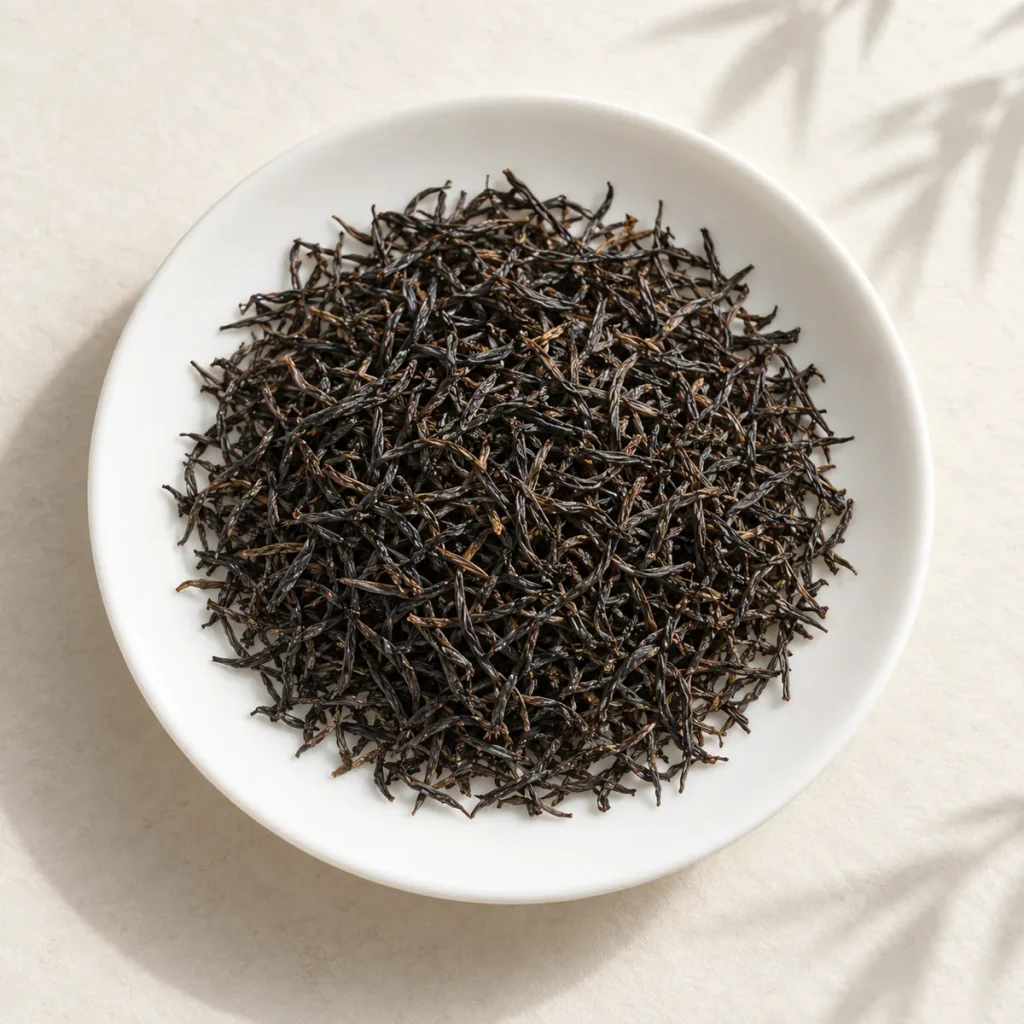
Qimen Black Tea originated in Qimen in southern Anhui and is one of China's most representative traditional gongfu black teas. Zhuye Zhong and improved cultivars selected from it form an important raw-material base. Classic Qimen Gongfu has fine, tight, elegant black leaves with a glossy finish. The liquor is bright red and translucent, while floral, fruity and honeyed notes combine into the distinctive aroma known as “Qimen fragrance.” The taste is fresh, mellow, sweet and refined, with a long, graceful high-aroma style characteristic of southern Anhui small-leaf black tea.

Origin
Traditional Qihong area of southern Anhui · Qimen as the core
Harvest
Tender buds and leaves picked by grade · spring tea especially representative
Craft
Four primary stages · seven refining stages
Aroma
Floral, fruity and honeyed · Distinctive Qimen fragrance
Taste
Fresh, mellow and sweet · Refined and clean
Liquor
Bright, translucent red · Visible golden ring
Dry Leaf
Fine, tight and elegantGlossy black
Liquor Color
Bright, translucent redVisible golden ring
Aroma
Floral, fruity and honeyedDistinctive Qimen fragrance
Taste
Fresh, mellow and sweetRefined and clean
Finish
Soft returning sweetnessPersistent after-aroma
Infused Leaf
Even, bright redTender and soft with buds

Tea Overview

Tea Category
Black tea · gongfu black tea (traditional principal form)
Cultivar
Zhuye Zhong and improved selections derived from it
Grade
Gongfu: 8 grades · the other 3 types: 3 grades each
Harvest Period
Primarily spring tea · produced in multiple seasons
Plucking Standard
Graded by product type · wider tenderness range for gongfu
Processing
Withering → rolling → oxidation → drying → refining
Also Known As
Qihong · Qimen Gongfu (traditional principal form)
Oxidation / Fermentation
Qimen Black Tea is fully oxidized. The traditional term fermentation refers primarily to enzymatic oxidation after rolling, which forms black-tea pigments such as theaflavins and thearubigins and contributes to the development of floral, fruity and honeyed aroma.

Origin & Terroir

The modern geographical-indication area for Qimen Black Tea spans parts of the traditional Qihong region across Huangshan and Chizhou in southern Anhui, while Qimen County remains the source of the name, the center of creation and the strongest cultural core. The hills and mountains of southern Anhui are humid, rainy, misty and heavily forested. Acidic red and yellow mountain soils together with Zhuye Zhong tea resources form an important ecological background for the development of the classic Qimen fragrance.

Origin
Traditional Qihong area of southern Anhui · Qimen as the core
Altitude
Hills and mountains · substantial elevation differences
Climate
Mild and humid · rainy and misty
Soil
Red and yellow soils · acidic mountain soils
Landform
Southern Anhui hills · stream valleys and mountains

Brewing

Gaiwan brewing · near-boiling water, quick pourWater first, then tea, then top up
Leaf Method
Gaiwan brewing · near-boiling water, quick pour
Teaware
White porcelain gaiwan or porcelain teapot
Leaf Amount
About 4 g / 150 mL
Water Temperature
About 95–100°C
Tea-to-Water Ratio
About 1:38 (adjustable within roughly 1:30–1:50)
Time
About 10 seconds, quick decant
Infusions
About 4–5 infusions, adjusted to grade and preferred strength
Water
Clean low- to medium-mineral drinking water
Brewing Steps · 4
  1. Warm the vessels and add tea: Warm a white porcelain gaiwan and tasting cups with hot water, empty them, then add about 4 g of classic Qimen Gongfu Black Tea.
  2. Pour near-boiling water: Add water at about 95–100°C quickly so the fine tight leaves are evenly wetted and the lifted Qimen fragrance opens.
  3. Decant quickly and drain fully: For the first infusion, pour out at around 10 seconds and drain the gaiwan thoroughly to avoid prolonged steeping and rising astringency.
  4. Smell, taste and continue: First observe the layered floral, fruity and honeyed aroma, then taste the bright red liquor; lengthen later infusions gradually according to the cup.

Composition & the Body

Research on Qimen Black Tea includes major non-volatile quality compounds across multiple finished-tea grades and studies of key aroma compounds and volatile metabolite profiles across different tea cultivars.

Composition Profile

Verified · 2026-09-25
  1. 01
    Tea polyphenols11.6–15.63 %
    Dry-leaf sample
  2. 02
    Caffeine2.28–3.45 %
    Dry-leaf sample
  3. 03
    Key volatile profileTea samples made from Qimen Zhong, Fuzao 2 and Wancha 4 contained 102, 75 and 88 aroma compounds respectively. Geraniol, trans-β-ionone, phenylacetaldehyde, linalool, hexanal and phenethyl alcohol were major contributors to the aroma of Qimen Zhong.
    Dry-leaf sample

    Six key aroma-active compounds jointly contribute to the core aromatic expression of Qimen Zhong.

Current evidence shows that tea polyphenols, caffeine and amino acids vary with Qimen grade, while aroma profiles are strongly affected by tea cultivar and processing stage. These studies are best used to build research-sample profiles rather than compressed into fixed composition constants.

All range values represent the six grade samples included in the corresponding study and are not legal upper or lower limits for all Qimen Black Tea. Volatile studies explain cultivar and processing differences and should not be numerically combined with non-volatile composition data. No human study specifically on Qimen Black Tea itself was included.

View Research Sources

祁门红茶滋味品质评价模型的构建

蒋家月, 李思影, 曾小艳, 浮雯君, 张显晨, 李叶云 · 茶业通报 · 2023

Finished Qimen Black Tea samples of Te Ming, Special Grade, Grade 2, Grade 3, Grade 5 and Grade 6 in the study.

Tea polyphenols ranged from 11.60% to 15.63% across the six grade samples, with higher-grade samples generally above lower-grade samples.

DOI: 10.16015/j.cnki.jteabusiness.2023.0017View Source

茶树品种对祁门红茶挥发性代谢谱及关键呈香物质的影响

刘亚芹, 王辉, 朱林, 雷攀登, 周汉琛 · 食品科学 · 2025

Qimen Zhong, Fuzao 2 and Wancha 4 processed using traditional Qimen Black Tea methods.

Tea cultivar significantly affected the volatile metabolite profile of Qimen Black Tea, and key aroma compounds changed most strongly during withering and drying.

DOI: 10.7506/spkx1002-6630-20241008-017View Source

Tea Culture

Landscapes, people and history within a single leaf.

01

A Thread of Qimen Fragrance

The most captivating part of Qimen Black Tea is not simply that it is red, but its fragrance. DB34/T 1086—2026 writes the distinctive Qimen fragrance directly into the product definition. Traditional language describes it as a composite of floral, fruity and honeyed notes. Fine Qihong is not defined by one loud aroma, but by elegance, refinement and persistence, with layers continuing to shift as the tea is smelled and tasted.

The 2026 standard also makes the name Qimen Black Tea clearer than before. It is not one single leaf form, but a system including Qimen Gongfu, Qihong Xiangluo, Qihong Maofeng and Qihong Jinzhen. The oldest and most representative traditional form is Qimen Gongfu: fine, tight leaves shaped through complex refining, and it was largely this gongfu form that built the international Keemun image in historical export markets.

This page therefore uses classic Qimen Gongfu as the main visual reference. Its dry leaf is not about large robust strips or complete golden covering, but fine elegant black strands with a glossy finish. Once brewed, the liquor is bright red with a golden ring and the taste fresh, mellow and sweet. The restrained appearance leaves the center of attention to aroma and liquor.

02

Qihong in the Guangxu Era

Qimen had a long green-tea tradition before Qimen Black Tea emerged in the early Guangxu period of the Qing. Official sources differ slightly on the exact year, with 1875 and 1876 both commonly cited. Local Qimen tourism and cultural materials often treat trial production around Pingli in 1875 as the beginning, while national intangible-cultural-heritage project materials record successful creation in 1876. Rather than forcing one date, the more accurate summary is that Qihong was created around 1875–1876 and then developed rapidly.

Its rise was directly connected to late-Qing international black-tea trade. After southern Anhui growers and merchants converted local Zhuye Zhong fresh leaf into black tea, the fine appearance, bright red liquor and distinctive high aroma quickly gained favor overseas. Qimen Black Tea entered international markets through trading centers such as Shanghai and Hankou, and Keemun gradually became one of the major names through which the world recognized Chinese gongfu black tea.

Since the 20th century, Qihong has passed through cycles of export growth and decline, state-run factory systems, market transformation and modern brand rebuilding. Today's Qimen Black Tea preserves the complex screening, cutting, winnowing and blending system of traditional gongfu while also developing Xiangluo, Maofeng, Jinzhen and other newer forms. The 2026 geographical-indication quality standard formally integrates these historical developments into one product system.

03

Clouded Mountains of Southern Anhui

Looking only at the administrative name Qimen can obscure the broader southern-Anhui mountain system behind the tea. Qimen County lies near 30°N, with rolling mountains, dense streams and very high forest cover. Local government often summarizes its tea environment as having many mountains, clouds, mists and rainy days, with comparatively little direct sunlight. Such humid mountain microclimates help tea shoots grow tenderly and retain tenderness.

Older standards recorded representative core-Qimen values of about 15.6°C annual mean temperature, around 1,725.6 mm annual rainfall and roughly 80% relative humidity, with acidic mountain soils such as red, yellow and yellow-brown soils. These figures are useful for understanding classic Qimen terroir but should not be extended simplistically across today's entire geographical-indication area, which also includes Yixian and selected traditional production zones in Shitai, Guichi and Dongzhi in Chizhou.

Modern Qihong terroir is therefore better understood as a continuous hilly and mountainous tea region across southern Anhui. Qimen is the cultural and craft center, while neighboring traditional areas share broadly similar humid climate, forested terrain and acidic-soil backgrounds. Zhuye Zhong and related tea resources produce tender shoots in this environment, and oxidation plus complex refining then transform them into the cup aroma known as Qimen fragrance.

04

Twelve Chapters of Gongfu

The gongfu in gongfu black tea is most visible in refining. Qimen Gongfu first passes through the four primary stages shared by traditional black tea: withering, rolling, oxidation and drying. Withering softens the leaf and removes moisture, rolling breaks cells and tightens the strands, enzymatic oxidation develops black-tea color, sweetness and body, and drying fixes the quality.

At that point, however, the tea is still only rough tea. Under the 2026 standard, classic Qimen Gongfu then goes through screening, cutting/rolling, winnowing, sorting, re-firing, blending and homogenizing. Different screen fractions are repeatedly adjusted for thickness, length, weight and cleanliness before blending stabilizes the aroma, taste and appearance of a finished batch. This is why classic Qimen Gongfu often appears finer and more even than many modern premium black teas.

Qihong Xiangluo, Maofeng and Jinzhen developed along different shaping paths. Xiangluo is shaped under controlled heat into curled strands, Maofeng retains a bent form, and Jinzhen emphasizes a tight straight shape. They share the foundational black-tea processes of withering, rolling and oxidation, but use different raw-material tenderness and shaping techniques to express distinct styles.

05

A Cup of Layered Fragrance

Classic Qimen Gongfu is especially well suited to beginning the tasting with aroma. Higher-grade dry tea is fine, tight, elegant and glossy black, while Li Cha and Te Ming may show more visible golden tips. After near-boiling water is added, sweet fragrance appears first, then floral notes, ripe-fruit impressions and honeyed sweetness begin to separate. These layers overlap rather than forming an exaggerated perfume-like intensity, and that subtle complexity is central to the appeal of Qimen fragrance.

The liquor should be bright and translucent red. High-quality tea often shows a luminous golden ring around the cup. The taste is fresh, mellow and sweet; higher-grade gongfu places particular emphasis on tender sweetness and freshness rather than simple strength. The small- to medium-leaf Zhuye Zhong base separates Qihong from the stronger large-leaf style of Dianhong: Qimen is generally more refined, elegant and aroma-focused, while Dianhong tends toward greater weight and fullness.

The infused leaf should be evenly red, bright and tender. Because traditional Qimen Gongfu is cut and refined, smaller leaf pieces in the infused leaf are normal and should not be judged by a rule that every infusion must reconstruct an intact one-bud-two-leaf shoot. More important are softness, even oxidation and the absence of dark stiffness or obvious green and miscellaneous odors.

06

Qihong and the World

Qimen Black Tea has been international from the beginning. Through late-Qing and Republican-era export trade it entered European markets, and Keemun became a highly recognizable Chinese black-tea name in overseas trade. That foreign reputation in turn helped shape the way Chinese consumers understand Qihong today: both a local tea of southern Anhui and a major representative of Chinese gongfu black tea on the world stage.

In 2008, the black-tea making craft of Qimen Black Tea entered China's second national list of representative intangible cultural heritage projects as project VIII-149. The traditional craft clearly divides production into primary processing and refining and places particular emphasis on the handwork of screening, cutting, winnowing, sorting, re-firing and homogenizing. In 2022, the craft also became part of Traditional tea processing techniques and associated social practices in China on UNESCO's Representative List of the Intangible Cultural Heritage of Humanity.

Today, protecting Qihong culture is no longer only about restoring old tea factories. Heritage transmission, modern quality standards, tea-garden ecology, tea tourism and new product forms all coexist within this century-old brand. The new 2026 geographical-indication quality standard is an important milestone: it brings Qimen Gongfu, Xiangluo, Maofeng and Jinzhen into one system and allows the traditional Qimen fragrance to continue into the next generation through new product language.

Frequently Asked Questions

Can Qimen Black Tea only be produced in Qimen County?
Not quite. Qimen County is the source of the name, the classic birthplace and the core of the national heritage project, but DB34/T 1086—2026 also includes traditional Qihong areas in Yixian under Huangshan and parts of Shitai, Guichi and Dongzhi in Chizhou.
Are Qimen Black Tea and Qimen Gongfu Black Tea the same thing?
Qimen Gongfu is the classic traditional form, but it is not the entire modern category. The 2026 standard divides Qimen Black Tea into four types: Qimen Gongfu, Qihong Xiangluo, Qihong Maofeng and Qihong Jinzhen.
How is Qimen Black Tea graded?
Under the current 2026 standard, Qimen Gongfu has eight grades: Li Cha, Te Ming, Special Grade, Grade 1, Grade 2, Grade 3, Grade 4 and Grade 5. Qihong Xiangluo, Qihong Maofeng and Qihong Jinzhen each have Special Grade, Grade 1 and Grade 2.
What is Qimen fragrance?
Qimen fragrance is the tea's most recognizable composite aroma, traditionally described as a refined and persistent blend of floral, fruity and honeyed notes. It arises from tea cultivar, ecology and the combined effects of withering, oxidation, drying and refining rather than from added flavoring.
Is all Qimen Black Tea picked as one bud and one leaf?
No. The 2026 standard allows Qimen Gongfu to use material ranging from one bud with one leaf to one bud with four leaves and equivalent clasping leaves. Xiangluo and Maofeng generally use one bud with one to two leaves, while Jinzhen uses one bud and one leaf just opening through one bud with two leaves.
What water temperature should I use for Qimen Black Tea?
For classic Qimen Gongfu, about 95–100°C water and quick gaiwan infusions work well. A useful starting point is about 4 g of tea to 150 mL of water, with the first infusion around 10 seconds and the liquor drained fully. These are everyday brewing recommendations, not compulsory clauses in the 2026 product-quality standard.

Tea Conversations

Tea lovers from around the world meet over a cup of tea.

Sign in or register to join the conversation. Your comment account is created automatically the first time you use a connected account.