Skip to content
Tea & Realm
English

Jin Jun Mei

Black tea · single-bud specialty black tea

High-mountain buds from Tongmu, golden liquor, honeyed fragrance, and a fine, fresh sweetness.

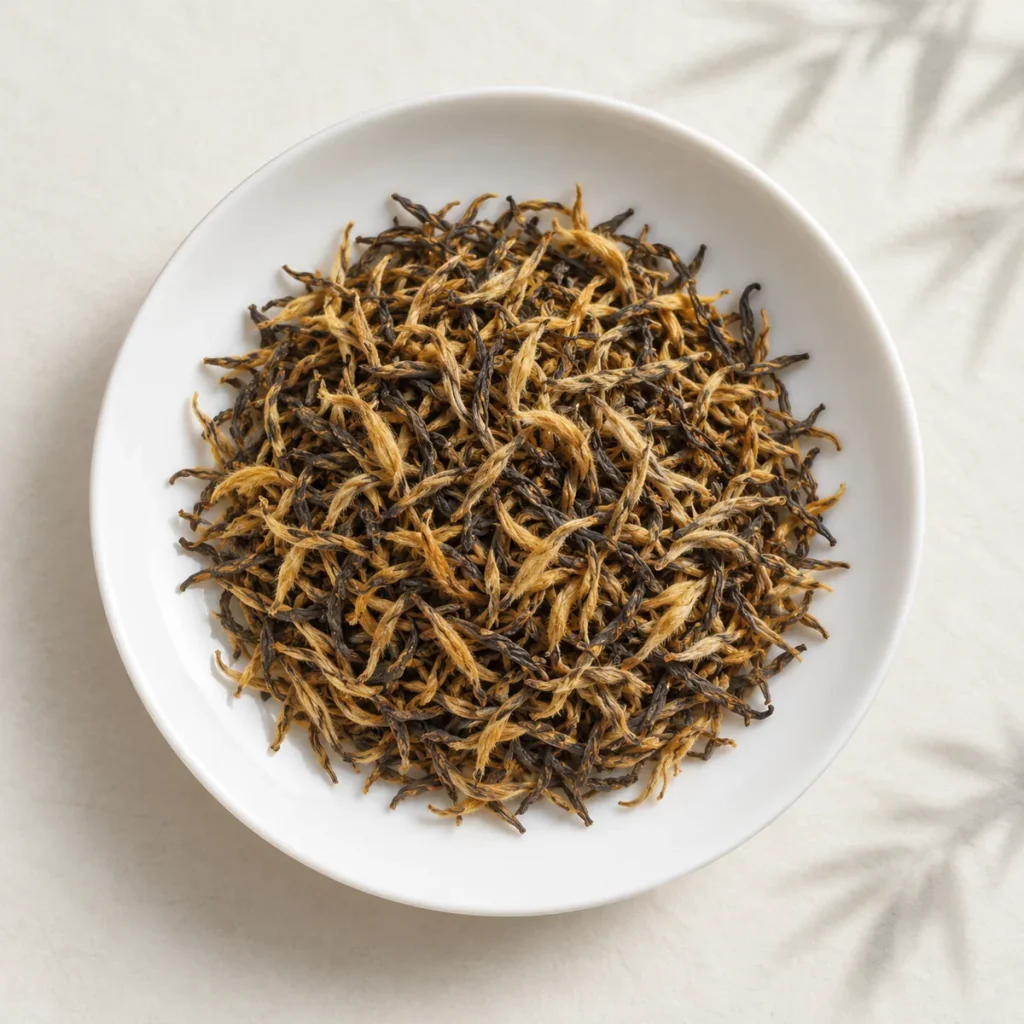
Jin Jun Mei comes from the Wuyishan National Nature Reserve centered on Tongmu Village in Xingcun Township, Wuyishan. It is made from single buds of high-mountain tea plants within the reserve and processed through withering, rolling, oxidation and drying. The finished tea is tight, elegant and weighty, with upright tips and an interwoven gold, yellow and black appearance with only a light showing of golden hairs. The liquor is clear and golden, with floral, fruity and honeyed aromas, while the taste is lively, sweet, brisk, delicate and persistent. It is one of the most distinctive modern Wuyi black teas.

Origin
Wuyishan · Tongmu protected area
Harvest
High-mountain single buds · tender spring picking
Craft
Withering · rolling · oxidation · drying
Aroma
Floral, fruity and honeyed · High, clean and persistent
Taste
Lively, sweet and brisk · Delicate and smooth
Liquor
Clear golden liquor · Distinct golden ring
Dry Leaf
Tight, elegant and weightyInterwoven gold, yellow and black
Liquor Color
Clear golden liquorDistinct golden ring
Aroma
Floral, fruity and honeyedHigh, clean and persistent
Taste
Lively, sweet and briskDelicate and smooth
Finish
Clean returning sweetnessPersistent after-aroma
Infused Leaf
Plump single budsBright copper and lively

Tea Overview

Tea Category
Black tea · single-bud specialty black tea
Cultivar
High-mountain tea plants within the reserve · no single cultivar specified
Grade
No grades under the industry standard
Harvest Period
Tender spring picking · single-bud raw material
Plucking Standard
High-mountain single buds · intact and even
Processing
Withering → rolling → oxidation → drying
Oxidation / Fermentation
A fully oxidized black tea. The traditional processing term “fermentation” refers primarily to enzymatic oxidation of tea polyphenols, during which the buds gradually shift from green toward copper-red and characteristic black-tea aroma and taste develop.

Origin & Terroir

The standard production area for Jin Jun Mei is not the whole of Wuyishan City, but the Wuyishan National Nature Reserve centered on Tongmu Village in Xingcun Township. The reserve has high mountains, deep valleys and dense forest cover within a humid mid-subtropical monsoon climate. Its relatively high average elevation, abundant rainfall, persistent mist and high humidity provide a distinctive ecological setting for the fine, fresh and sweet character of high-mountain tea buds.

Origin
Tongmu, Wuyishan · 565 km² protected area
Altitude
High-mountain reserve · substantial elevation variation
Climate
Humid and rainy · pronounced mist
Soil
Red and yellow soils · acidic mountain soils
Landform
High mountains and deep valleys · forested stream valleys

Brewing

Gaiwan brewing · 100°C boiling waterWater first, then tea, then top up
Leaf Method
Gaiwan brewing · 100°C boiling water
Teaware
White porcelain gaiwan
Leaf Amount
3 g / 150 mL
Water Temperature
100°C
Tea-to-Water Ratio
About 1:50
Time
First 4 infusions: about 5 seconds each
Infusions
Multiple infusions; after the fourth, extend each by 5–10 seconds
Water
Clean drinking water with no off-odors
Brewing Steps · 4
  1. Warm the gaiwan and add the tea: Warm a 150 mL white porcelain gaiwan and tasting cups with boiling water, empty them, then add about 3 g of Jin Jun Mei.
  2. Pour boiling water quickly: Use 100°C boiling water and pour swiftly into the gaiwan so the single buds move evenly and become fully wetted.
  3. Pour out after five seconds: For the first four infusions, about 5 seconds is sufficient. Focus on the clear golden liquor and the integrated floral, fruity and honeyed aroma.
  4. Extend later infusions: After the fourth infusion, add about 5–10 seconds to each subsequent steep according to how the flavor develops.

Composition & the Body

The strongest tea-specific evidence currently available for Jin Jun Mei concerns aroma chemistry. Studies include GC-MS research on the Junmei series and GC-IMS work that examines volatile aroma in both Jin Jun Mei dry tea and brewed liquor.

Composition Profile

Verified · 2026-09-25
  1. 01
    Jin Jun Mei aroma profileNineteen volatile compounds were identified in Jin Jun Mei, accounting for 96.77% of the relative abundance of detected aroma compounds. Alcohols accounted for about 70.90%, with major compounds including phenethyl alcohol, linalool, benzyl alcohol, hexanal and benzaldehyde.
    Dry-leaf sample

    The high proportion of alcohols, including phenethyl alcohol and linalool, is associated with floral and sweet aromatic directions.

  2. 02
    Volatile aroma in dry tea and liquorThree commercial Jin Jun Mei samples were included in the same GC-IMS study. Jin Jun Mei was characterized mainly by terpenes, esters and alcohols such as linalool and methyl benzoate, and the aroma-release profiles of the dry tea and brewed liquor were not identical.
    Other sample

    Linalool and related volatiles contribute to floral and sweet aromatic expression.

Existing studies consistently show that Jin Jun Mei aroma is formed by multiple volatile alcohols, esters, aldehydes and terpenes, and that the volatile-release profile of dry tea differs from that of the brewed liquor.

This batch does not use tea-polyphenol or amino-acid values from commercial publicity or single inspection reports as universal composition values for Jin Jun Mei. No tea-specific human evidence was included.

View Research Sources

正山小种红茶骏眉系列的香气成分研究

侯冬岩, 回瑞华, 李铁纯, 武晓英, 吴寒 · 食品科学 · 2011

Jin Jun Mei samples within a study of the Zhengshan Xiaozhong Junmei series, compared with Yin Jun Mei and Chigan.

Jin Jun Mei showed systematic aroma-composition differences from Yin Jun Mei and Chigan, with alcohols accounting for a relatively large share of its detected volatile compounds.

DOI: 10.7506/spkx1002-6630-201122061View Source

基于GC-IMS技术的红茶及茶汤挥发性香气组分研究

贾明, 姜俊, 仲伟国, 崔正坤, 石磊, 付茵茵, 秦光华 · 山东林业科技 · 2026

Dry tea and liquor from three commercial Jin Jun Mei samples.

Dry tea and brewed liquor showed different volatile-release characteristics, indicating that brewing changes the aroma profile available to perception.

View Source

Tea Culture

Landscapes, people and history within a single leaf.

01

One Bud Turns to Gold

Jin Jun Mei is a modern Wuyi black tea with an unusually strict definition. GH/T 1118—2015 does not use the name for every “golden-bud black tea.” It specifically limits the raw material to single buds from high-mountain tea plants within the 565 km² Wuyishan National Nature Reserve centered on Tongmu Village. Origin, single-bud material and a defined processing method together form the standard identity of Jin Jun Mei.

Its appearance also differs from the “all-golden bud” black teas often seen in the market. The standard requires tight, elegant, weighty strands with upright tips and only a slight showing of golden hairs, with an overall interwoven gold, yellow and black coloration. The brewed liquor is not deep red but clear, bright golden with a golden ring. Aroma combines floral, fruity, honeyed and other notes including the sweet-potato-like character recorded in the standard, while the taste emphasizes liveliness and sweet briskness rather than heavy astringency.

Another easily overlooked point is that the Jin Jun Mei industry standard explicitly states that the product has no grades. Labels such as “Special Grade Jin Jun Mei” or “Grade 1 Jin Jun Mei” may be company-specific commercial classifications, but they are not official quality grades in GH/T 1118—2015. For an encyclopedia-style page, distinguishing standard terminology from market language is especially important.

02

A New Black Tea from Tongmu

Jin Jun Mei does not have an ancient history, but its development is clearly rooted within the Wuyi black-tea tradition. Public information from Fujian's agricultural authorities records that in 2005, a team inheriting Zhengshan Xiaozhong craft in Tongmu Village within the Wuyishan National Nature Reserve experimented with local high-mountain tea buds and innovated on the basis of traditional Zhengshan Xiaozhong black-tea knowledge. The result became the new black tea later known as Jin Jun Mei.

The tea then went through continued refinement. Further trials and comparisons were conducted in 2006, the process was optimized again in 2007 based on tasting feedback, and the product entered the market around 2008. It both inherits from and differs sharply from Zhengshan Xiaozhong: the raw material shifts from bud-and-leaf shoots to extremely tender single buds, while production moves away from traditional smoky style toward an unsmoked profile centered on floral, fruity and honeyed aroma, fresh sweetness and golden liquor. The result is a very different modern black-tea drinking experience.

In 2015, the supply-and-marketing industry standard GH/T 1118—2015 was issued, formally defining for the first time what counts as Jin Jun Mei. It wrote the 565 km² protected area, high-mountain single buds, four core processing stages and the idea of “golden liquor, sweetness in the cup, aroma within the sweetness” into the product definition. From the first innovative trials in 2005 to an industry standard a decade later, Jin Jun Mei offers an unusually clear example of how a new tea can rapidly develop tradition, market identity and formal standards.

03

High Mountains of Tongmu

One of the least replaceable conditions of Jin Jun Mei is that its raw-material area is written directly into the product definition. The Wuyishan National Nature Reserve lies in the northern Wuyi Mountains and covers about 565 km². It contains overlapping ridges, deeply cut stream valleys, an overall average elevation of roughly 1,200 m and Huanggang Mountain rising above 2,100 m. Large areas of mid-subtropical evergreen broadleaf forest remain intact, and forest cover is exceptionally high.

The reserve also has a very clear humid high-mountain climate. Official materials record an annual mean temperature of about 13°C, annual rainfall around 2,000 mm, locally above 3,000 mm, and relative humidity around 78%–84%. Strong elevation differences create pronounced vertical climate, so valleys, slopes, forest edges and traditional-use zones at different heights experience different combinations of temperature, moisture and sunlight.

Soils shift with elevation from red and yellow-red soils to yellow soils and higher mountain soils. For Jin Jun Mei, it is more useful to understand forests, high mountains, streams, humidity and vertical climate at the scale of the entire reserve than to attach a single altitude number to a “mountain site.” This is why the standard refers to “single buds from high-mountain tea plants within the reserve” rather than specifying one elevation point.

04

Oxidizing a Single Bud

The core Jin Jun Mei process can be summarized in four words: withering, rolling, oxidation and drying. That looks similar to ordinary black tea, but because the raw material consists entirely of fine single buds, the margin for error at every step is smaller. Single buds contain abundant moisture and have delicate tissues. Withering must soften them and remove enough water without dissipating too much of their fresh aromatic character.

Rolling needs to break cells sufficiently for later enzymatic oxidation while still preserving the buds and their tight, elegant shape. During the stage traditionally called “fermentation,” polyphenols continue oxidizing under enzyme action, leaf color and aroma gradually shift, and layered floral, fruity and honeyed notes begin to form. Too little oxidation leaves green odor and astringency; too much can reduce liveliness and delicate fragrance.

Once the desired oxidation is reached, prompt drying stops further change and fixes aroma and taste. Unlike traditional smoked Zhengshan Xiaozhong, the dedicated Jin Jun Mei standard does not include a pine-smoke firing requirement. Its identity instead comes from the high-mountain single buds and unsmoked process, which produce clear golden liquor, a fresh-sweet mouthfeel and delicate layered aroma.

05

Golden Liquor, Honeyed Resonance

Jin Jun Mei is well suited to a tasting approach of “correct the color first, then discuss the aroma.” Standard Jin Jun Mei dry tea is not uniformly golden. It should be interwoven gold, yellow and black, tight and weighty with upright tips and only a slight showing of golden hairs. Dry tea covered entirely in loose yellow fuzz and looking excessively golden is actually less consistent with the typical appearance described by the industry standard.

The liquor should be golden, clear and bright, with a distinct golden ring. T/CTMA 045—2022 further describes the aroma as an integrated floral, fruity and honeyed profile and emphasizes persistence. The taste should be lively, sweet and brisk, with aroma carried into the liquor and a delicate, clean sweetness that lasts. This style differs from many black teas that aim for deep red liquor and strong astringency.

The infused leaf gives another check on raw material. Jin Jun Mei that truly meets the definition is made from single buds, so the brewed leaf should show plump, full, lively and even buds in bright copper tones. If the infused leaf contains many one-bud-one-leaf shoots, larger leaves or stems, it differs visibly from the single-bud raw-material definition in GH/T 1118—2015.

06

A New Tea Becomes Famous

Jin Jun Mei is an unusual case: rather than slowly emerging from vague ancient legends, it made a rapid leap from innovative product to nationally known famous tea within the contemporary tea industry. Fujian's official materials place its creation inside more than four centuries of Zhengshan Xiaozhong black-tea tradition while clearly identifying it as a new product developed through innovation after 2005.

This innovation in turn changed the market and cultural image of Tongmu black tea. Jin Jun Mei renewed consumer attention to high-mountain Wuyi black tea, bud-based raw materials and unsweetened straight drinking, while also bringing traditional teas such as Zhengshan Xiaozhong back into wider public view. Wuyishan National Park today still places ecological protection first while promoting ecological tea gardens and Tongmu black-tea branding in traditional-use areas, requiring tea production and national-park management to continually negotiate their boundaries.

One distinction is especially important: Jin Jun Mei is not currently listed as an independent national intangible-cultural-heritage project. Its innovation grew out of the traditional craft of Zhengshan Xiaozhong, while “Zhengshan Xiaozhong Black Tea Making Craft” is currently a representative intangible-cultural-heritage project at the Fujian provincial level. Jin Jun Mei's cultural value is therefore more accurately described as a modern innovation built on traditional black-tea craft, rather than as a separate national or UNESCO heritage project.

Frequently Asked Questions

What type of tea is Jin Jun Mei?
Jin Jun Mei is a black tea, specifically a single-bud specialty black tea made from single buds of high-mountain tea plants within the Wuyishan National Nature Reserve. It is processed through withering, rolling, oxidation and drying, and its typical liquor is clear and golden.
Does Jin Jun Mei have to come from Tongmu?
Under GH/T 1118—2015, the raw material must come from the 565 km² Wuyishan National Nature Reserve centered on Tongmu Village in Xingcun Township, Wuyishan. Single-bud black tea produced elsewhere cannot simply adopt this standard definition.
Does Jin Jun Mei have Special Grade and Grade 1?
Not under the industry standard. GH/T 1118—2015, clause 4.1, explicitly states that Jin Jun Mei “has no grades.” Labels such as Special Grade or Grade 1 in the market are usually company-specific commercial classifications rather than industry-standard grades.
Why isn't Jin Jun Mei completely golden?
The standard sensory description calls for dry tea with gold, yellow and black interwoven and a glossy appearance, showing only a light amount of golden hairs. Jin Jun Mei that matches the standard is therefore not a batch of uniformly bright-gold buds.
Why is Jin Jun Mei liquor golden rather than deep red?
Jin Jun Mei uses fine high-mountain single buds and a specific combination of withering, rolling, oxidation and drying. The industry standard directly includes “golden liquor” in the product definition, and the tasting standard likewise calls for clear golden liquor with a golden ring.
What water temperature should I use for Jin Jun Mei?
T/CTMA 045—2022 specifies 100°C water. Under the medium-strength option, use 3 g of tea in a 150 mL gaiwan, steep the first four infusions for about 5 seconds each, then add about 5–10 seconds to each later infusion.

Tea Conversations

Tea lovers from around the world meet over a cup of tea.

Sign in or register to join the conversation. Your comment account is created automatically the first time you use a connected account.