Skip to content
Tea & Realm
English

Dianhong Gongfu

Black tea · gongfu black tea

Large-leaf tea from the plateau, golden tips and sweet fragrance, rich and mellow in the cup.

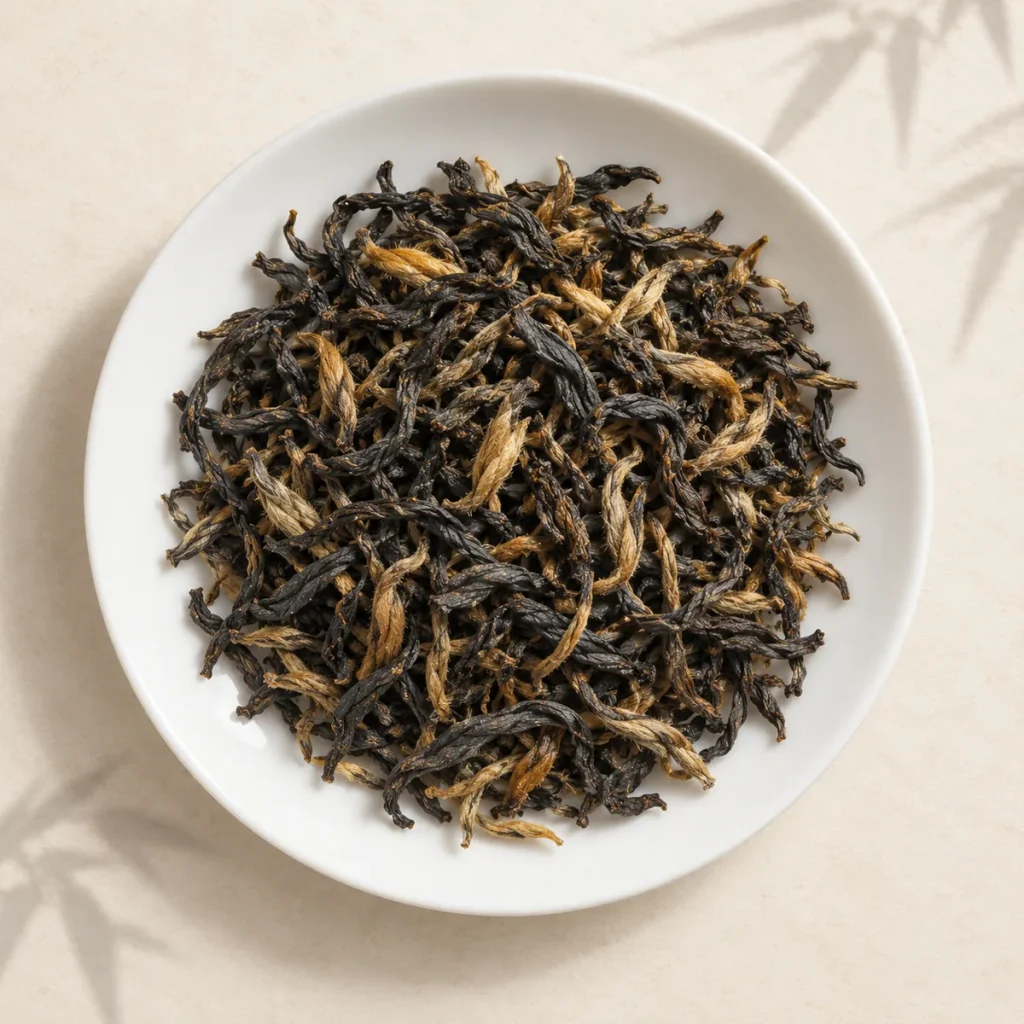
Dianhong Gongfu is a strip-style gongfu black tea made from fresh leaves of Yunnan large-leaf tea plants. Its classic style originated in Fengqing, Lincang, before spreading to multiple highland tea regions across Yunnan. The large leaves and buds are thick and rich in internal compounds, giving the finished tea robust, tightly twisted strands with a glossy dark appearance and visible golden tips. The liquor is bright red, with a rich sweet aroma that often carries floral and fruity notes, while the taste is sweet, mellow, brisk, full and powerful, combining the strength and rounded sweetness characteristic of Yunnan highland black tea.

Origin
Yunnan Plateau · major production in southwest Yunnan
Harvest
Graded plucking · tender buds and leaves
Craft
Withering · rolling · oxidation · drying · refining
Aroma
Rich sweet aroma · Distinct floral-fruity notes
Taste
Sweet, mellow and brisk · Full, strong and substantial
Liquor
Bright vivid red · Clear golden ring
Dry Leaf
Robust and tightly twistedGlossy dark leaves with golden tips
Liquor Color
Bright vivid redClear golden ring
Aroma
Rich sweet aromaDistinct floral-fruity notes
Taste
Sweet, mellow and briskFull, strong and substantial
Finish
Sweet returning finishLong-lasting aftertaste
Infused Leaf
Even, bright redPlump, tender and soft

Tea Overview

Tea Category
Black tea · gongfu black tea
Cultivar
Yunnan large-leaf tea plants
Grade
Single Bud · Special Grade · Grade 1 · Grade 2 · Grade 3 · Grade 4
Harvest Period
Picked by season · tender buds and leaves for higher grades
Plucking Standard
Tender buds and leaves by grade · one bud with one or two leaves is common
Processing
Withering → rolling → oxidation → drying → refining
Also Known As
Yunnan gongfu black tea
Oxidation / Fermentation
A fully oxidized black tea. The traditional term “fermentation” mainly refers to the enzymatic oxidation and polymerization of polyphenols after rolling damages leaf cells. The leaves gradually change from green toward red, while the bright red liquor, sweet aroma and rich mellow taste develop.

Origin & Terroir

Dianhong Gongfu can be produced across Yunnan, but its classic style was shaped in the large-leaf tea regions of southwest Yunnan. Highland mountains and gorges around Lincang, Baoshan and Dehong combine low latitude, high elevation and clearly defined wet and dry seasons. Together with acidic red mountain soils and Yunnan large-leaf tea plants, these conditions underpin Dianhong's substantial raw material, strong liquor and lifted sweet fragrance.

Origin
Yunnan Province · classic heartland in southwest Yunnan
Altitude
Highland mountain tea · wide elevation range
Climate
Low-latitude highland · distinct wet and dry seasons
Soil
Red mountain soils · acidic
Landform
Highland mountains · deep gorges

Brewing

Tea first · pour at 90–95°CWater first, then tea, then top up
Leaf Method
Tea first · pour at 90–95°C
Teaware
White porcelain gaiwan or porcelain cup
Leaf Amount
About 3 g / 150 mL
Water Temperature
About 90–95°C
Tea-to-Water Ratio
About 1:50
Time
Cup brewing: about 2–3 minutes
Infusions
About 3–4 infusions
Water
Clean low- to medium-mineral drinking water
Brewing Steps · 4
  1. Warm the vessel and add tea: Warm a white porcelain gaiwan or cup, empty it, then add about 3 g of Dianhong Gongfu.
  2. Pour hot water: Add water at about 90–95°C so the robust twisted leaves quickly absorb water and release their sweet fragrance.
  3. Steep until the liquor opens: For cup brewing, steep about 2–3 minutes and begin drinking when the liquor is bright red and the sweet aroma has fully opened.
  4. Refill and continue: Leave a small amount of liquor before refilling, then lengthen later infusions slightly according to strength.

Composition & the Body

Research on Dianhong Gongfu includes studies of major non-volatile quality compounds in representative products as well as volatile metabolites and key aroma compounds under different temperature-controlled oxidation processes.

Composition Profile

Verified · 2026-09-25
  1. 01
    Tea polyphenols16.61 %
    Dry-leaf sample
  2. 02
    Caffeine14.6 mg/g
    Dry-leaf sample
  3. 03
    Volatile profile under variable-temperature oxidationAcross five variable-temperature oxidation treatments, 747 volatile metabolites in 16 classes were identified. Total volatile content ranged from about 214.44 to 286.97 μg/g, and 152 key aroma compounds with OAV > 1 were screened.
    Dry-leaf sample

    β-Ionone, linalool, geraniol and related compounds made important contributions to fresh-sweet and floral aromas.

In a representative traditional Dianhong Gongfu sample group, tea polyphenols, free amino acids, caffeine, total catechins and theaflavins were all reported as mean values. Research also shows that the temperature path during oxidation significantly changes total volatile abundance and key aroma-active compounds.

All numerical values are statistics from defined research sample groups and are not fixed composition values for all Dianhong Gongfu. “Wild Dianhong” and traditional Dianhong were comparison groups in one study and their values should not be mixed. No tea-specific human evidence was included.

View Research Sources

传统滇红工夫红茶与野生滇红工夫红茶的品质分析

徐亚文, 牛淼, 刘娜, 韩利艳, 黄燕兰, 王雪蕾, 杨翔, 李家华 · 食品工业科技 · 2023

Representative traditional Dianhong Gongfu products from five tea factories in Fengqing and Yunxian.

The traditional Dianhong Gongfu samples had a mean tea-polyphenol content of 16.61%.

DOI: 10.13386/j.issn1002-0306.2022060151View Source

变温发酵工艺滇红工夫挥发性成分及关键香气成分分析

王艳燕, 刘志薇, 严慧婷, 陆建伟, 何亚梅, 高峻, 白冰, 陆丽萍 · 食品科学 · 2024

Summer shoots of Yunnan large-leaf tea plants at one bud with two or three leaves, processed into Dianhong Gongfu under five 35°C/25°C oxidation combinations.

The 35°C for 3 h + 25°C for 3 h treatment received the highest aroma score and also had the highest total volatile content.

DOI: 10.7506/spkx1002-6630-20240519-126View Source

Tea Culture

Landscapes, people and history within a single leaf.

01

Large Leaves Turn Red

Dianhong Gongfu is one of the classic ways of making black tea from Yunnan large-leaf tea plants. The current China Tea Science Society standard defines it as a strip-style black tea made from large-leaf fresh leaves harvested within Yunnan Province and processed through withering, rolling, oxidation, drying and refining. This definition matters because “Dianhong” can refer broadly to Yunnan black tea, including gongfu black tea, broken black tea and differently shaped specialty products, whereas “Dianhong Gongfu” specifically refers to the intact strip-style tea formed through a gongfu black tea refining system.

The large, substantial buds and leaves of Yunnan large-leaf tea plants give Dianhong Gongfu a strong visual and sensory identity. Higher grades should be robust and tightly twisted, glossy dark brown to brown-black, with the fine hairs on tender buds turning a visible gold. Once brewed, the liquor is bright red and often shows a luminous golden ring around the cup. Single Bud and Special Grade standards especially emphasize rich sweet fragrance, noticeable floral-fruity aroma and a sweet, mellow, fresh taste.

For that reason, the “strength” of Dianhong does not mean simple bitterness or heaviness. Well-balanced Dianhong Gongfu combines the power and concentration of large-leaf material with the rounded sweetness of full oxidation and the freshness and floral-fruity character of tender higher-grade buds. Golden tips, red liquor and sweet fragrance together form its most recognizable visual and flavor identity.

02

The First Red Tea of Shunning

Yunnan has an ancient tea history, but “Dianhong” made in the modern gongfu black tea style is a much newer tradition dating to the late 1930s. In 1938, tea specialist Feng Shaoqiu traveled to Yunnan to investigate tea production and trade. In Shunning—today's Fengqing—he saw local large-leaf tea plants with robust buds, thick leaves and dense white hairs and used the fresh leaf to trial-produce black tea. Materials from Yunnan's agricultural authorities and national heritage records state that the one-bud-two-leaf samples produced bright, richly red liquor, vividly red infused leaves and strong aroma and flavor, receiving high praise after being sent to Hong Kong.

In 1939, the Shunning Experimental Tea Factory was established and Dianhong moved from trial production into larger-scale manufacture. Against the backdrop of wartime trade and international demand, Yunnan black tea quickly became an important export. The name “Dianhong” then stabilized: “Dian” for Yunnan and “hong” for black tea, distinguishing it from established gongfu black teas such as Qihong and Ninghong while establishing a new Yunnan large-leaf black-tea style.

Production later expanded from Fengqing to other Yunnan large-leaf tea regions and diversified into gongfu black tea, broken black tea and other forms. Fengqing remains the birthplace and a core center of traditional craft, but the modern product-standard scope of Dianhong Gongfu now covers Yunnan Province. From a 1938 trial to one of Yunnan's representative regional tea brands, Dianhong is a Chinese black-tea tradition not yet a century old but already highly influential.

03

The Highlands of Southwest Yunnan

The classic style of Dianhong Gongfu is closely linked to the highland mountain environment of the large-leaf tea regions of southwest Yunnan. Provincial industry planning identifies Lincang, Baoshan and Dehong as key Dianhong processing areas. Historically, Fengqing, Yunxian, Shuangjiang and other tea areas along the Lancang and Nu river systems have also supplied important raw material. Their common feature is not one fixed altitude, but a strongly layered climate produced by low latitude combined with highland mountains.

Fengqing is the clearest window into classic Dianhong terroir. The county spans both sides of the Lancang River, with mountains, gorges, hills, basins and river valleys interwoven and more than two thousand meters of elevation difference. Its low-latitude highland mountain monsoon climate has an annual mean temperature around 16–17°C, strong sunshine and day-night temperature contrast in the dry season, and high humidity with concentrated rainfall in the wet season. This vertical variation gives tea gardens at different heights different growth rhythms and aromatic foundations even within the same county.

Major Yunnan tea regions also widely develop acidic mountain soils such as red and lateritic red soils. Forests, river valleys and monsoon conditions provide water and heat, while Yunnan large-leaf tea plants produce thick, substantial shoots within this environment. It would therefore be misleading to apply the altitude or rainfall of one Fengqing core garden to all Dianhong. A more accurate view is that highland mountains, strong vertical climate and large-leaf tea material together form the central terroir background of Dianhong.

04

Four Steps to Black Tea

Primary processing of Dianhong appears to consist of only four major stages—withering, rolling, oxidation and drying—but traditional craft summarizes the real difficulty as “five critical controls”: fresh-leaf selection, withering timing, rolling timing, oxidation timing and drying heat. Every stage determines whether the later sweet fragrance, liquor color, leaf shape and concentration can remain in balance.

Fresh leaves first lose moisture through controlled withering, changing from crisp and rigid to soft and pliable while aroma begins to shift. Rolling both twists the thick large-leaf material into tight strands and breaks cells so polyphenols and enzymes can interact. The tea then enters the stage traditionally called “fermentation,” more precisely enzymatic oxidation: leaf color gradually shifts from green toward red-yellow, raw green odors fade, and sweet and floral-fruity aromas develop. Too little oxidation leaves green harshness; too much can flatten and muffle the aroma.

Once oxidation reaches the desired point, drying rapidly lowers moisture and stops further enzyme activity, setting aroma and taste. The rough tea is then refined through screening, winnowing, sorting, blending and homogenizing to improve style and cleanliness. In 2025, Yunnan implemented its first provincial technical specification for gongfu black tea processing, bringing both primary and refining stages—long managed largely through experience—into a more unified technical framework.

05

Golden Tips, Red Liquor

Tasting Dianhong Gongfu begins with what might be called the “power of the large leaf.” Higher-grade dry tea should be robust, tightly twisted and substantial, glossy black-brown or brown-black, while the fine hairs on tender buds turn golden through oxidation and drying. Single Bud can be densely covered in gold, while Special Grade and Grade 1 show abundant golden tips among dark glossy strands and retain a more complete bud-and-leaf structure.

The liquor is the second key. Higher-grade standards range from bright orange-red to bright red and moderately bright red, while classic Dianhong often shows a luminous golden ring at the cup wall. Sweet fragrance forms the base, with Single Bud and Special Grade especially emphasizing rich, persistent sweetness and distinct floral-fruity notes. The taste should be sweet, mellow and brisk with enough concentration, rather than merely astringent. The rich internal compounds of large-leaf tea give the liquor noticeable weight and stimulation, but good oxidation and drying turn that force into body and returning sweetness.

The infused leaf should be evenly red, bright and soft, with plump buds and tender leaves visible in higher grades. Dark liquor, stiff dark-brown leaf, or obvious sour, stale or muffled odors often indicate problems with oxidation or drying. A natural “cream down” or cooling haze in good black tea is not automatically a flaw; it is associated with interactions among polyphenol oxidation products, caffeine and other liquor components and should be distinguished from cloudiness caused by impurities.

06

The Dianhong Tea Route

The cultural story of Dianhong is inseparable from the modernization of China's tea industry in the 20th century. It is not a famous tea known only through ancient legend, but a new product born around 1938–1939 through tea specialists, experimental factories, export trade and Yunnan large-leaf tea. The establishment of the Shunning Experimental Tea Factory brought Yunnan—previously known mainly for other tea types—into the modern black-tea system and quickly introduced “Dianhong” to Hong Kong and international markets.

Fengqing consequently became known as the homeland of Dianhong. In 2014, the making of Dianhong black tea was added as an extension project to China's fourth national list of representative intangible cultural heritage. In 2022, it became part of “Traditional tea processing techniques and associated social practices in China” on UNESCO's Representative List. Safeguarding today is not only about remembering Feng Shaoqiu and the year of creation, but also about transmitting the sensory judgment that links withering, rolling, oxidation and drying.

At the same time, Dianhong's modern brand structure has become increasingly complex. “Dianhong Gongfu” can cover strip-style large-leaf black tea made to standard anywhere within Yunnan, while “Fengqing Dianhong Tea” has its own geographical-indication certification mark and Fengqing County boundary. Keeping these concepts distinct makes it easier to see how a tea that began in Fengqing expanded into one of the most representative black-tea categories of the entire province.

Frequently Asked Questions

What type of tea is Dianhong Gongfu?
Dianhong Gongfu is a gongfu-style black tea made from Yunnan large-leaf fresh leaves and processed through withering, rolling, oxidation, drying and refining into intact twisted strips.
Is Dianhong Gongfu produced only in Fengqing?
No. Fengqing is the classic birthplace and a core area of the heritage craft, but T/CTSS 38—2021 defines Dianhong Gongfu across the administrative region of Yunnan Province. Fengqing Dianhong Tea is a separate geographical-indication certification mark limited to Fengqing County.
How many grades does Dianhong Gongfu have?
T/CTSS 38—2021 recognizes six grades: Single Bud, Special Grade, Grade 1, Grade 2, Grade 3 and Grade 4. Single Bud and Special Grade have stricter expectations for golden tips, sweet aroma, floral-fruity fragrance and fresh sweetness.
Why does Dianhong Gongfu often have so many golden tips?
Tender buds of Yunnan large-leaf tea plants naturally carry abundant fine hairs. After oxidation and drying, those hairs become golden to orange-gold, so higher-grade Dianhong often shows obvious golden tips. The amount depends on raw-material tenderness and grade; not every grade should be entirely golden.
Are the floral and fruity aromas in Dianhong Gongfu added?
Traditional Dianhong Gongfu does not depend on added flavoring. Its sweet and floral-fruity aromas arise naturally from Yunnan large-leaf material during withering, rolling, enzymatic oxidation and drying.
What water temperature should I use for Dianhong Gongfu?
For everyday brewing, start around 90–95°C with about 3 g of tea to 150 mL of water. Begin drinking after about 2–3 minutes for cup brewing; higher-grade tea with many golden tips can use slightly cooler water or a shorter steep.

Tea Conversations

Tea lovers from around the world meet over a cup of tea.

Sign in or register to join the conversation. Your comment account is created automatically the first time you use a connected account.