Skip to content
Tea & Realm
English

Xinyang Maojian

Green tea · twisted pan-fired green tea

Spring tips from the Dabie Mountains, clean and fresh with a long returning sweetness.

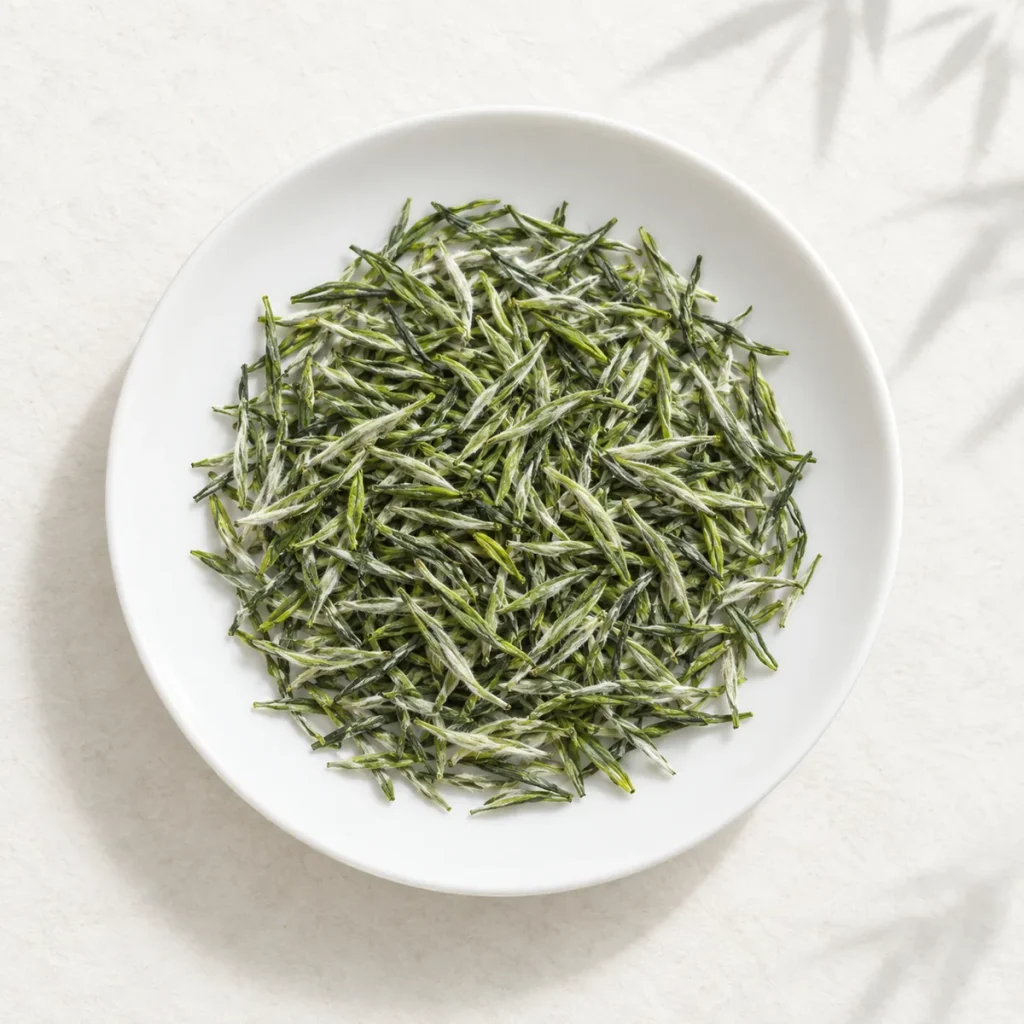
Xinyang Maojian is produced in Xinyang, Henan, from tender buds and leaves of local population tea plants and other suitable cultivars. The finished tea is known for leaves that are fine, rounded, tight and straight, with abundant white hairs. The liquor is bright tender green, the aroma high and persistent, and the taste ranges from brisk and fresh to fuller and mellow, expressing the distinctive green-tea character of the northern foothills of the Dabie Mountains.

Origin
Xinyang, Henan · northern foothills of the Dabie Mountains
Harvest
Primarily spring · graded plucking
Craft
Shengguo · shouguo · first drying · final drying
Aroma
Clean, high and lasting · Persistent tender-leaf aroma
Taste
Fresh, brisk and mellow · Clear returning sweetness
Liquor
Bright tender green · Clear and lively
Dry Leaf
Fine, rounded, tight and straightTender green with visible white hairs
Liquor Color
Bright tender greenClear and lively
Aroma
Clean, high and lastingPersistent tender-leaf aroma
Taste
Fresh, brisk and mellowClear returning sweetness
Finish
Returning sweetness and salivationPersistent after-aroma
Infused Leaf
Tender green and evenSoft and lively

Tea Overview

Tea Category
Green tea · twisted pan-fired green tea
Cultivar
Xinyang population plants and suitable cultivars
Grade
Treasure Grade · Special Grade · Grade 1 · Grade 2 · Grade 3 · Grade 4
Harvest Period
Primarily spring tea · opening date announced each year
Plucking Standard
Graded plucking · intact and even buds and leaves
Processing
Spreading → shengguo → shouguo → first drying → final drying

Origin & Terroir

Xinyang lies at the northern foot of the western Dabie Mountains and eastern Tongbai Mountains, in a transition zone from subtropical to warm-temperate climate. The wetter southern hills and mountains support tea gardens on deep-soiled slopes and uplands. A warm, humid monsoon climate together with acidic yellow-brown soils provides the environmental foundation for the tea's freshness, high aroma and brewing endurance.

Origin
Xinyang, Henan · citywide administrative area
Altitude
Predominantly hill and mountain tea gardens
Climate
Warm and humid · abundant rainfall
Soil
Mostly yellow-brown earth · acidic soils
Landform
Northern Dabie foothills · mountain and hill terrain

Brewing

Middle-drop or standard glass brewingWater first, then tea, then top up
Leaf Method
Middle-drop or standard glass brewing
Teaware
Clear glass or white porcelain cup
Leaf Amount
About 3 g / 150 mL
Water Temperature
About 85°C
Tea-to-Water Ratio
About 1:50
Time
First infusion: about 1–2 minutes
Infusions
About 3 infusions
Water
Clean, low-mineral drinking water
Brewing Steps · 4
  1. Warm the cup and add the tea: Warm a clear glass or white porcelain cup, empty it, and add about 3 g of Xinyang Maojian.
  2. Moisten with a little water: Add a small amount of water at about 85°C so the tight, straight leaves begin to absorb water and release their clean aroma.
  3. Fill and wait: Continue adding water to about 150 mL and let the tea stand for roughly 1–2 minutes before drinking.
  4. Leave some liquor and refill: Refill when about one third of the liquor remains, and avoid prolonged high-temperature steeping.

Composition & the Body

Xinyang Maojian has relatively complete research on non-volatile quality compounds and key aroma-active compounds, allowing a tea-specific composition profile to be presented.

Composition Profile

Verified · 2026-09-25
  1. 01
    Free amino acids53.21–61.07 mg/g
    Dry-leaf sample
  2. 02
    Caffeine37.59–45.19 mg/g
    Dry-leaf sample
  3. 03
    Total catechins166.53–184.18 mg/g
    Dry-leaf sample

Within finished-tea samples reported in the same paper, free amino acids, caffeine, tea polyphenols and total catechins were all given as defined ranges. Separate sensory-chemistry research has also identified key odorants in Xinyang Maojian and examined how they change during processing.

These values are ranges from specific research samples and are not fixed legal composition values for the product. Aroma studies concern tea liquor or processing-stage chemistry and should not be numerically combined with non-volatile dry-leaf data. No tea-specific human evidence was included.

View Research Sources

信阳毛尖茶品质成分分析

崔继来, 周洁, 周倩倩, 范静怡, 刘国峰 · 信阳师范学院学报(自然科学版) · 2022

Finished Xinyang Maojian samples; range reported in the publicly accessible abstract.

Free amino acids ranged from 53.21 to 61.07 mg/g.

DOI: 10.3969/j.issn.1003-0972.2022.02.015View Source

Tea Culture

Landscapes, people and history within a single leaf.

01

Spring Tips from the Dabie Mountains

Xinyang Maojian is a northern-edge green tea known for both its twisted leaf and its taste. Under the current national standard, it must be produced within Xinyang City's administrative area, using tender buds and leaves from local traditional population plants or suitable cultivars, and processed locally according to Xinyang Maojian methods. Its classic appearance is summarized as “fine, rounded, tight, straight, with abundant white hairs,” sharply contrasting with the flat form of Longjing and the curled spiral of Biluochun.

High-grade Xinyang Maojian is tender green with visible white hairs, and the liquor should be bright tender green. Treasure Grade emphasizes a persistent tender-leaf aroma and freshness; Special Grade emphasizes a high, lasting clean aroma and briskness; from Grade 1 onward, a fuller, more mellow body becomes increasingly apparent. Xinyang Maojian is therefore not limited to a single thin “bud-tea” profile. Material ranging from very tender spring buds to one bud with one or two leaves can create different layers of aroma, freshness, body and returning sweetness.

In recent years, the local tea industry has revisited the idea that “the more tender, the better” should be the only measure of quality. The national standard does allow at least 85% single buds for the highest Treasure Grade, but local government and industry have also continued to encourage one-bud-one-leaf and one-bud-two-leaf production in order to bring high aroma, stronger taste, body and returning sweetness back into the center of quality discussion. For this site, the more useful approach is not to tell consumers which is “best,” but to explain how tenderness, grade and flavor relate to one another.

02

A Tea Lineage Through the Centuries

The Dabie Mountain and upper Huai River region around Xinyang has a long history of tea use and production. National intangible-cultural-heritage materials note the discovery of ancient tea leaves in a tomb in Gushi County, extending the local tea story back more than two thousand years. Xinyang tea entered tribute systems in the Tang, and by the Song the region was already an important tea-producing area. These early records show that tea had deep roots in Xinyang, but they should not be treated as proof that the modern product name and complete processing system of “Xinyang Maojian” already existed in their current form.

The modern style of Xinyang Maojian took shape much later, closely tied to the revival of the local tea industry in the late Qing and early Republican period. Toward the end of the Guangxu reign, a number of tea associations and enterprises were established in Xinyang, introducing and improving cultivation and processing methods. By the 1920s, local tea makers further refined tossing and straightening in the shouguo pan and the use of large bamboo tea whisks, producing a more stable fine, rounded, tight and straight leaf. National intangible-cultural-heritage materials regard the technical improvements around 1926 as an important stage in the maturation of the traditional Xinyang Maojian craft.

In the 21st century, Xinyang Maojian gained both national geographical-indication standards and local legislative protection. In 2014, the making of Xinyang Maojian was included in China's fourth national list of representative intangible cultural heritage projects. In 2022, it became part of “Traditional tea processing techniques and associated social practices in China” on UNESCO's Representative List of the Intangible Cultural Heritage of Humanity. The tea now carries three modern identities at once: a standardized product, a protected-origin tea, and a living craft tradition.

03

Mountain Ridges and Cloudy Air

Xinyang lies at the southern edge of Henan, where the Dabie Mountains, Tongbai Mountains and Huai River basin meet. Unlike core Jiangnan green-tea regions that sit fully within a classic subtropical climate, Xinyang occupies a transition from subtropical to warm-temperate conditions, further shaped by mountain climate. The result is a tea-growing environment with four distinct seasons, ample rainfall and humid air.

GB/T 22737—2008 records an annual mean temperature of roughly 15.1–15.3°C, annual rainfall around 900–1,400 mm and average relative humidity near 77%. The land descends gradually from the southern mountains toward the north. Many high-quality tea gardens lie on the northern slopes of the Dabie and Tongbai mountains and on deep-soiled rolling hills. Yellow-brown and yellow-cinnamon soils are common, and their acidity and organic-matter content are broadly favorable for tea roots.

Within the city's broad legal production area, traditional understanding places particular emphasis on Shihe, Pingqiao and the renowned “Five Clouds, Two Pools, One Stockade, One Mountain, One Temple” sites. Their mountains, forest, streams, mist and elevation create more distinctive local microclimates, but they do not constitute the entire legal Xinyang Maojian area. Understanding the tea therefore requires keeping two scales in view at once: the citywide geographical-indication territory and the traditional core sites.

04

Two Pans: Shengguo and Shouguo

The most recognizable feature of traditional Xinyang Maojian processing is the continuous transition between the shengguo and shouguo pans. Fresh leaves are first graded and spread so the material becomes more even. In the shengguo pan, higher heat fixes the leaf while a large bamboo tea whisk is used to stir and roll it, gradually removing moisture and building the foundation of the twisted shape. The tea then moves to the shouguo pan, where tossing and straightening further tighten, round and lengthen the strands.

This differs from Longjing, which is flattened directly by hand against the pan. Xinyang Maojian retains a fine, rounded, tight and straight form, making tossing in the shouguo pan especially important: the tea is lifted toward the upper edge and its shape is repeatedly reorganized as it falls back. National intangible-cultural-heritage materials identify both the large-bamboo-whisk method and shouguo tossing as important characteristics of the traditional craft, and recent official descriptions from Xinyang continue to emphasize “shengguo heat-fixing, bamboo-whisk rolling and shouguo straightening.”

After shaping come first drying, cooling and final drying, followed by sorting of the rough tea and, when needed, an additional drying stage. Staged drying lowers moisture to a stable level while preserving the liveliness of green-tea aroma. Modern mechanical production separates the functions of shengguo and shouguo into heat-fixing, rolling, loosening and straightening, but the traditional method remains the clearest way to understand why Xinyang Maojian is described as fine, rounded, tight and straight.

05

Clear Liquor, High Aroma

Xinyang Maojian is often summarized as “fine, rounded, tight and straight, rich in white hairs, high in aroma, strong in taste and green in liquor,” but actual tasting should take grade differences into account. Treasure Grade dry leaf is tight, elegant, rounded and straight, tender green with abundant white hairs; the liquor is bright tender green, with a persistent tender-leaf aroma and brisk freshness. Special Grade is fine, rounded, tight and fairly straight, tender green with visible hairs and a high, lasting clean aroma. By Grade 1, more typical roasted-chestnut or clean notes may appear and the taste shifts from pure freshness toward fuller mellowness.

Brightness in the liquor is especially important. When high-grade tea has abundant fine hairs, tiny trichomes may be visible suspended in the cup, but that is not the same as obvious turbidity. In recent years the market has debated styles that chase extremely small single buds and heavy shaping at the cost of a liquor that is “small, cloudy and thin,” prompting renewed local emphasis on the aroma and taste of traditional one-bud-one-leaf and one-bud-two-leaf material. The site therefore should not present a cloudy liquor as the visual standard for Xinyang Maojian.

Good tea should show clear freshness on entry, followed—depending on tenderness—by different levels of body, sweetness and roasted-chestnut character. Returning sweetness and salivation are generally more important than an aggressive first-hit intensity. The infused leaves should remain bright green, soft and relatively intact. Dull gray liquor, muffled aroma, burnt bitterness, coarse astringency or reddened, stiff infused leaves all depart from the typical quality direction.
06

Tea Country Xinyang

In Xinyang, tea is not merely a premium spring product but an industry that connects mountain-village production, urban life and regional identity. From the Shihe River to the Dabie Mountain tea zone, each spring flush sets picking, processing, trading and tea-cultural events in motion. Since implementation of the 2023 Xinyang Maojian Tea Protection Regulation, the spring opening date has also been formally announced by the government according to the actual growth of population plants and other major cultivars and to current weather conditions.

The traditional craft continues through national intangible-cultural-heritage transmission. In 2014, the making of Xinyang Maojian entered China's fourth national list of representative intangible cultural heritage projects. Representative practitioners still teach with traditional tools such as the large bamboo tea whisk, shengguo and shouguo pans, and bamboo drying baskets. After “Traditional tea processing techniques and associated social practices in China” was inscribed on UNESCO's Representative List in 2022, Xinyang also became one of the important regions participating in safeguarding and tea-cultural exchange related to the inscription.

At the same time, the modern Xinyang tea industry is changing traditional production through cultivar selection, digital traceability, intelligent manufacturing and tea-tourism integration. Local cultivars such as Xinyang 10 and Yucha 1 continue to spread, while anti-counterfeiting and traceability systems connect origin, production and sales. The tea's “tradition,” then, does not stop beside the hand-firing pan; it continues to evolve across old cultivars, historic sites, traditional flavor styles and modern quality management.

Frequently Asked Questions

What type of tea is Xinyang Maojian?
Xinyang Maojian is a green tea and a classic twisted pan-fired style. Its dry leaf is known for being fine, rounded, tight and straight, often with visible white hairs. Traditional hand processing includes shengguo, shouguo and staged drying.
Where is the legal production area for Xinyang Maojian?
GB/T 22737—2008 defines the geographical-indication area as the administrative territory under Xinyang City, Henan. The “Five Clouds, Two Pools, One Stockade, One Mountain, One Temple” sites are renowned traditional core locations, but they are not the entire legal production area.
How many grades does Xinyang Maojian have?
The current national standard recognizes six grades: Treasure Grade, Special Grade, Grade 1, Grade 2, Grade 3 and Grade 4. Grading is tied not only to finished-tea quality but also to fresh-leaf tenderness and harvest season.
Must Xinyang Maojian be made only from single buds?
No. Only the highest Treasure Grade requires at least 85% single buds. Special Grade is primarily one bud and one leaf just opening, while Grades 1 and 2 use progressively less tender bud-and-leaf material. In recent years Xinyang authorities have also encouraged one-bud-one-leaf and one-bud-two-leaf production to emphasize traditional aroma and taste.
If I see fine hairs in Xinyang Maojian liquor, is the tea cloudy?
High-grade Maojian can contain many fine leaf hairs, and a small amount of natural trichome suspension after brewing is normal. That is not the same as obvious turbidity. The national standard still expects higher-grade liquor to be tender green or green and bright, so distinctly gray or murky liquor is not an ideal quality sign.
What water temperature should I use for Xinyang Maojian?
For everyday brewing, around 85°C and a tea-to-water ratio of about 1:50 are useful starting points. About 3 g of tea to 150 mL of water is easy to manage, and you can begin drinking after roughly 1–2 minutes.

Tea Conversations

Tea lovers from around the world meet over a cup of tea.

Sign in or register to join the conversation. Your comment account is created automatically the first time you use a connected account.