Skip to content
Tea & Realm
English

Lushan Yunwu Tea

Green tea · twisted green tea

Clouds gather over Lushan; in the cup, fresh mellow tea carries the mountain's clean air.

Lushan Yunwu Tea is produced in and around Lushan in Jiujiang, Jiangxi, within its protected geographical-indication area. It is made from local population plants or suitable small- and medium-leaf cultivars. Typical quality features include lustrous green twisted leaves, a persistent clean aroma, bright liquor, and a fresh, mellow taste with a sweet finish.

Origin
Jiujiang, Jiangxi · Lushan tea area
Harvest
Spring harvest · tender buds and leaves
Craft
Heat-fixing · rolling · shaping · drying
Aroma
Clean and persistent · Fresh yet composed
Taste
Fresh and mellow with returning sweetness · Full-bodied and structured
Liquor
Bright tender green · Clear and glossy
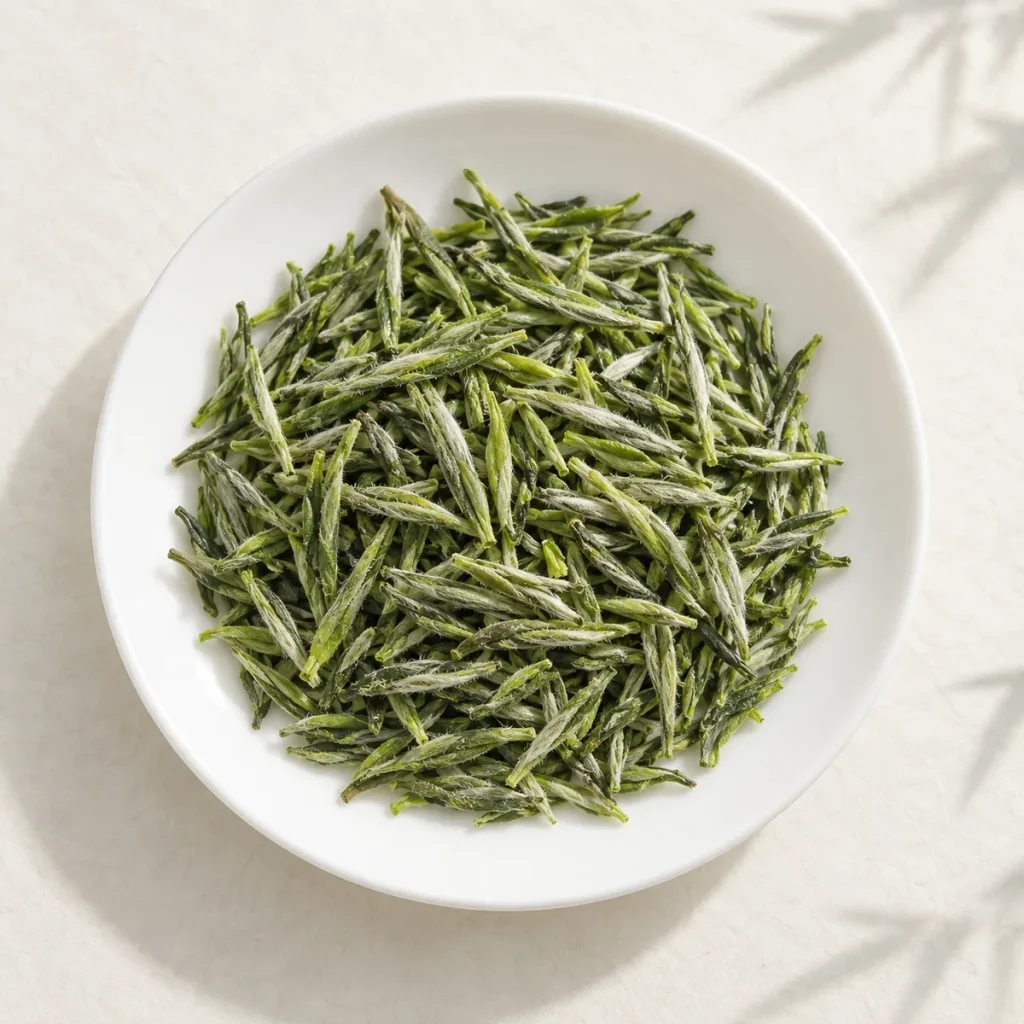
Dry Leaf
Tight, fine strands with pointed tipsLustrous green and even
Liquor Color
Bright tender greenClear and glossy
Aroma
Clean and persistentFresh yet composed
Taste
Fresh and mellow with returning sweetnessFull-bodied and structured
Finish
Clean, moist returning sweetnessLong-lasting finish
Infused Leaf
Tender and evenFresh, lively green

Tea Overview

Tea Category
Green tea · twisted green tea
Cultivar
Population plants and suitable small- to medium-leaf cultivars
Grade
Special Grade · Grade 1 · Grade 2 · Grade 3
Harvest Period
Spring production · high-mountain harvest starts later
Plucking Standard
Careful hand plucking · intact, even, clean fresh leaves
Processing
Spreading → heat-fixing → rolling → straightening → drying
Also Known As
Lushan Yunwu

Origin & Terroir

Lushan Yunwu Tea is defined by a humid landscape shaped jointly by mountain, river and lake. Lushan lies close to the Yangtze River and Poyang Lake, and its core high-mountain tea gardens have long experienced a cool, moist and misty microclimate. The modern geographical-indication area extends farther across the wider Jiujiang region, including areas around Poyang Lake and Lushan Xihai, so the terroir includes both a distinctive high-mountain core and broader surrounding landscapes.

Origin
Jiujiang, Jiangxi · Lushan and surrounding areas
Altitude
Core high-mountain gardens mostly above 800 m
Climate
Cool, humid and misty · marked day-night temperature difference
Soil
Mountain forest soils · rich in organic matter
Landform
High-mountain slopes · valleys and hills

Brewing

Primarily top-drop brewingWater first, then tea
Leaf Method
Primarily top-drop brewing
Teaware
Clear glass or white porcelain cup
Leaf Amount
About 3 g / 150 mL
Water Temperature
80–85°C
Tea-to-Water Ratio
About 1:50
Time
First infusion: about 2–3 minutes
Infusions
About 3 infusions
Water
Low-mineral soft water
Brewing Steps · 4
  1. Warm the cup and cool the water: Warm a clear glass or white porcelain cup with hot water while allowing freshly boiled water to cool to around 80–85°C.
  2. Water first, then tea: Fill the cup to roughly seventy percent with hot water, then gently add about 3 g of dry tea and watch the fine twisted leaves absorb water, sink and open.
  3. Let the flavor unfold: Steep for about 2–3 minutes, then begin drinking once the liquor turns bright tender green to green-yellow and the clean aroma has opened. Avoid prolonged covered steeping.
  4. Leave some liquor and refill: Refill when about one third of the liquor remains. The second and third infusions can be lengthened slightly.

Composition & the Body

Research specifically on Lushan Yunwu includes studies of volatile compounds from different origins, metabolomics examining elevation and picking period, and biochemical data from fresh leaves of cultivars developed specifically for Lushan Yunwu production.

Composition Profile

Verified · 2026-09-25
  1. 01
    Volatile compound profileA total of 76 volatile compounds were identified. Representative relative abundances included benzyl alcohol 13.76%, phenethyl alcohol 14.41%, cedrol 5.37%, and linalool 3.70%.
    Dry-leaf sample

    Linalool, phenethyl alcohol and related compounds are associated with floral aromatic expression.

  2. 02
    Elevation and picking-period metabolomic profileIn first-pick samples, caffeine, theobromine, catechins and gallic acid decreased as elevation increased. In second-pick samples, these bitterness-related compounds were significantly higher at medium and high elevations than in first-pick tea.
    Dry-leaf sample

The composition profile of Lushan Yunwu is strongly affected by elevation, picking period, origin and tea-plant cultivar. Finished-tea studies are useful for explaining aroma and metabolomic differences, while biochemical data from dedicated cultivars' fresh leaves should be treated only as background on the raw material.

Fresh-leaf data from dedicated cultivars must not be conflated with finished tea, and the sample basis must remain visible. Trends involving elevation or picking period apply only within the design of the cited studies and should not be generalized to all Lushan Yunwu Tea. No tea-specific human evidence was included.

View Research Sources

庐山云雾茶挥发性成分主成分分析及产地判别

刘晔, 葛丽琴, 王远兴 · 食品科学 · 2017

Lushan Yunwu samples from three origins including Tongyuan, Saiyang and Xingzi.

Samples from the three origins could be distinguished by PCA using their volatile profiles, indicating that origin influences aroma chemistry.

DOI: 10.7506/spkx1002-6630-201724010View Source

Altitude and picking period affect the quality of Lushan Yunwu tea: Insights from sensory and metabolomic analysis

Gui-Zhen Chen; Wen-Gang Liu; Jie Huang; Ting Deng; Yan Chen; Yang-Ling Zhang; Ji-Gang Huang; Hong-Fei Wei; Yin-Xiang Gao; Xin-Feng Jiang · Food Chemistry: X · 2025

Lushan Yunwu samples from different elevations and from first and second picking periods.

Elevation and picking period jointly altered the composition of amino acids, catechins, alkaloids and volatile compounds.

DOI: 10.1016/j.fochx.2025.103328View Source

Tea Culture

Landscapes, people and history within a single leaf.

01

Clouds over Lushan

Lushan Yunwu Tea is a traditional green tea named for the landscape and terroir of Lushan and its surrounding area in Jiujiang, Jiangxi. The current national standard describes it as green tea made from fresh leaves of local population plants or suitable cultivars, with characteristic lustrous green dry leaf, bright green liquor, high aroma and mellow taste. The newest geographical-indication protection area now extends beyond the traditional mountain zone around Lushan into the wider Jiujiang-administered areas of Poyang Lake, Lushan Xihai and their surroundings.

Lushan Yunwu should not be understood only as a very delicate, very light spring green tea. Its classic style places more emphasis than many fine green teas on the strength of its twisted leaf and the fuller body of its liquor. Traditional descriptions such as the “six excellences” and modern grading standards use different language, but both point toward lustrous green appearance, persistent clean aroma, bright liquor and a fresh, mellow taste with returning sweetness.

02

A Continuing Tea Tradition

The history of tea on Lushan is represented today by two overlapping layers: historical records and local tradition. Official cultural materials from Lushan state that Yunwu tea has been cultivated for more than a thousand years. Local tea histories commonly summarize it as flourishing in the Jin and Tang periods, becoming famous in the Song, and already serving as tribute tea by the Song. From the Ming onward, tea from Lushan increasingly circulated under the name “Yunwu Tea.”

Some local accounts push the origin of Lushan tea back to the Han dynasty and associate early cultivation with Buddhist monastic activity in the mountains. Because such accounts often combine local gazetteers, tradition and later storytelling, they are better treated as cultural origin narratives rather than as fully settled historical fact in every detail.

From the 1930s onward, the region gradually moved into larger-scale cultivation. Implementation of the national standard Geographical Indication Product — Lushan Yunwu Tea in 2007 brought the production area, cultivation, processing and quality requirements into a more systematic framework. That national standard remained valid after its 2025 review.

03

Mountain-and-Lake Terroir

The traditional terroir of Lushan Yunwu is rooted in Lushan's distinctive mountain environment. The mountain lies close to both the Yangtze River and Poyang Lake, where humid air is lifted by the terrain and readily forms cloud, mist and rainfall. When the 2007 national standard described the traditional core tea area, it recorded an annual mean temperature of about 11.5°C, roughly 188 foggy days per year and annual rainfall around 1,800 mm.

Today Lushan City also identifies high-elevation areas above 800 m—including Maweishui, Xiaotianchi, Dayueshan, Hanyang Peak, Qingliangu and the botanical garden area—as priority zones for upgrading premium high-mountain tea gardens. Their cool, humid, misty conditions and noticeable day-night temperature differences represent the most characteristic high-mountain core of Lushan Yunwu terroir.

The geographical-indication area expanded in 2025 to 185 townships, however, so climate, elevation and soil figures from the mountain core should not be treated as if they described the entire modern legal protection area.

04

Heat and Handwork

Modern Lushan Yunwu production can be described through two related frameworks: standardized contemporary processing and more finely divided traditional handcraft. The Jiangxi local standard sets out a principal sequence of fresh leaf, spreading, heat-fixing, cooling and moisture redistribution, rolling, straightening, tightening and shaping, and drying.

Traditional hand production is often broken down further into heat-fixing, loosening, rolling, a second pan-heating, straightening, twisting, sorting, raising the fine hairs and drying. During the “raising the hairs” stage, controlled friction helps the fine leaf hairs become visible, but excessive force must be avoided so the tender buds do not break.

Rolling, straightening and tightening give Lushan Yunwu its structured twisted form, clearly distinguishing it from Longjing, whose leaf is flattened in the pan. The craft is reflected in the cup as well: the tea retains the clean aroma and freshness expected of green tea while developing a relatively full and weighty liquor.

05

Clean Aroma and Fuller Body

Evaluation can begin with the structure of the dry leaf. Special Grade tea should be tight and fine with pointed tips, lustrous green, even and clean. As grade decreases, the leaf becomes more compact or somewhat coarser and looser. Good Lushan Yunwu is not simply about making the leaf as tiny as possible; quality depends on a balance of tenderness, tightness and integrity.

Higher-grade liquor is bright tender green, with a clean and fresh aroma that is expected to persist. The first sip should show freshness, followed by fuller body and a natural returning sweetness. The infused leaf should be tender, even and lively green.

Obvious scorching, stale or muffled odors, coarse astringency, foreign notes, dull liquor or stiff, dark infused leaves usually point to problems in raw material, heat-fixing, drying or storage.

06

Tea Life on Lushan

On Lushan, tea is difficult to separate from the mountain itself. Temples, academies, mountain springs, tea gardens and generations of visiting writers and scholars together form part of the cultural landscape. Local tea history has long linked Yunwu Tea with Lushan's religious traditions, literati culture and spring-water culture.

That tradition continues today. Lushan City has developed tea farms, tea research institutions, tea gardens for visitors and tea-tourism routes that recombine picking, processing, tasting, study and mountain travel. The making of Lushan Yunwu Tea has been included in the fourth group of representative intangible cultural heritage projects of Jiangxi Province and in the province's first directory for the revitalization of traditional crafts.

A cup of Lushan Yunwu therefore carries not only the clean aroma, fresh mellow taste and returning sweetness of green tea, but also the mountain landscape, agriculture, craft knowledge and contemporary life of Lushan.

Frequently Asked Questions

What type of tea is Lushan Yunwu?
Lushan Yunwu is a green tea, typically made in a twisted form and not oxidized in the way black or oolong teas are. Typical qualities include lustrous green dry leaf, bright green liquor, persistent clean aroma, and a fresh mellow taste with returning sweetness.
Can Lushan Yunwu only be produced at the top of Lushan?
No. The traditional core is concentrated on Lushan and the surrounding mountain area, but the 2025 geographical-indication protection requirements cover Lushan, Jiujiang-administered areas of Poyang Lake, Lushan Xihai and surrounding regions across 185 townships or offices.
Is all Lushan Yunwu high-mountain tea?
Not in an absolute sense. Many high-quality core mountain gardens lie above 800 m, but the broader geographical-indication area also includes lower-elevation mountain and lakeside zones.
Must Lushan Yunwu be picked as one bud and one leaf?
No single pattern is mandatory for every grade. Current standards place greater emphasis on careful hand plucking and on fresh leaves being intact, fresh green, even and clean, with consistent tenderness within each batch. Different grades and products may use leaves of different tenderness.
What water temperature should I use for Lushan Yunwu?
For everyday drinking, around 80–85°C is a useful starting point. You can begin with about 3 g of tea to 150 mL of water and adjust for leaf tenderness and personal taste.

Tea Conversations

Tea lovers from around the world meet over a cup of tea.

Sign in or register to join the conversation. Your comment account is created automatically the first time you use a connected account.