Skip to content
Tea & Realm
English

Oriental Beauty

Oolong tea · specialty tea of Taiwan, China · heavily partially oxidized

Leafhopper bites become honeyed fragrance, five colors bloom in the dry leaf, and amber glows in the cup.

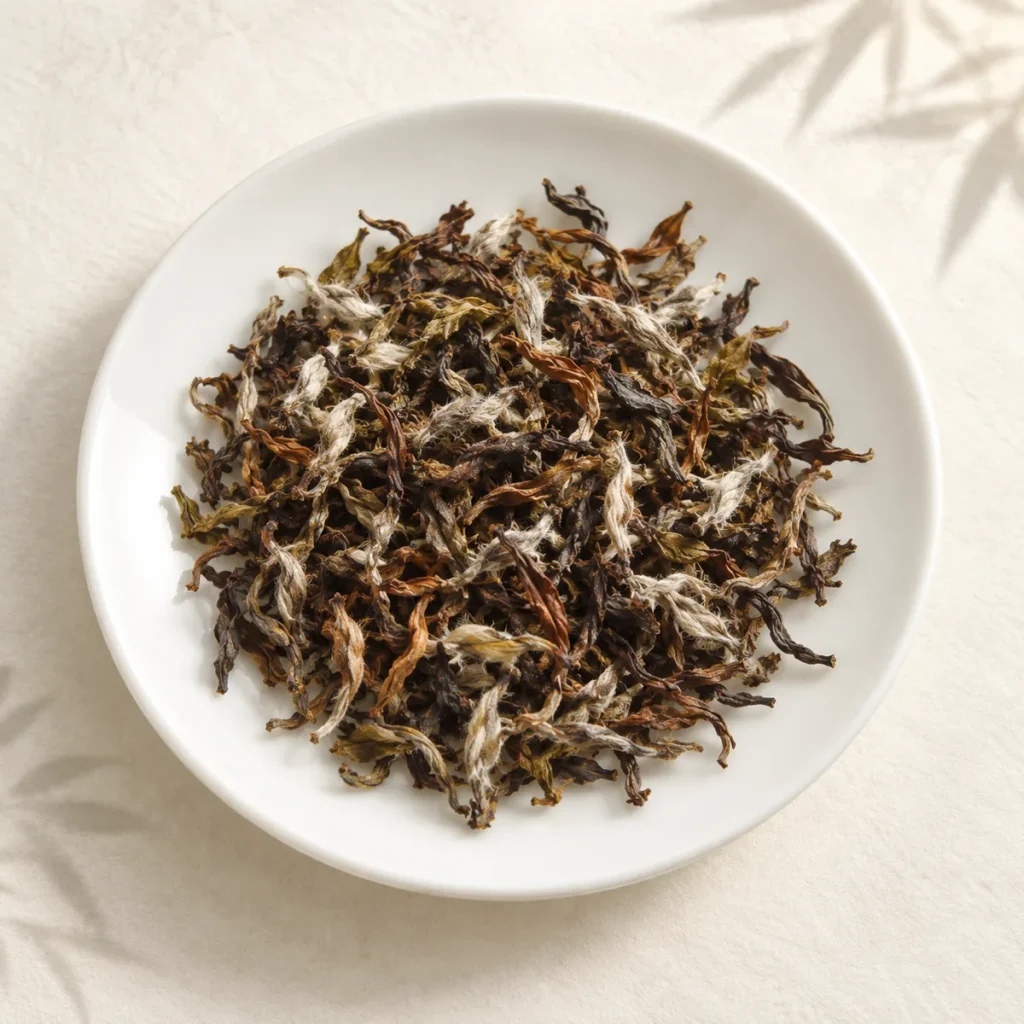
Oriental Beauty is a heavily partially oxidized oolong tea developed in Taiwan, China, also known as Baihao Oolong and Pengfeng Tea. Traditionally, Qingxin Damao is the most representative cultivar, and classic quality depends on tender shoots that have been fed on by the tea green leafhopper, a condition known locally as zhuoyan. Finished tea shows white, green, yellow, red and brown tones interwoven with visible white hairs. The liquor is bright orange-red to amber, with naturally honeyed and ripe-fruit aromas, while the taste is rounded, mellow, sweet and salivating. It is one of the most recognizable specialty oolong styles from Taiwan, China.

Origin
Northern hills of Taiwan, China · mainly Hsinchu, Miaoli, Taoyuan and New Taipei
Harvest
Leafhopper-bitten shoots · one bud with one to two leaves
Craft
Sun withering · heavy tossing · pan-firing · resting to soften · rolling
Aroma
Natural honeyed aroma · Distinct ripe-fruit aroma
Taste
Rounded, mellow and full · Sweet, moist and lively
Liquor
Orange-red amber · Bright and translucent
Dry Leaf
Visible white hairsFive colors like a flower
Liquor Color
Orange-red amberBright and translucent
Aroma
Natural honeyed aromaDistinct ripe-fruit aroma
Taste
Rounded, mellow and fullSweet, moist and lively
Finish
Salivating returning sweetnessLong honeyed resonance
Infused Leaf
Fine, tender and softEven yellow-red brightness

Tea Overview

Tea Category
Oolong tea · specialty tea of Taiwan, China · heavily partially oxidized
Cultivar
Primarily Qingxin Damao · other suitable cultivars also used
Grade
TAGs: Select · Fine Select · Choice
Harvest Period
Summer is classic · quality winter tea also exists
Plucking Standard
Leafhopper-bitten tender shoots · one bud with one to two leaves
Processing
Withering → heavy tossing → pan-firing → resting to soften → rolling → drying
Also Known As
Baihao Oolong · Pengfeng/Pong Fong Tea · Five-Color Tea · Champagne Oolong
Oxidation / Fermentation
Oriental Beauty is among the more heavily oxidized partially oxidized teas of Taiwan, China. Early Taiwan research reported catechin oxidation in Baihao Oolong on the order of roughly 50–60%, but this should not be converted into a fixed “fermentation percentage.” Actual oxidation varies with raw material, season and processing, so the site uses the description “heavily partially oxidized.”
Roasting
After drying, Oriental Beauty may be graded, refined and lightly to moderately baked to stabilize moisture and aroma. Its core value is natural honeyed and ripe-fruit fragrance, fine white hairs and a rounded liquor, so heavy roasting that obscures delicate insect-induced aroma is generally not the goal.

Origin & Terroir

Oriental Beauty is not tied to a single township. Taiwan tea authorities list major production areas including Shiding in New Taipei, Longtan in Taoyuan, Beipu and Emei in Hsinchu, and Toufen and Tongluo in Miaoli. These northern and north-central hill regions are generally warm and humid and provide summer ecological conditions favorable to tea green leafhopper activity.

Origin
Northern hills of Taiwan, China · mainly Hsinchu, Miaoli, Taoyuan and New Taipei
Altitude
Mostly hills and lower mountains · no single altitude standard
Climate
Humid subtropical · summer insect-tea ecology
Soil
Tea-suitable hill soils · good drainage
Landform
Hills and tablelands · lower mountain gardens

Brewing

White porcelain gaiwan · 80–90°CWater first, then tea, then top up
Leaf Method
White porcelain gaiwan · 80–90°C
Teaware
White porcelain gaiwan or clear glass pot/cup
Leaf Amount
About 4–5 g / 150 mL
Water Temperature
80–90°C
Tea-to-Water Ratio
About 1:30–1:38
Time
First infusion about 45–60 seconds
Infusions
About 4–6 infusions · extend according to tenderness and strength
Water
Clean, relatively soft drinking water
Brewing Steps · 4
  1. Warm the vessel and add tea: Warm a white porcelain gaiwan or clear glass pot, empty it, then add about 4–5 g of Oriental Beauty and let the multicolored dry leaves settle naturally.
  2. Cool the water slightly: Let freshly boiled water cool to about 80–90°C, then pour gently so high heat does not overextract astringency and suppress the natural honeyed aroma.
  3. Wait for the amber liquor: Steep the first infusion for about 45–60 seconds, observe the bright orange-red amber color, and look for ripe-fruit, honeyed and fine-bud sweetness.
  4. Extend later infusions: Lengthen later steeps according to liquor strength, focusing on the rounded mouthfeel, returning sweetness, salivation and persistence of the honeyed resonance.

Composition & the Body

Composition research on Oriental Beauty is unusually distinctive: plant-defense responses induced by tea green leafhopper feeding combine with the later high-oxidation processing sequence to shape its honeyed, ripe-fruit and floral metabolite profile.

Composition Profile

Verified · 2026-09-26
  1. 01
    Leafhopper- and processing-induced aromaIn leafhopper-damaged Qingxin Damao processed into Oriental Beauty, major volatiles including linalool oxides, benzyl alcohol, 2-phenylethanol and 2,6-dimethyl-3,7-octadiene-2,6-diol increased during manufacture.
    Other sample

    These volatiles are closely associated with mature-fruit, honeyed and floral aromatic characteristics.

  2. 02
    Metabolomic profile through processingDuring enzymatic stages, catechins were oxidized or degraded into theaflavins and oolongtheanins. Total aroma abundance rose from 259.24 to 564.52 μg/L and then fell to 274.74 μg/L during non-enzymatic stages, while linalool could thermally convert to hotrienol.
    Other sample
  3. 03
    Volatilomic authentication profileVolatilomics of 38 related samples identified 37 significant metabolites useful for origin discrimination. Phenethyl alcohol, methyl salicylate, benzyl alcohol, benzaldehyde and linalool-related compounds showed stable relevance in grade-related sensory evaluation.
    Dry-leaf sample

A classic 2007 study showed increases during processing in linalool oxides, benzyl alcohol, 2-phenylethanol and related volatiles from leafhopper-bitten Qingxin Damao material. A 2022 metabolomics study further showed stage-dependent catechin oxidation, theaflavin/oolongtheanin formation and changes in aroma abundance.

Insect-induced metabolism is a flavor-formation mechanism and must not be interpreted as a health benefit. Cultivar, insect pressure and processing conditions all alter the metabolite profile. No tea-specific human evidence was included.

View Research Sources

Chemical Profiling and Gene Expression Profiling during the Manufacturing Process of Taiwan Oolong Tea “Oriental Beauty”

Jeong-Yong Cho, Masaharu Mizutani, Bun-ichi Shimizu, Tomomi Kinoshita, Miharu Ogura, Kazuhiko Tokoro, Mu-Lien Lin, Kanzo Sakata · Bioscience, Biotechnology, and Biochemistry · 2007

Leafhopper-damaged Qingxin Damao fresh leaves and samples from stages of Oriental Beauty processing.

Insect stress and subsequent processing jointly activated defense metabolism and increased key volatile compounds.

DOI: 10.1271/bbb.60708View Source

A targeted and untargeted metabolomics analysis of 'Oriental Beauty' oolong tea during processing

Lin Zeng, Shan Jin, Yan-qing Fu, Lian-shuang Chen, Jun-feng Yin, Yong-quan Xu · Beverage Plant Research · 2022

Samples spanning the full Oriental Beauty manufacturing process.

Taste and aroma were continuously reshaped across processing rather than being formed once after insect feeding.

DOI: 10.48130/BPR-2022-0020View Source

Authenticity verification and quality assessment of Taiwan Oriental Beauty oolong tea with a volatilomic strategy

Wei-Chen Wang; Cheng-Yu Kuo; Yi-Feng Zheng; Han-Ju Chien; Yen-Ching Lin; Chih-Chun Kuo; Hsuan-Han Huang; Hsien-Tsung Tsai; Tsung-Chen Su; Chien-Chen Lai · Applied Food Research · 2025

Oriental Beauty from Taiwan, China, together with comparison samples used for origin authentication.

Combined volatile profiles can support authenticity and quality-grading research, but no single compound is sufficient for authentication.

DOI: 10.1016/j.afres.2025.101448View Source

Tea Culture

Landscapes, people and history within a single leaf.

01

The Five-Color Beauty

Oriental Beauty is easy to recognize from the dry leaf alone. High-quality tea often shows white, green, yellow, red and brown tones together, with conspicuous white hairs on the bud tips and naturally curled strands that can resemble a dried flower. Taiwan's Tea and Beverage Research Station treats it as a distinct local specialty style rather than simply grouping it with lightly fragrant oolong.

It also has many names: Baihao Oolong, Pengfeng Tea, Pong Fong Tea, Five-Color Tea, Champagne Oolong and Fan Zhuang Oolong. These names reflect different periods, communities and market memories. “Oriental Beauty” is now the most internationally recognizable name, while Hakka tea villages in Hsinchu still retain names such as Pengfeng Tea with strong local linguistic character.

What truly defines the tea, however, is its flavor structure. Fine white-haired shoots are fed on by tea green leafhoppers and then undergo heavy withering, heavy tossing and a relatively high degree of partial oxidation, eventually producing orange-red amber liquor with natural honeyed and ripe-fruit fragrance. It sits between typical lightly oxidized oolong and black tea while still retaining the technical logic of oolong-style zuoqing and pan-firing.

02

Old Stories of Pengfeng Tea

The history of Oriental Beauty is rich in attractive legends, but tea research generally treats them cautiously. Taiwan's Tea and Beverage Research Station suggests that the style likely developed alongside the tea industry of northern Hakka settlements during the Japanese colonial period and regards it as an important locally developed specialty tea. This is more reliable than treating one legendary year as the sole moment of invention.

The best-known Beipu story says that after tea gardens were attacked by tea green leafhoppers, farmers still processed the damaged tender shoots and unexpectedly obtained unusually strong honeyed-fruity fragrance that sold for a high price. Villagers thought the claim sounded like “pengfeng”—Hakka for boasting—and the name Pengfeng Tea followed. The story neatly explains the local name, but it belongs to oral tradition rather than a strictly documented invention record.

The equally famous story that a British queen personally named the tea “Oriental Beauty” also appears widely in promotional materials, yet there is insufficient first-hand historical documentation to verify the exact person, date or naming event. It is therefore better retained as cultural legend. What can be confirmed is that Baihao Oolong/Pengfeng Tea gained increasing recognition through modern export markets and competitions, while “Oriental Beauty” became the most powerful international-facing name.

03

The Northern Hills of Taiwan

Unlike Wuyi rock tea, Oriental Beauty has no single mountain site or unified geographical-indication boundary. Taiwan tea authorities list major production areas across Shiding in New Taipei, Longtan in Taoyuan, Beipu and Emei in Hsinchu, and Toufen and Tongluo in Miaoli. They share the northern and north-central hill belt of Taiwan but differ in soils, slope aspect and microclimate.

Beipu and Emei in Hsinchu are the most historically symbolic core areas. Their layered hills, moist mist, lower mountains, basins and slopes provide a warm and humid environment with enough summer heat for both tea growth and seasonal leafhopper activity. Longtan, Miaoli and other areas extend similar insect-tea ecology across tablelands and hills.

Oriental Beauty terroir therefore has to include the insect. Without appropriate tea green leafhopper activity, even the same cultivar and similar processing struggle to reproduce the classic honeyed character. This is a distinctive agricultural ecology jointly formed by tea plant, insect, summer climate and grower management.

04

Leafhopper Bites Become Fragrance

The most irreplaceable step in Oriental Beauty happens before the leaf enters the factory. Tea green leafhoppers pierce and feed on tender shoots. In response, the tea plant activates biochemical defense pathways; shoot growth slows, the buds remain small, and precursors associated with honeyed, ripe-fruit and floral aromas increase. Tea growers commonly call this condition zhuoyan or zhuoxian.

The harvested material is usually very tender, commonly one bud with one or two leaves. It then undergoes relatively heavy sun withering, indoor resting and repeated tossing, allowing continued moisture loss and promoting a comparatively high degree of enzymatic oxidation. Compared with lightly oxidized pouchong-style teas, Oriental Beauty uses much heavier withering and tossing, and the liquor color gradually moves toward orange-red amber.

Once the desired oxidation is reached, the leaves are pan-fired to stop enzyme activity. A particularly recognizable step follows: the fired leaves are covered or rested so they soften and regain pliability before rolling, deblocking and drying. Final grading, refining and moderate baking stabilize the finished tea without masking the delicate honeyed aroma.

05

Honeyed Amber

Tasting Oriental Beauty begins with the white hairs and “five colors.” High-quality bud tips show conspicuous white trichomes, while tender leaves present interwoven white, green, yellow, red and brown rather than uniform black or green. This complex appearance reflects tender material, insect feeding, physiological response and relatively heavy partial oxidation.

After brewing, the liquor should be bright orange-red to amber. The most important aromas are natural honeyed sweetness and ripe fruit. Fine examples can suggest ripe pear, mature fruit, honey or nectar, but should not have the sharp, one-dimensional impression of added flavoring. In island-wide Oriental Beauty evaluations, aroma and taste typically carry substantial scoring weight.

The mouthfeel should be rounded and mellow. Heavier oxidation does not mean the tea should become bitter and harsh like overbrewed strong black tea. Excellent Oriental Beauty is sweet, smooth and salivating, with honeyed sweetness lingering in the throat and back of the mouth. Water around 80–90°C often shows this softness and aromatic detail more clearly than direct boiling water.

06

Tea Fragrance of the Hakka Villages

Oriental Beauty is deeply connected with the Hakka tea country of northern Taiwan. Beipu, Emei, Longtan and the hills of Miaoli are not only production zones but important Hakka settlement areas and spaces in the modern history of Taiwan's tea industry. The name Pengfeng, with its Hakka linguistic flavor, shows how closely the tea is tied to local life rather than existing merely as a market product.

Today the tea is also entering a new stage of standardization. Taiwan's Tea and Beverage Research Station began promoting dedicated TAGs demonstration evaluation for Oriental Beauty in 2024, and by 2025 it had been formally included in the island's organic-tea classification and grading system, using market grades such as Select, Fine Select and Choice along with digitized bilingual flavor reports. This gives a high-value specialty tea once judged mainly through competition placement and master experience a more transparent modern vocabulary.

Oriental Beauty does not currently have one single geographical indication or island-wide intangible-heritage identity covering all of Taiwan. Beipu Pengfeng Tea, Emei Oriental Beauty Tea, Miaoli Oriental Beauty Tea and other local products have separate origin-certification marks that protect regional authenticity. Its cultural value is therefore best understood as a specialty tea born in northern Hakka communities, jointly shaped by insect ecology and tea-making skill, and continuing to evolve toward modern standardization.

Frequently Asked Questions

What type of tea is Oriental Beauty?
Oriental Beauty is an oolong tea, specifically a heavily partially oxidized specialty tea of Taiwan, China. It is also known as Baihao Oolong and Pengfeng/Pong Fong Tea and is known for multicolored dry leaf, amber liquor, natural honeyed aroma and ripe-fruit fragrance.
Why does Oriental Beauty need tea green leafhopper feeding?
When tea green leafhoppers pierce and feed on tender shoots, the tea plant activates biochemical defense responses that provide important precursors for Oriental Beauty's characteristic natural honeyed and ripe-fruit aromas. Tea growers commonly call such material zhuoyan or zhuoxian.
Can Oriental Beauty only be made from Qingxin Damao?
Qingxin Damao is the most classic and representative traditional cultivar, but it is not the only one used today. TAGs Oriental Beauty evaluations also include suitable cultivars such as Jinxuan and Bailu. The more accurate description is therefore “primarily Qingxin Damao.”
How is Oriental Beauty graded?
There is currently no single compulsory legal grading system for every Oriental Beauty product. Taiwan's TAGs classification and grading system uses market grades such as Select, Fine Select and Choice. Competition awards such as Special Prize, First Prize or Second Prize are competition results, not universal legal retail grades.
Why is Oriental Beauty called Baihao Oolong?
It uses very tender shoots, and high-quality finished tea shows conspicuous white trichomes on the bud tips. Together with the interwoven white, green, yellow, red and brown colors, this led to traditional names such as Baihao Oolong and Five-Color Tea.
What water temperature should I use for Oriental Beauty?
Research from Taiwan's Tea and Beverage Research Station found that 80–90°C water produced better sensory results than direct boiling water. For everyday brewing, use about 4–5 g per 150 mL, steep the first infusion around 45–60 seconds and extend later steeps according to strength.

Tea Conversations

Tea lovers from around the world meet over a cup of tea.

Sign in or register to join the conversation. Your comment account is created automatically the first time you use a connected account.